Friday, January 12, 2007

Vallejo's Marine World to become Discovery Kingdom

Marine World to become Discovery Kingdom

Sources say park will re-brand, designate park into three areas

By Matthias Gafni, Times-Herald staff writer

Article Launched: 01/12/2007 06:54:16 AM PST

After decades showcasing sea life in its name, the Marine World branding will soon be sleeping with the fishes, the Times-Herald learned Thursday.

On Wednesday, Six Flags President and CEO Mark Shapiro is scheduled to visit the Vallejo park and announce its new name - Six Flags Discovery Kingdom, say industry sources. The corporate head will also announce a new design to the park, dividing the property into Sky, Sea and Land, sources said.

"It's the whole re-branding thing," says Tim Baldwin, a writer with Texas-based amusement park trade magazine Amusement Today.

"They're trying to capture a little niche with each part of the park offering a different experience," he said.

Six Flags officials remained tight-lipped Thursday on any name change or improvements.

"We don't want to confirm anything right now," said park spokeswoman Nancy Chan. "Everything is under a shroud of secrecy."

Speculation grew last week when park officials mailed out press fliers announcing Wednesday's press conference with Shapiro, touting a "landmark announcement."

"We are aware they intend to change the name of the park," said Jim Reikowsky, of the Vallejo Convention and Visitors Bureau, who hadn't heard the new name yet.

"The park has changed a great deal, so I think it's a natural thing as it evolves. Š It may need to be re-branded and time to change the name," he said.

Six Flags Marine World originally came to Vallejo from Redwood City in 1986 as Marine World Africa USA, and has changed its name over time.

In addition to the name change and new park design, the park plans on adding a Holiday in the Park event for December 2007, said Amusement Today editor/publisher Gary Slade.

"It's a themed-Christmas operation. They put up millions and millions of Christmas lights, have Christmas-themed shows, Christmas decorations Š" Slade said. "It's like their Halloween event (Fright Fest), but for Christmas.

"It's a good way for Six Flags to stretch the season to make more money and stretch their revenue, but at the same time it also keeps your kids employed Š offering more economic assistance to your community," Slade said.

The name game

The Marine World theme park evolution has brought a flurry of names, including:

• Marine World Africa USA
• New Marine World Theme Park
• Six Flags Marine World
• Six Flags Discovery Kingdom (to debut in 2007 season)

The park's plans came to light as Six Flags, Inc. announced Thursday it agreed to sell three of its water parks, including Concord's Waterworld USA, and four of its theme parks to PARC 7F-Operations Corp. of Jacksonville, Fla. for $312 million.

"We're pleased with the sale price for this portfolio of parks, particularly since we were able to retain the Magic Mountain parks," Shapiro said in a released statement. "This transaction confirms the value inherent in our major market branded parks."

The company is attempting to shed several hundred million dollars in debt over the next several years, and improve operational and financial flexibility, according to a Six Flags statement.

However, industry analysts say the Vallejo park appears safe.

"I would anticipate at this time, with them adding the holiday park and the name change that this is a park they want to hang on to," Slade said.

E-mail Matthias Gafni at mgafni@thnewsnet.com or call 553-6825.

Solano County Environmental study out for carpool lanes

Environmental study out for carpool lanes

http://local.dailyrepublic.net/story_localnews.php?a=news02.txt

Solano County's first carpool lanes can be built over the next couple of years without facing major environmental obstacles, according to a new report. An eastbound lane and a westbound lane are to be built in the median of Interstate 80 from Red Top Road to just east of Air Base Parkway in Fairfield, a distance of 8.7 miles. The project is to cost $80 million. Construction could start this summer with work on Green Valley Creek bridge, which must be widened. However, this is only a small part of the project, being done at that time to comply with laws protecting the steelhead fish in the creek.


Major work is to begin in 2008. All construction is to be done within the existing Caltrans right-of-way.... by 2010, the project will increase travel speeds by 14 percent in the carpool lanes and 4 percent in the regular lanes. Cars presently average 46 mph during the morning rush hour and 33 mph during the evening rush hour.... The lanes would be open to all traffic on weekends and during non-peak travel hours. Caltrans and MTC will determine which hours the carpool lane rules would be in effect

Oil facilities are getting refined / ConocoPhillips, Chevron hoping to boost production

Dan Walters: Governor promotes job training - sacbee.com

sacbee.com - The online division of The Sacramento Bee

This story is taken from Sacbee / Politics.


Dan Walters: Governor promotes job training

By Dan Walters - Bee Columnist
Published 12:00 am PST Friday, January 5, 2007

Whatever else one might say about Arnold Schwarzenegger's political career -- and it's a mixed bag -- he deserves boundless credit for being the first governor in living memory to make improving the state's shameful neglect of work-oriented education a priority.

We used to call it "vocational education," but today its advocates prefer "career and technical education" (CTE), hoping that the new title gives it a more modern image. Whatever the nomenclature, it means giving young people who are so inclined the training necessary to secure and hold high-paying jobs that are vital to society's day-to-day functioning with employers who are begging for skilled workers.

Carpenters, electricians, telecommunications technicians, plumbers, auto mechanics and other skilled workers are in short supply, largely because politicians and others who make education policy in California have catered to the wholly fallacious notion that everyone should go to college and hold a white-collar job.

The mathematical fact is that a relatively small minority of ninth-grade students will go on to earn four-year or higher college degrees. At least as many, in fact, will drop out before even getting high school diplomas. Why, then, have we adopted policies that ignore the majority and cater to the minority and, in effect, encourage non- academic-oriented youngsters to drop out? Because adopting the college-for-everyone approach carries the least political risk.

As a teenager in Austria, Schwarzenegger was trained as a salesman and became a huge success by selling himself as an athlete and motion picture star. He later attended community college in California and has retained his appreciation of job-oriented education that doesn't entail a four-year college degree. There's no political advantage to adopting that attitude; he's done it, from all appearances, just because he thinks it's the right thing to do for California's economy and young people.

Schwarzenegger has singled out CTE for special appropriations throughout his brief governorship and included $500 million for more vocational classrooms, shops and other facilities in the recently approved school bond issue. This week, he took another step by announcing that his 2007-08 budget would include $52 million to enhance CTE, including all-important reforms to increase the number of teachers in career fields. The ranks of those teachers have been shrinking as misguided local school boards and administrators denigrated their programs and grabbed their classrooms for other purposes.

"We must reverse the trend of underfunding career technical education," Schwarzenegger said in a statement. "California is leading the way in giving students a first-class ticket to high-paying jobs in the global marketplace. In addition, these programs help prevent dropouts by keeping students interested in school. I know firsthand how beneficial these programs can be in helping students succeed. When I was in Austria, I learned how to work in retail and how to be a salesman, skills I've used for the rest of my life."

Schwarzenegger's commitment to CTE was singled out in a cover story in Time magazine last April, spotlighting the growing problem of youngsters dropping out of high school, and since he began trumpeting the issue, there's been a palpable change in the political climate.

Foundations are touting CTE as a win-win cure for dropouts and society's need for trained workers, business leaders are making noise about the job vacancies that will become more numerous as baby boomers retire and some politicians who had previously championed college-for-everyone are jumping on the CTE bandwagon.

Schwarzenegger is clinching the political sale for CTE, just in time.


Go to: Sacbee / Back to story

This article is protected by copyright and should not be printed or distributed for anything except personal use.
The Sacramento Bee, 2100 Q St., P.O. Box 15779, Sacramento, CA 95852
Phone: (916) 321-1000

Copyright © The Sacramento Bee

Small US employers struggle to fill jobs amid tight labor supply - The Clarion-Ledger

New northern connector could ease highway traffic, increase worries

New connector could ease highway traffic, increase worries

http://local.dailyrepublic.net/story_localnews.php?a=news02.txt

Herman Rowland's former Cadenasso winery property at Abernathy Road and Interstate 80 will anchor the eastern entrance to the region's next planned major road - the North Connector. The four-lane road will take a bite out of Rowland's land and send thousands of cars daily by his farm and warehouse. Transportation officials say the road will also help solve the area's traffic woes, both on I-80 and on nearby rural roads.. Opponents say the road will take traffic off the freeway and bring it through their neighborhoods. The North Connector is to incorporate an existing section of Business Center Drive near the Safeway and Costco shopping areas in Green Valley.. The North Connector is to run from Abernathy Road to Highway 12 in Jameson Canyon, a distance of about five miles. The goal is to provide a new link between Green Valley and central Fairfield for local traffic.. "It's absolutely beautiful soil." But he sees the need for the North Connector. "Everybody has to sacrifice a little," Rowland said. Meanwhile, he's been dealing with county and state laws that govern produce stands. He's also found concrete on some of his land that he thinks is left over from when the state built the nearby freeway decades ago. All of this has made it harder to realize his dreams for the property.. Next, the North Connector will pass Russell Road, where a warehouse and barn will be removed. A concrete installation company that uses the warehouse must relocate. No other businesses and no homes stand in the way of the new road.. Overall, the road will cover about 23 acres of prime agricultural land. One of these farms - the Valine property - is protected by the Solano Land Trust. Since 2000, it has been covered by a conservation easement that keeps it privately owned, but with the development rights retired.. a conservation easement, while preserving the land from subdivisions and other buildings, cannot stop it from being condemned and taken for a road.. The environmental study for the North Connector calls for the Solano Transportation Authority to compensate for prime farmland lost to the road by preserving farmland elsewhere.. Some residents see the North Connector as becoming a segment of Highway 12, though that is not officially going to happen. But they see it as linking the Suisun City-to-Rio Vista segment of Highway 12 near Abernathy Road and the Fairfield-to-Napa segment at Jameson Canyon near Green Valley..

Solano County Home-buying forecast looking up

Housing targets seen as 'realistic' for Solano County

KEEPING California at the forefront of scientific and technological development

'Good year' ahead for U.S. economy, Kohn says - MarketWatch

Supervisor Mike Reagan to serve as the new chair of the board

Congrad's to Mike Reagan who also serves on Solano EDC's Executive Committee and Board of Directors.

Taking their seats in Solano

Full house welcomes new and returning officials at ceremony
By Erin Pursell/Staff Writer
TheReporter.Com
Article Launched:01/10/2007 06:36:57 AM PST
It was standing room only Tuesday during a lively swearing in ceremony of numerous officials and it helped kick off the new year for Solano County government.

Words of thanks to family members, friends and Solano's citizens were offered to 300 in attendance who were packed into the Board of Supervisors Chamber.

Those elected and appointed seized the opportunity to reflect on past experience and look enthusiastically to the future.

"I'm going to work very hard to earn their trust," said Supervisor Jim Spering, who replaces Duane Kromm as the newest member of the board, and was sworn in with his granddaughter at his side.

With 20 years of experience as mayor of Suisun City, Spering spoke briefly on the need for a collaborative effort between all of Solano's cities to work on challenges that range from transportation, to public safety, to defending the core values of the Orderly Growth Initiative.

An extension of that initiative, with revisions, was defeated in the Nov. 7 election.

"If we work together with the seven cities we can meet the challenges that Solano County faces," he said.

Kromm, meanwhile, offered a few final thoughts and words of encouragement to Spering.

"I know he'll serve you with a good heart and good intentions," Kromm said. "I think it's always good to think big and long-term and we've done a good job of that here in Solano County."

Sheriff and Coroner Gary Stanton, meanwhile, was among those who took an oath of office yet again.

"I've done one term already and I think by all measurements it was a good one," he said. "We're going to keep doing what we've been doing and we've got a lot of new ideas."

With the county's new staff in place, the supervisors proceeded to nominate and elect Supervisor Mike Reagan to serve as the new chair of the board, and Supervisor Mike Silva to serve as vice chair.

Reagan presented Supervisor John Vasquez with a plaque commemorating Vasquez's service as board chair.

"It's a difficult job," said an emotional Vasquez regarding public service. "I don't take it lightly and none of us up here do."

As Reagan took his seat as chair, he briefly outlined some of the challenges ahead for Solano County and called, first and foremost, for investment strategies to create more jobs.

"The swearing-in ceremonies we have just witnessed should be seen as more than the passing of title and conferring of honors " he said. "It is a profound responsibility."

Reagan has represented Solano's 5th District - including Dixon, Rio Vista and parts of Vacaville and Suisun City - since January 2005 and served as vice chair of the supervisors during 2006.

"I'm confident that we are up to the challenge and I'm equally confident that 2007 is going to be a very good year," he said. "Let's get to work."

Other officials sworn in include Marc Tonnesen, Assessor- Recorder; Simona Padilla-Scholtens, Auditor-Controller; David Paulson, District Attorney; and Charles Lomeli, Treasurer-Tax Collector/Clerk.

Erin Pursell can be reached at county@thereporter.com.

MTC has $2 billion wish list for Bay Area highway improvements

SF Gate Return to regular view
MTC has $2 billion wish list for Bay Area highway improvements
- Michael Cabanatuan, Chronicle Staff Writer
Wednesday, January 10, 2007

(01-10) 11:57 PST OAKLAND -- The Bay Area's regional transportation-planning agency is forwarding a $2 billion wish list to the state agency charged with handing out billions of dollars in highway bond money.

The California Transportation Commission will decide next month how to spend the $4.5 billion in statewide congestion-relief money that voters approved in November as part of the $20 billion Proposition 1B.

Projects requested by the Bay Area's Metropolitan Transportation Commission include a fourth bore of the Caldecott Tunnel; carpool lanes on highways 101 and 4 and interstates 80, 580 and 680; a new San Francisco approach to the Golden Gate Bridge; a truck-climbing lane over the Altamont Pass; a new Cordelia Junction interchange for interstates 80 and 680 and Highway 12; and a regional system that would use technology to manage traffic.

to read the rest of the article check out the San Francisco Chronicle

E-mail Michael Cabanatuan at mcabanatuan@sfchronicle.com.

$25 million set for Bay Area security

Posted on Wed, Jan. 10, 2007


$25 million set for Bay Area security
HOMELAND SECURITY DEPARTMENT MARKS REGION AS `HIGH RISK' IN CASE OF ATTACK
By Renee Koury
Mercury News

The Bay Area will get $25 million in federal funds out of $445 million to be distributed nationwide to help protect buses, trains, ferries, ports and passengers against possible terrorist attacks.

The Bay Area was designated by the Department of Homeland Security as one of eight major urban areas at ``high risk'' in case of a terrorist attack. The risk is measured by the potential threat to the region, the vulnerability of people and structures, and the potential toll on human life and economic vitality, said homeland security spokeswoman Joanna Gonzalez.

Though funds are generally earmarked for each region, transportation agencies still must apply for the grants and state exactly how funds would be used, she said.

In the Bay Area, bus and rail systems including the Valley Transportation Authority, BART, the San Francisco Municipal Railway and Caltrain, can apply for part of $13.8 million set aside for improving safety on the region's bus and rail systems.

An additional $584,000 is set aside to protect the local ferry systems. Agencies qualified to apply for these funds include the Golden Gate Bridge Highway and Transportation District, the Blue & Gold Fleet, the city of Alameda ferries and the city of Vallejo ferry system.

The Bay Area's four major ports, identified by the federal government as San Francisco, Richmond, Oakland and Stockton, can apply for part of $11.2 million set aside for Bay Area port safety.

``The funding in the past has been uneven,'' said Sidonie Sansom, chief of homeland security for the San Francisco Port. ``This year we have a chance to do more of the projects we've already started.''

The ports have installed high security gates with previous grants. Sansom could not say how new funds might be used, but said the four ports might collaborate on projects because of the interdependence of the waterways.

At Bay Area Rapid Transit District, spokesman Linton Johnson said funds might be used for security cameras, extra police, bomb sniffing dogs or other projects.

The grants were announced Tuesday by Homeland Security Secretary Michael Chertoff in Washington. ``We're investing resources where risk is greatest and where the funds will have the most significant impact,'' Chertoff said. ``This year's grants reflect a rigorous, disciplined approach that places risk first, driven by hard analysis from the intelligence community and supported by common sense.''

Chertoff said the grants were expected to be awarded in the spring, but that recipients will have to submit thorough plans that spell out how they plan to use the money to reduce their risk of a terror attack.

Nearly half the nationwide grant money, $201 million, would be used to secure ports and subway systems, including Amtrak. The Port Authority of New York and New Jersey would get the biggest share of those funds, $27.2 million.

The New Orleans region, devastated by Hurricane Katrina in 2005, will get $17.3 million, followed by $15.7 million for the Houston area.

The Department of Homeland Security set aside $172 million to protect the nation's transit systems, with New York City and northern New Jersey getting the largest cut of $61 million. This year, money for rail and bus systems is combined, so recipients can decide which system needs more attention, Chertoff said.

Washington, D.C., and the Baltimore area will get $18.5 million, the Boston area $15.3 million, followed by the San Francisco Bay Area at $13.8 million. Amtrak will get $8.3 million.

Transit funding this year includes 19 ferry systems in 14 regions in California, Connecticut, southern New Jersey and Delaware, northern New Jersey and New York City, North Carolina, Texas, Virginia and Washington state.

Intercity bus systems and trucking safety will each get $11.6 million. And Homeland Security set aside $48.5 million for ``buffer zone protection'' which would provide security around critical facilities such as chemical plants.

The Homeland Security funding figures came as New York City Mayor Michael Bloomberg testified before a Senate hearing considering further legislation to enact recommendations of the Sept. 11 commission.

Bloomberg told the Senate Homeland Security Committee that the city was long overdue to get its fair share of anti-terrorism grants. He compared the current system to spreading dollars ``across the country like peanut butter.''

``For the sake of New York City and the security of our nation, I hope you will stop writing politically derived formulas into homeland security bills,'' Bloomberg told the senators.
The Associated Press contributed to this report. Contact Renee Koury at rkoury@mercurynews.com.


© 2007 MercuryNews.com and wire service sources. All Rights Reserved.
http://www.mercurynews.com

Touro plan clears first hurdle for North M.I.

Touro plan clears first hurdle
By J.M. Brown, Times-Herald staff writer
Vallejo Times Herald
Article Launched:01/10/2007 06:42:37 AM PST
Touro University won the first major victory Tuesday for its ambitious plan to design and build a retail corridor and education village on a rough stretch of northern Mare Island that lacks even basic infrastructure.

The Vallejo City Council unanimously approved a six-month agreement to negotiate exclusively with Touro to redevelop the 190-acre area the city has been unable to secure a revitalization deal for since the Navy closed Mare Island Naval Shipyard nearly 11 years ago.

Where three other developers expressed doubt about investing in the property, Touro officials pledged Tuesday that they have secured up to $500 million in private funding to create their "university village" concept, which includes a research center, retail zone and river walk.

If the plan succeeds, the corridor would provide residents of the new Mare Island housing developments with more places to shop, eat and study. It would also put a new face on a critical intersection, at G Street and Azuar Drive.

Any developer would have to pay the more than $25 million cost of installing water, sewer and other infrastructure costs, which city officials said other companies had been reluctant to cover. Touro has agreed to shoulder those costs, as well as the city's negotiating expenses.

Council members asked that the island's master developer, Lennar Mare Island, be kept in the loop about Touro's plans. They also asked how the project would affect the university's goal to expand the current 44-acre campus on the island's south end.

"We find the two projects synergistic," Touro's pointman for the project, vice president Richard Hassel, told council members.

City community development director, Craig Whittom, assured council members that Lennar would be kept abreast of the talks with Touro.

The two developers were unable to agree on what to do with the land before Lennar's exclusive period to work on the project expired last year.

Councilmember Tom Bartee thanked the Touro officials for their interest in Mare Island, but said he wants to see "a game plan" for how the university will further develop its existing campus. He also asked city development officials to create a project timetable and ensure the city gets "fair market value" for the north parcel.

Councilmember Stephanie Gomes, who before winning election was a vocal opponent of the city's waterfront redevelopment scheme, said the public is leery of any changes to development plans and delays.

Still, she said she supports exploring Touro's plans, adding, "You can't do great things unless you take that great leap."

Also Tuesday, Gomes joined fellow member Gary Cloutier in pressuring downtown redevelopment officials to be precise about when the plans to revitalize the Virginia Street corridor will get underway. Gomes said area business owners and residents are "hanging on a shoestring," waiting for ground to break.

After Triad Downtown Vallejo LLC's builder quit the project last summer, the developer decided to construct the mixed-use zone itself. The council unanimously OK'd those changes Tuesday, but came armed with questions about the project's timeline and funding.

"Is Triad ready and able to do it?" Gomes asked.

Triad's development director, Chris Austin, told the council he "can't give a percentage" of commitment but said he expects construction will begin in April - two months ahead of schedule.

Austin said lending companies have pledged to fund the condominium portion, but said construction proposals from union builders are being renegotiated for lower costs.

The cost for condo buyers likely will rise because Triad's finished product will be of higher quality than the initial builder planned, Austin said. But the cost of the mandated affordable housing units will not increase.

Also Tuesday, former City Councilmember Joanne Schivley spoke on behalf of some downtown property owners who have complained about a restriction that they only lease space to retail merchants, in keeping with Triad's redevelopment concept.

Schivley said some owners have invested in downtown longer than Triad has been a revitalization player, and deserve the chance to earn rental income from non-retail tenants until Triad gets closer to completing its project in June 2009.

"That's 2-1}2 years away - that's quite a while before there is critical mass in downtown Vallejo to support only retail," she said.

Annette Taylor, the city's liaison with Triad, said Vallejo will continue discussing the issue with property owners and will report back to the council next month.

Also Tuesday, the council approved agreements with two small labor groups to forgo salary increases and make other concessions to cut $192,000 from the city's projected $1.5 million deficit.

After passing on a contract extension with the firefighter union and failing to reach a deal with the police union, the council voted in December to cut $7 million this fiscal year and next from the public safety budget.

E-mail J.M. Brown at jmbrown@thnewsnet.com or call 553-6834.

US Jobless claims fall to lowest level in nearly 6 months

gwinnettdailypost.com


Jobless claims fall to lowest level in nearly 6 months

01/12/2007 -

By Martin Crutsinger
The Associated Press

WASHINGTON - The number of newly laid off workers filing claims for unemployment benefits fell sharply last week to the lowest level in nearly six months.
The Labor Department reported Thursday that applications for jobless claims dropped by 26,000 to 299,000 last week on a seasonally adjusted basis. It marked the first time jobless claims have fallen below 300,000 since the week of July 22.
The improvement was much better than the decline of 9,000 that analysts had been expecting and provided further evidence that the slowing U.S. economy has not begun to seriously affect the labor market outside of specific industries such as housing and auto manufacturing.
But analysts cautioned against reading too much in the latest decline, saying that jobless claims are notoriously difficult to read during holiday periods.
Ian Shepherdson, chief U.S. economist at High Frequency Economics, in Valhalla, N.Y., predicted a big increase in claims in coming weeks as retail stores lay off temporary workers hired for the holiday shopping season.
On Wall Street, investors took encouragement from the dip in jobless claims, believing it showed that the economy is not slowing too quickly. The Dow Jones industrial average jumped 72.82 points to finish the day with another record close at 12,514.98.

Print Version

Road officials seek 4 lanes on Highway 12
By KEVIN COURTNEY
Register Staff Writer
Thursday, January 11, 2007 6:00 AM PST

The Metropolitan Transportation Commission and Caltrans are now both recommending that the state make Highway 12 through Jamieson Canyon Road a four-lane road funded by new congestion relief bonds.

MTC staff had recommended a less costly three-lane option, but on Wednesday morning commissioners representing the nine Bay Area counties said four lanes made for a better project.

“This is really great news,” said Napa County Supervisor Bill Dodd, who intends to lobby to get final sign-off from the California Transportation Commission on Feb. 28.

Jamieson Canyon Road is a major commute bottleneck between Napa and Solano counties. Proposals for local transportation sales taxes in Solano and Napa counties that would have widened this stretch of highway were defeated by voters in June.

The MTC considers Jamieson Canyon widening its No. 2-rated Bay Area project for funding from Proposition 1B, Gov. Arnold Schwarzenegger’s transportation bond approved in the November election, Dodd said.

Both the MTC and Caltrans support a trimmed-down four-lane connection from Interstate 80 to Highway 29. By leaving some curves on the Solano side and installing a median barrier on only half of the six-mile length, the cost can be cut from $190 million to $133 million, said Jim Leddy, executive director of the Napa County Transportation Planning Agency.

State bonds would cover $84 million, with Napa and Solano counties expected to come up with the remaining $49 million from other highway funds, Dodd said.

The Napa County Transportation Planning Agency and MTC staff had proposed a $107 million three-lane option, with two westbound lanes and just one eastbound.

By keeping the cost down, they hoped that the project might win the favor of the California Transportation Commission, which won’t have enough money to fund all the recommended projects statewide.

Caltrans convinced the MTC that a three-lane Jamieson Canyon wasn’t an adequate solution, Dodd said. “They want to do it right,” he said.

It should strengthen Jamieson Canyon’s chances for bond funding if Caltrans and the MTC have a unified request, Dodd said.

Prior to the MTC meeting at the end of February, Dodd said he would enlist community leaders to write letters to the CTC supporting the project.

Besides being a big bottleneck during morning and evening rush hours, Jamieson Canyon slows the movement of goods, which harms the wine industry, he said.

Leddy, who worked for two state senators before taking his NCTPA job in December, has political connections in Sacramento to strengthen Napa’s case, Dodd said.

The proposed four-lane design would save money by not realigning as much roadway on the curvy stretch in Solano County, Leddy said. More funds would be saved by installing a median barrier along half the highway. The barrier would be placed in the areas with the highest accident rates, Leddy said.

If the scaled back design is funded by the CTC, Napa gets improved traffic flows as well as greater safety, he said.

Solano County and Caltrans have a multi-phase plan to improve the I-80/I-680 connection and route Highway 12 through traffic off the interstate.

Projects that receive state bond money must be under construction by 2012. Local sponsors are hoping for a 2010 start.
Bay Area agency places 3 Solano projects on list
By Erin Pursell and Robin Miller/Reporter Staff
TheReporter.Com
Article Launched:01/11/2007 06:32:48 AM PST
A wish list of nearly $2 billion in highway work compiled by the Metropolitan Transportation Commission includes three Solano County projects hoping to win a chunk of a state bond voters passed in November.

Funding toward work on Highway 12, the interchange at Interstate 80 and I-680 and relocation of the Cordelia truck scales were among 18 projects on the MTC list submitted Wednesday for state money.

"There's relief in sight for the interchange and Highway 12," said Solano County Supervisor Jim Spering. "This a huge step for keeping these projects on schedule."

MTC is recommending that Highway 12 be widened to four lanes between Fairfield and Napa, Spering noted. "Solano County did quite well," he said. "Most of our projects have pretty good support."

Specifically on the MTC list for Solano County is $150 million for the I-80 and 680 interchange and I-80 HOV extension and $88.6 million for the widening on Highway 12. The funding request in regard to the Cordelia truck scales was not available.

The California Transportation Commission will decide next month how to spend the $4.5 billion in statewide congestion-relief money that voters approved in November as part of the $20 billion Proposition 1B.

The MTC - the transportation coordinating, planning and financing agency for the Bay Area - had announced a tentative list of priority projects last month. The state Transportation Commission will now make the final determination about which projects will ultimately be funded.

The pool of funds available for local projects is only about $1.5 billion, officials have estimated. Still, the MTC list included more than that in order to give state officials some choices.

Erin Pursell can be reached at county@thereporter.com. Robin Miller can be reached at citydesk@thereporter.com.

More home sales, but lower prices - Sacramento Business Journal:

Sacramento Business Journal - January 12, 2007
http://sacramento.bizjournals.com/sacramento/stories/2007/01/08/daily52.html

Business News - Local News
Business Pulse Survey:
The governor's health proposal
More home sales, but lower prices
Sacramento Business Journal - 9:19 AM PST Friday
by Michael Shaw
Staff writer

While analysts aren't ready to declare an end to the housing slump, the surprising news from the fourth quarter was that buyers were drawn back into the region's new-home market, a report released Friday said.

It could be a blip or a larger indication that the market hit bottom months ago.

"I thought the fourth quarter would be more of the same," said Greg Paquin, president of The Gregory Group, which compiles the closely watched report. "It seems to me that we've staved off the continued downward trend we've been seeing. Ultimately, one quarter doesn't tell a shift one way or another, but I was pleased to see it."

Paquin said it's an unexpected turn, especially for the time of year when home buying is usually the slowest, and may be due to builder incentives and dropping prices.

Some builders confirmed that they had a much better quarter than expected.

"Our increase is 235 percent," said Jill Shannon, vice president of sales and marketing at Dunmore Homes in Granite Bay. The company had 47 sales in the fourth quarter, compared to 14 for the same three-month period in 2005.

"We're cautiously optimistic," she said of the increase. "Everybody is waiting to see how it's going by mid-2007."

The local office of KB Home posted an increase of about 20 percent compared with the previous year, said territory president Barry Grant. The national homebuilder was the third-largest in the Sacramento region in 2005, selling 1,071 homes.

Overall sales were up in the fourth quarter for Sacramento, Yolo, El Dorado and Placer counties, compared with the prior quarter and with fourth-quarter 2005. About 2,400 new homes sold in the last three months of 2006, up 57 percent from the same period in 2005.

On a county-by-county basis, the biggest winners for new-home sales were Placer and Yolo counties, which had sales rivaling those during the tail end of the housing boom.

Early reports from the resale market seemed to show the opposite story -- a decline in sales compared with last year. While fourth-quarter figures aren't available, a market analysis from Lyon Real Estate showed sales of existing homes dropped by about 34 percent for the three-month period of September through November, compared with the same period in 2005.

But as sales perked up for new homes, prices generally fell. Paquin said that suggests builders are cutting deals. The median home price -- meaning half the homes sold for more and half for less -- dropped in the four-county area to $434,990, a 4.7 percent decline compared with a year earlier. The average price was also down, falling about 3 percent from last year to $474,000.

It's a rare situation when homebuilders can take heart in climbing sales and buyers in falling prices, Paquin said.

"Look at Yolo County," Paquin said, where the average price plummeted by about $65,000. "The interesting thing is how rapidly it's going down. Buyers may be saying that, whether it's hit bottom or not, the prices are good enough for them."

Incentives such as upgrades to appliances or floor coverings, which don't show up in a home's price, are making the true cost of a home even lower.

Another positive indicator was that the new-home inventory also fell, for the first time in two years. Inventory can include everything from a completed home to a lot that's ready for construction.

At the end of December, the inventory stood at 3,925 homes, down about 600 compared with the end of September. That's about a 14-week supply if builders were to stop developing new homes altogether. Compared with the three-week supply of new homes or lots available in early 2005, it looks bleak for builders. But it's the first time the inventory trend has reversed over the past two years.

The inventory of resale homes has also been dropping steadily for the past several months though analysts aren't sure whether that's a seasonal shift or a positive indicator.

The stronger numbers have been backed up by stories from developers, Paquin said.

"They're telling us that their cancellation rate is way down," he said.

A version of this story also appears in the Jan. 12 print edition of the Business Journal.


Contact the Editor Need Assistance? More Latest News

Subscribe or renew online


All contents of this site © American City Business Journals Inc. All rights reserved.

UC Regents to discuss two new UCSF buildings - San Francisco Business Times:

San Francisco Business Times - January 12, 2007
http://sanfrancisco.bizjournals.com/sanfrancisco/stories/2007/01/08/daily60.html

Business News - Local News
Business Pulse Survey:
Home values
UC Regents to discuss two new UCSF buildings
San Francisco Business Times - 12:59 PM PST Friday

When the University of California Regents meet in Mission Bay next week, they will discuss two proposed UCSF buildings, including a stem cell research structure.

A Regents committee may amend the budget for the stem cell building -- the UCSF Institute for Regeneration Medicine -- to add an extra $4.8 million. UCSF's plan for the building calls for 45,000 square feet for stem cell research. The building will cost from $100 million to $116 million total. It will be built on the Parnassus campus, part of it taking the place of Toland Hall, which is rated seismically poor and will be demolished.

UCSF will also apply to the California Institute for Regenerative Medicine for money to help pay for the building. In April CIRM will request proposals for $85 million in grants for that type of major facilities construction. CIRM has allocated a total of $275 million for grants under that program, aimed at major capital construction projects.

UCSF will also brief the Regents on its proposed Neurological Disease and Neuroscience Building, which the university now wants to increase in size to 115,000 square feet. This building will be on the Mission Bay campus. The Regents won't be asked to approve that project yet, since plans for it are not complete.


Contact the Editor Need Assistance? More Latest News

Subscribe or renew online


All contents of this site © American City Business Journals Inc. All rights reserved.

Waterfront Uses' Discussion Planned

Waterfront Uses' Discussion Planned
By Ian Thompson

SUISUN CITY - Suisun City's planners want to hear from the residents on what they consider the best future uses of the waterfront around the Suisun City Boat Launch.

The city's Community Development Department is asking residents to take part in a Jan. 22 brainstorming session in the Suisun City Hall Council chamber at 7 p.m.

The area in question is the shorefront between Delta Cove and the Suisun Wildlife Center, which is one of the last undeveloped areas on the Suisun Slough's west side.

In September 2006, the City Council took an overall look at the area and city planners sketched out a series of possible ideas, which included:

-- Relocating the fuel dock closer to the boat launch and moving the fuel storage area away from where potential development may go.

-- Extending the pedestrian promenade south to the walking trails.

-- Improving the fishing pier or create two new piers, one for fishing and the other for people who just want to watch aquatic activity on the slough. This could include a dock that would accommodate kayakers and the local youth rowing club. A new fishing dock may be put adjacent to the boat ramps.

-- Putting in an aquatic center and storage building to allow the Parks and Recreation Department to store material for waterfront events.

-- Extending the boat ramps further south.

In December, the council hired Design, Community & Environment of Berkeley to undertake the design effort. Members of that firm will be at the brainstorming meeting.

The Jan. 22 meeting is a first step to putting together a design for the area. The city planners will present their ideas to help spur input and other ideas from residents.

The results of this meeting will be used by Design, Community & Environment to come up with a preliminary design that will go to the city council for review later this year.

Reach Ian Thompson at 427-6976 or at ithompson@dailyrepublic.net.

At a Glance

What: Public meeting to get ideas from residents on the best use for the waterfront area around the Suisun City Boat Launch.

When: 7 p.m. Jan. 22.

Where: Suisun City Council chamber

Info: 421-7300

Fairfield-Suisun Teachers Sit Among Nation's, County's Best

Fairfield-Suisun Teachers Sit Among Nation's, County's Best
By Susan Winlow

FAIRFIELD - The Fairfield-Suisun Unified School District ranks third in the state when it comes to board-certified teachers produced in 2006.

The district also has the largest contingent of nationally certified teachers in Solano County. Since 1999 there have been a total of 20 teachers board-certified while in the district, including the 11 certified for 2006. Seventeen of the 20 are still employed with the district.

"We are absolutely elated with the progress our teachers have made," said district superintendent A. Woodrow Carter. "We feel this will be exhibited down to the desktop and this will impact student achievement for years to come."

National Board Certification is the highest credential in the teaching profession and can take up to three years to complete. It measures what teachers should know and be able to do. Teachers are asked to build a portfolio that includes student work samples, assignments, video tapes and an analysis of their classroom teaching. They are also assessed on their knowledge of the subjects they teach.

"This is the nation's top-gun program and these teachers can be justifiably proud of their achievements," Carter said.

The Fairfield-Suisun district sits only behind Los Angeles and San Francisco for the number of board-certified teachers. Both districts have more students and schools than Fairfield-Suisun, which has about 23,000 students and 28 schools. San Francisco has about 60,000 students and 120 schools and Los Angeles is the second-largest school district in the nation with more than 741,000 students.

Reach Susan Winlow at 427-6955 or swinlow@dailyrepublic.net.

NEW CERTIFICATES

2006 Fairfield-Suisun board-certified teachers

-- Elizabeth Adam, E. Ruth Sheldon Elementary School

-- Crystal Castaneda, Nelda Mundy Elementary School

-- William Collison, Amy Blanc Elementary School

-- Rebecca Hammann, Dover Middle School

-- John Hartley, E. Ruth Sheldon Elementary School

-- Stephanie Hoftyzer, Laurel Creek Elementary School

-- Lisa Leduc, Amy Blanc Elementary School

-- Dayna Rigot, Amy Blanc Elementary School

-- Laurel Salerno-White, Fairfield High School

-- Kevin Scully, Rodriguez High School

-- Pamela Williamson, Rodriguez High School

TOP DISTRICTS

Top five California districts in production of nationally board certified teachers in 2006:

Los Angeles - 94

San Francisco - 16

Fairfield-Suisun - 11

Long Beach - 10

Oakland - 10

A total of 293 California teachers earned board certification.

Thursday, January 11, 2007

New Nut Tree Store Openings

New Nut Tree Store Openings

Stores at the Nut Tree continue to open their doors, as construction at the site continues.

Citibank opened its newest Bay Area financial center there on Wednesday, which will be open Monday through Thursday from 9 a.m. to 5 p.m., Friday from 9 a.m. to 6 p.m. and Saturday from 9 a.m. to 1 p.m. It also has a 24-hour automated teller machine center and 24-hour "Citiphone" access. For information call 451-5130.

Peet's Coffee & Tea also recently opened. Store hours are from 5:30 a.m. to 9 p.m. Monday through Friday, and 6 a.m. to 9 p.m. Saturday and Sunday. Call 447-7177.

Bay Area Agency Places 3 Solano Projects on List

Bay Area Agency Places 3 Solano Projects on List
By Erin Pursell and Robin Miller/Reporter Staff
TheReporter.Com

A wish list of nearly $2 billion in highway work compiled by the Metropolitan Transportation Commission includes three Solano County projects hoping to win a chunk of a state bond voters passed in November.

Funding toward work on Highway 12, the interchange at Interstate 80 and I-680 and relocation of the Cordelia truck scales were among 18 projects on the MTC list submitted Wednesday for state money.

"There's relief in sight for the interchange and Highway 12," said Solano County Supervisor Jim Spering. "This a huge step for keeping these projects on schedule."

MTC is recommending that Highway 12 be widened to four lanes between Fairfield and Napa, Spering noted. "Solano County did quite well," he said. "Most of our projects have pretty good support."

Specifically on the MTC list for Solano County is $150 million for the I-80 and 680 interchange and I-80 HOV extension and $88.6 million for the widening on Highway 12. The funding request in regard to the Cordelia truck scales was not available.

The California Transportation Commission will decide next month how to spend the $4.5 billion in statewide congestion-relief money that voters approved in November as part of the $20 billion Proposition 1B.

The MTC - the transportation coordinating, planning and financing agency for the Bay Area - had announced a tentative list of priority projects last month. The state Transportation Commission will now make the final determination about which projects will ultimately be funded.

The pool of funds available for local projects is only about $1.5 billion, officials have estimated. Still, the MTC list included more than that in order to give state officials some choices.

Erin Pursell can be reached at county@thereporter.com. Robin Miller can be reached at citydesk@thereporter.com.

Touro Plan Clears First Hurdle

Touro Plan Clears First Hurdle
By J.M. Brown, Times-Herald staff writer

Touro University won the first major victory Tuesday for its ambitious plan to design and build a retail corridor and education village on a rough stretch of northern Mare Island that lacks even basic infrastructure.

The Vallejo City Council unanimously approved a six-month agreement to negotiate exclusively with Touro to redevelop the 190-acre area the city has been unable to secure a revitalization deal for since the Navy closed Mare Island Naval Shipyard nearly 11 years ago.

Where three other developers expressed doubt about investing in the property, Touro officials pledged Tuesday that they have secured up to $500 million in private funding to create their "university village" concept, which includes a research center, retail zone and river walk.

If the plan succeeds, the corridor would provide residents of the new Mare Island housing developments with more places to shop, eat and study. It would also put a new face on a critical intersection, at G Street and Azuar Drive.

Any developer would have to pay the more than $25 million cost of installing water, sewer and other infrastructure costs, which city officials said other companies had been reluctant to cover. Touro has agreed to shoulder those costs, as well as the city's negotiating expenses.

Council members asked that the island's master developer, Lennar Mare Island, be kept in the loop about Touro's plans. They also asked how the project would affect the university's goal to expand the current 44-acre campus on the island's south end.

"We find the two projects synergistic," Touro's pointman for the project, vice president Richard Hassel, told council members.

City community development director, Craig Whittom, assured council members that Lennar would be kept abreast of the talks with Touro.

The two developers were unable to agree on what to do with the land before Lennar's exclusive period to work on the project expired last year.

Councilmember Tom Bartee thanked the Touro officials for their interest in Mare Island, but said he wants to see "a game plan" for how the university will further develop its existing campus. He also asked city development officials to create a project timetable and ensure the city gets "fair market value" for the north parcel.

Councilmember Stephanie Gomes, who before winning election was a vocal opponent of the city's waterfront redevelopment scheme, said the public is leery of any changes to development plans and delays.

Still, she said she supports exploring Touro's plans, adding, "You can't do great things unless you take that great leap."

Also Tuesday, Gomes joined fellow member Gary Cloutier in pressuring downtown redevelopment officials to be precise about when the plans to revitalize the Virginia Street corridor will get underway. Gomes said area business owners and residents are "hanging on a shoestring," waiting for ground to break.

After Triad Downtown Vallejo LLC's builder quit the project last summer, the developer decided to construct the mixed-use zone itself. The council unanimously OK'd those changes Tuesday, but came armed with questions about the project's timeline and funding.

"Is Triad ready and able to do it?" Gomes asked.

Triad's development director, Chris Austin, told the council he "can't give a percentage" of commitment but said he expects construction will begin in April - two months ahead of schedule.

Austin said lending companies have pledged to fund the condominium portion, but said construction proposals from union builders are being renegotiated for lower costs.

The cost for condo buyers likely will rise because Triad's finished product will be of higher quality than the initial builder planned, Austin said. But the cost of the mandated affordable housing units will not increase.

Also Tuesday, former City Councilmember Joanne Schivley spoke on behalf of some downtown property owners who have complained about a restriction that they only lease space to retail merchants, in keeping with Triad's redevelopment concept.

Schivley said some owners have invested in downtown longer than Triad has been a revitalization player, and deserve the chance to earn rental income from non-retail tenants until Triad gets closer to completing its project in June 2009.

"That's 2-1Ž2 years away - that's quite a while before there is critical mass in downtown Vallejo to support only retail," she said.

Annette Taylor, the city's liaison with Triad, said Vallejo will continue discussing the issue with property owners and will report back to the council next month.

Also Tuesday, the council approved agreements with two small labor groups to forgo salary increases and make other concessions to cut $192,000 from the city's projected $1.5 million deficit.

After passing on a contract extension with the firefighter union and failing to reach a deal with the police union, the council voted in December to cut $7 million this fiscal year and next from the public safety budget.

E-mail J.M. Brown at jmbrown@thnewsnet.com or call 553-6834.

Officials Take Oaths of Office

Officials Take Oaths of Office
By Ben Antonius

FAIRFIELD - Eight months after they were elected, one new supervisor and seven returning officials took their oaths of office during a Tuesday morning ceremony.

The formalities drew a standing-room-only crowd of family members, political supporters and co-workers, although the only actual personnel change was Supervisor Jim Spering replacing former Supervisor Duane Kromm.

Spering, the former mayor of Suisun City, represents a significant political shift from the more-liberal Kromm, who decided not to pursue a third term. In June, Spering defeated former Fairfield Mayor Karin MacMillan, a political ally of Kromm's.

Spering, who took the oath of office with his granddaughter at his side, offered some words of support for the controlled-growth principles Kromm has long championed. But he also noted "public safety was the No. 1 issue in every precinct" during his campaign.

"I bring a lot different perspective to the board than Mr. Kromm," Spering said. "But I have a lot of respect for him."

Before stepping down after eight years, Kromm said he knew Spering "will serve with a good heart" and asked his colleagues to support a near-universal health care policy proposed Monday by Gov. Arnold Schwarzenegger. Solano County has been working for several years on its own plan to cover most residents.

"I think it is always good for every government to think both big and to think long-term," he said.

Supervisors also selected a new chairman and vice chairman, as they do every January. Supervisor Mike Reagan, the vice chairman in 2006, was elected chairman and Supervisor John Silva was elected vice chairman.

In a prepared statement he read after being elected chairman, Reagan reiterated his oft-stated belief that creating local jobs is the most effective way of solving problems.

The county can attract employers by addressing crime, improving flood protection, keeping the General Plan revision process on schedule and easing the regulatory process for businesses, he said.

"We know that our challenges were long in the making and will require long-term solutions," he said. "And we ought to know that either we invest today or we will surely pay excessively tomorrow."

Most officials kept their remarks brief after being sworn in.

Supervisor John Vasquez choked up while thanking his family for their support and joked that he was unopposed in his re-election campaign "because nobody wanted the job."

Reach Ben Antonius at 427-6977 or bantonius@dailyrepublic.net.

Vallejo's New City Manager Takes the Helm

Vallejo's New City Manager Takes the Helm
By J.M. Brown, Times-Herald staff writer


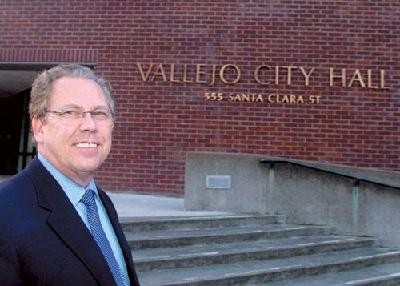
Joe Tanner stands outside 555 Santa Clara St., where he will be working, taking over the position of Vallejo city manager. (Mike Jory/Times-Herald)

Even before lunch, new city manager Joe Tanner had a pretty good idea of how tough a town Vallejo might be to run.

On his first day Monday, while touring the scene of a devastating restaurant and motel fire, the left leg of his navy blue suit met with an exposed nail, causing an irreparable rip.

"I lost a suit in the line of duty," Tanner chuckled.

However symbolic, the moment reinforced what Tanner already knows about Vallejo. "It's the kind of city that separates the men from the boys," he said.

There are high hopes that Tanner will stabilize City Hall following three controversial managers - one who sparked a defamation lawsuit, a second who was ousted by the council, and a third who chose budget cuts over contract concessions to the politically mighty fire union.

But Tanner doesn't see the upheaval as his problem to overcome.

In an interview Monday, the 59-year-old Tanner said he did "not come to this city with an agenda" other than getting "this city on its financial feet."

"There are only 100 pennies in a dollar - you can't spend 110," he said.

But after only a day on the job, he's not sure yet exactly how to raise revenue or cut expenses. He did, however, weigh in on some of Vallejo's simmering controversies, which may provide some insight on how he'll run the show.

Tanner said he supported former interim city manager John Thompson's recommendation to cut police and fire department positions to shore up a projected $4 million deficit - which the council OK'd last month.

Thompson tried to reach a deal with fire union leader Kurt Henke, but it fell through because a council majority did not want to extend a public safety contract they felt the city could already ill afford.

Although Tanner said he did not "have an opinion on extending the contract," he said, "I think what John Thompson did and what the council approved was a step in the right direction."

With a council defined by two camps - critics and supporters of the firefighter union - and citizens divided over Wal-Mart plans and other development projects, Tanner said he is not choosing sides yet.

While the contract talks are over for now, Tanner said he has the stripes to handle future labor deals.

During 30 years of managing five other Northern California cities, Tanner said he faced a public safety strike and a "blue flu," when the police force called in sick to protest labor disagreements.

"It was silly," he said. "We called in the county sheriff (to patrol the streets.) The cops were back to the table, and that was the end of that."

Still, "You never want to fight with employee groups," he said, comparing the battle to two brothers fighting. "You both end up with black eyes."

Tanner said he has a lot of experience creating revenue and cutting budgets.

He leveled 287 buildings to spark the successful redevelopment of downtown Pleasant Hill, and created special tax districts elsewhere to backfill city coffers.

With "smart-growth" proponents often bending the council's ear about redevelopment - some actually filing lawsuits - Tanner said his philosophy on growth can be summed up in one phrase: "If it doesn't make money for the city, it's not smart."

Does that mean he supports Wal-Mart's plan to build a Supercenter on Sonoma Boulevard, with the mega-company's promise that it will bring Vallejo a half-million dollars in revenue?

In some cities, Tanner said Wal-Mart has "come in and been horrible," but in other places, "it's been wonderful." Only future studies will determine whether the company's plan for Vallejo is right, he said.

Ultimately, he said, he will follow the council's guidance.

He understands that means sometimes pleasing a majority and upsetting a minority - battle lines that could change with November's mayoral and council election.

"If you ask me to dig a ditch, I'll say where and how deep as long as you've got the majority," Tanner said.

Even though the last full-time city manager, Roger Kemp, was ousted in a highly political showdown between two council camps, Tanner said he was not deterred from seeking Vallejo's top job.

Why not? Tanner rested his hand on his chin and pensively said, "I know Roger Kemp." He would not elaborate.

Kemp had been selected over Tanner and others when the last city manager vacancy was filled in 2004.

Before taking the Vallejo job two months ago, Tanner had retired from Pleasant Hill but re-entered the game to run Pacifica.

He won early kudos Monday from Vallejo Fire Chief Don Parker, who took Tanner on a tour of the burned-out Good Day Café - the scene on Sunday night of the city's worst fire in 16 months. Tanner met the diner's owner and expressed concern about six firefighters who were hurt in a separate blaze Saturday.

"It sure helps when the firefighters see the boss out there like that and being a real person," Parker said. "He wanted to have a close look."

The two had lunch at Dillon's Bread Company on Ryder Street before Tanner headed back to City Hall for staff meetings and a chat with Mayor Tony Intintoli Jr.

All in all, he said his first day "was a whirlwind." And he acknowledged that the ride has just begun.

E-mail J.M. Brown at jmbrown@thnewsnet.com or call 553-6834.

Ideas Sought for Development on Suisun City Waterfront

Ideas Sought for Development on Suisun City Waterfront
By Ian Thompson

SUISUN CITY - Suisun City's planners want to hear from the residents on what they consider the best future uses of the waterfront around the Suisun City Boat Launch.

The city's Community Development Department is asking residents to take part in a Jan. 22 brainstorming session in the Suisun City Hall Council chamber at 7 p.m.

The area in question is the shorefront between Delta Cove and the Suisun Wildlife Center, which is one of the last undeveloped areas on the Suisun Slough's west side.

In September 2006, the City Council took an overall look at the area and city planners sketched out a series of possible ideas, which included:

- Relocating the fuel dock closer to the boat launch and moving the fuel storage area away from where potential development may go.

- Extending the pedestrian promenade south to the walking trails.

Read the rest of the story in the Daily Republic Friday.

Wednesday, January 10, 2007

Copart expands into Portland, Oregon

Copart moves into Oregon
East Bay Business Times - 10:08 AM PST Tuesday

Copart Inc. has opened a 29-acre vehicle-salvage facility south of Portland, Ore., its third in the state, the company said Monday.

The Fairfield headquartered company said the new yard, located in the city of Woodburn, would help it expand its capacity in the area.

Founded in 1982, Copart (NASDAQ: CPRT) offers a range of vehicle-salvage services. It operates 124 facilities in North America.

Tuesday, January 02, 2007

Dixon Fish farm seeks OK for 80-acre expansion

Fish farm seeks OK for 80-acre expansion

By Julie Kay/Staff Writer

TheReporter.Com
Article Launched:01/02/2007 05:30:36 AM PST

The Solano County Planning Commission will hold a public hearing Thursday on the proposed expansion of a Dixon fish farm.

Shih Aquaculture is located in the northeast corner of Dixon's Hyde and Hackman roads. The proposed expansion would take place over an 80-acre area and include construction of 22 ponds of 1.8 acres each.

An environmental impact study has indicated the project will not have a significant effect on the environment, and county staff have recommended an approval of the project.

The existing aquaculture facility, on an 80-acre tract surrounded entirely by agricultural land, originally was permitted in 1996. The proposed expansion would take place directly south of the current facility, in two phases over three years.

During the first phase, 12 ponds would be constructed on the west half of the acreage. During the second phase, an additional 10 ponds would be constructed on the east half. The ponds will measure 533 feet by 177 feet, and will hold 9.8 acre-feet of water.

The project site is designated intensive agriculture under the Solano County General Plan. Its environmental impact study found that the risk of one or more of the fish ponds failing during an earthquake is small.

The owner, Eric Shih, has taken steps to mitigate possible pesticide drift from the tract to adjoining properties, says the report. In the facility's more than 10 years of operation, there have been no complaints from neighbors about pesticide drift, it continues.

The study found that the proposed expansion would be consistent with the General Plan regarding traffic circulation and population densities and distributions. It notes that there are adequate utilities, access roads, drainage and other necessary facilities in the area, and that the expansion will not constitute a nuisance or danger to people living near or passing through the area.

The meeting will be at 7 p.m. in the Board of Supervisors Chamber in the County Administration Center at 675 Texas St., Fairfield.

Julie Kay can be reached at schools@thereporter.com.

Experts: Economy good for Solano County in 2007

Experts: Economy good for Solano County in 2007

By RACHEL RASKIN-ZRIHEN/Times-Herald staff writer
Vallejo Times Herald

Article Launched:12/31/2006 09:12:47 AM PST
Local and regional experts agree Solano County will improve economically in the coming year, though not all prognosticators agree about the area's job growth prospects.

"Overall, the Solano County economy has enjoyed healthy economic growth and the Bay Area migration is expected to continue to supply the pipeline of new businesses to the county in 2007," said Solano Economic Development Corp. vice president Sandy Person.

Person concedes that bringing enough jobs to the county to accommodate its labor force, will continue to be a challenge in 2007. A significant percentage of the county's labor force now commutes outside the county, she said. Bringing more reliable, affordable energy to the county is another main challenge, she said.

Vallejo Chamber of Commerce board chairman Verna Mustico, said she believes several of the long-promised local redevelopment projects will actually begin to move forward in 2007.

"It looks like the downtown project and the waterfront project are getting back on track, and something may be coming together between Touro (University) and Lennar (Mare Island) over the university village vision Touro has for Mare Island, which would be a plus for Vallejo," Mustico said.

The University of the Pacific Eberhardt School of Business' most recent quarterly forecast also predicts Solano County's personal income and population will continue climbing into the foreseeable future.

University researchers agree with a recent United States Department of Commerce's Bureau of Economic Analysis report, which revealed that personal income grew nationally by 1.4 percent in the past quarter. While growth picked up in all regions, it was especially strong in the region that includes California, bureau figures show.

Eberhardt dean Chuck Williams said Vallejo-Fairfield residents can expect continued job growth.

"The region has been enjoying steady job growth since 1998," Williams said. After 2 percent job growth in 2005, the economy is expected to post an average of 1.6 percent job growth through 2009, he said. That's higher than the state's rate of 1.4 percent, he added.

Fueling local employment expansion is job growth in all but three sectors - federal government, construction and manufacturing - which are predicted to lose some jobs in the short term, Williams said. Job growth is expected to be especially strong in the professional and business sector and the education and health sector, he said.

As more jobs come to the region, the unemployment rate will be kept in the low 5 percent range even as the regional population grows nearly 1 percent annually until 2009, Williams said.

The school's job growth predictions don't line up exactly with the latest Manpower Employment Outlook Survey, which predicts the Solano/Napa region will experience a hiring slowdown in the first part of 2007. The Solano/Napa area is among only two areas the Manpower survey forecasts will experience net job losses - 4 percent locally - in the coming quarter.

By contrast, San Rafael is expected to gain 50 percent more jobs, the largest gain statewide, and Kings County is expected to make the sharpest drop, losing 7 percent of its jobs, according to Manpower.

The best job prospects locally, in the short term, will be in public administration, while it will be slightly harder to find jobs in construction, wholesale and retail trade in the coming quarter, said area Manpower spokeswoman Sherrie Phillipi.

Manpower's latest survey finds that though the decline in confidence among employers is slight nationwide, it makes for the lowest net employment outlook for the nation in two years.

In terms of real estate sales, a major economic driver that has declined recently, Mustico, a Vallejo Realtor, said she "hopes and expects" home sales and prices to begin inching back up after the first of the year.

E-mail Rachel Raskin-Zrihen at RachelZ@thnewsnet.com or call 553-6824.

Heart of Vacaville Improvement district keeps it ticking

Heart of Vacaville

Improvement district keeps it ticking

Article Launched: 01/02/2007 05:30:36 AM PST


The public-private partnership that promotes downtown Vacaville begins the new year with a full plate.

None of the projects and initiatives on its agenda is more important than strengthening the underpinnings that will create long-term stability for the Downtown Vacaville Business Improvement District.

The City Council wisely reinforced its long-term investment in what is becoming better known as the "Heart of the City" by recently renewing its contract with the downtown business group. That will enable the improvement district to continue to collect fees from businesses and property owners within its boundaries.

The council also included a matching grant of $52,250 from the downtown redevelopment agency.

While the original agreement would have reduced the district's annual grant from the city by 5 percent per year, the council prudently held the line and added $2,250 to improve the marketing and support for the farmers' market held on Saturdays.

Despite the huge draw of Merriment on Main and the CreekWalk Concert Series, downtown Vacaville remains a hidden secret to many who live in the far corners of Vacaville, and to neighbors in surrounding communities. The business group, however, has steadily improved its visibility with a variety of events.

Lured by the Downtown Bicycle Race, the Art & Wine Stroll, the Wine and Brew Festival or the Middle Earth Festival, visitors from near and far experience the warmth and charm of downtown Vacaville. They discover the new dining and entertainment venues that are multiplying.

Downtown's office environment is maturing. And its restaurant roster is growing with a diversity of American and ethnic eateries that are flourishing. A wine bar will be the next addition in Town Square. Lunchtime concerts in the square were a wonderful complement to the weekday fare.

The work of supporting and nurturing businesses downtown continues. The district established an emergency operations plan to help businesses cope in the event of a natural disaster. It is working with the city to improve the approaches to the downtown area.

Its most critical goal for the new year is one we wholeheartedly endorse: completing a manual of policies and procedures that will strengthen the organizational structure, so that it can manage itself well into the future. Its board of directors will experience the natural churn of new members and longtime supporters. By having well-defined policies and explicit procedures, the organization can better withstand the typical ebb and flow of businesses and property owners who participate in the district's leadership.

The city, through the redevelopment agency, has fostered the growth of the Downtown Vacaville Business Improvement District. It has experienced its formative years and must now look ahead to more productive, more effective and more sophisticated programs to capitalize on its growth and development to date.

After all, it is the heart of the city.

Bay Area Housing market cool-down expected to continue next year

Housing market cool-down expected to continue next year

By Eve Mitchell I Business Writer

Article Last Updated: 12/31/2006 06:23:54 AM PST


AN IRON WORKER slides down from the metal structure at the corner of Broadway and Grand Avenue in Oakland where condos are under construction. (Staff file)

THE CHILL is not gone.

That's the outlook this year for the Bay Area's residential real estate market, which moved into what real estate types like to call "balanced territory" in 2006. The slowdown follows a red-hot market over the last few years that set new sales records and favored sellers, who saw record prices and double-digit appreciation.

Observers expect a continued cooling in 2007 with a lot more homes on the market, along with longer selling times than those inventory-challenged days of just two years ago. Some homeowners could see a slight gain in home values, some might see a slight drop while other places will see values stay flat. Sales will continue to be off from previous records highs, but just how much is a matter of debate.

Still, the cooling market that started to surface in spring 2005 is not likely to get really,

really cold, observers say. They point to predictions calling for interest rates to hold steady in 2007 along with a healthy job market and economy. In addition, demand for housing remains strong in the Bay Area, which has little available land to build on.

"I think (2007) is still going to be a balanced market," said Scott Kucirek, Northern California general sales manager for Prudential California Realty. "I don't think it's going to tilt to a buyer's market. ... We've hit the stability point where things are leveling off. ... I don't think we'll see a giant 20 percent price correction. All the macroeconomic factors are still good. Interest rates are low, the economy is doing well and jobs are picking up."

Depending on a home's location, home prices are likely to increase by up to 5 percent or stay level in the Bay Area this year compared with 2006, Kucirek said. Some places such as Solano County could see prices decline by up to 5 percent compared with last year, he said.

But other areas, such as Berkeley, Piedmont and the Montclair district of Oakland, could see prices rise in the 3 to 5 percent range, he said.

"I think the Peninsula, from what I can see, holds steady," said Kucirek, adding the same could be said for Fremont, Hayward and Castro Valley.

Kucirek expects sales volume in the Bay Area will be in the same range as last year.

From January to October of 2006, sales of existing single-family houses decreased 19 percent compared with the same period in 2005, according to the California Association of Realtors. In October, the Bay Area's median single-family home price was $734,970, up 2 percent from a year earlier, but sales declined by 14 percent.

California is expected to see a 2 percent drop in home prices and a 7 percent drop in home sales next year, according to an association forecast. However, the shortage of housing stock in the Bay Area market, along with the region's strong economy, will likely help the region fare better than the state as a whole, according to Robert Kleinhenz, the association's deputy chief economist.

A recent report by mortgage giant Freddie Mac said that interest rates for a 30-year fixed-rate mortgage are expected to hold steady at 6.5 percent in 2007. There was a time last year when there was talk that interest rates could rise above that level, which would have created a further drag on the housing market.

If interest rates stay around 6.5 percent, that should help stabilize the housing market, said Ross DeVol, director of regional economics at the Milken Institute

Leona Quarry in the Oakland Hills near I-580 is shown under development. (Staff file)

in Santa Monica.

"In some sense, people have been very concerned about high interest rates and that home mortgages might go up. I think for the most part we can take that off the table as a big concern for 2007," said DeVol, who believes the worst of the housing downturn has already occurred.

As far as price declines occurring this year, DeVol thinks there will be more likelihood of that happening in San Joaquin County than the Bay Area.

"If you look at the share of home sales that are new construction versus existing homes, the Central Valley has a much greater share of the total housing market being new construction," he said.

That translates into higher inventory levels, a factor that could drive prices down by as much as 5 percent in San Joaquin County, he said.

DeVol expects home sales to be 10 to 15 percent lower in the Bay Area compared with 2006, while home prices will on average be flat or decline an average of 2 to 3 percent.

"We don't think home sales are going to decline much further from where they are today ... unless you have significant job losses," DeVol said. "That clearly could change that. That doesn't appear to be on the horizon for next year. It's hard for me to envision that the bottom is going to fall out in terms of prices."

Sellers are starting to come to grips with the fact that the market is slowing, said Patrick Lashinsky, an executive with ZipRealty Inc., an Emeryville-based online real estate firm.

"People who have homes on the market for a longer period of time — three to four months — they are taking their prices down or they are taking their homes off the market, both of which helps to put the market in a better position (due to less inventory). There are still buyers, but they don't want to pay top dollar," he said.

The last time there was a big cool off in the market in the Bay Area was in the early 1990s. Back then, the median price for all homes peaked at $225,000 in January 1990 before dipping to $205,000 in January 1991, or almost a 9 percent decline, according to DataQuick Information Systems. The median rose to $226,000 in June 1994, then dropped to as low $208,000 in February 1995, before reaching $226,000 in April 1996, after which homes prices continued to rise steadily.

Chris Thornberg, an economist with Bay Area-based Beacon Economics, expects homes prices to drop an average of 3 to 4 percent this year in the Bay Area while sales will continue to cool.

Thornberg said the economy is better than it was when the 1990s housing bubble burst, which will help soften any price declines in the current market, he said.

Still, it's likely that sales will continue to be slow this year.

"There has never been a bubble this big. It's going to be a very frosty market for a number of years, with lower turnover of home sales," he said. "We've already seen a huge decline (in 2006)."

It's Not That Easy Being Green, but Techs Are Trying This Year

Search Results for Selected Items
The Wall Street Journal

January 3, 2007

PORTALS
By LEE GOMES

DOW JONES REPRINTS
This copy is for your personal, non-commercial use only. To order presentation-ready copies for distribution to your colleagues, clients or customers, use the Order Reprints tool at the bottom of any article or visit:
www.djreprints.com.

• See a sample reprint in PDF format.
• Order a reprint of this article now.

It's Not That Easy
Being Green, but Techs
Are Trying This Year
January 3, 2007; Page B1

Quick, name the speech in which Al Gore said the following: "Climate change is an important environmental issue. The broad consensus of established scientific experts is that warming can be attributed to human activities. Significant steps are needed to reduce greenhouse gas emissions."

OK, it's a trick question. The sentences are taken from the Web site of Intel and represent the chip maker's official position.

Among U.S. companies, such explicit declarations that global warming is real and worrisome are still relatively rare. The position on manmade warming from the National Association of Manufacturers, for example, is less definitive. "We aren't entirely persuaded," says a spokeswoman. "There is evidence out there, but it is not conclusive. The mainstream media ignores research that goes against global warming."

In Silicon Valley, though, climate change is pretty much taken as a given. It's part of the tech industry's shift in recent years toward the green end of the spectrum. This year, Silicon Valley delegates -- in a combination of good will and self-interest -- will be fanning out across the country to preach on the issue to the unconverted.

Just last week, the Silicon Valley Leadership Group, a regional business booster association founded in 1977 by David Packard, of H-P fame, announced a 12-point campaign called Clean and Green that takes traditional regional planning issues, such as ride-sharing and mass transit, and frames them in the context of global warming. The same group made headlines earlier last year by breaking with other California business groups to endorse the legislation being pushed by nouveau-environmentalist Gov. Arnold Schwarzenegger to limit greenhouse gases, among other steps.

Carl Guardino, the tech group's CEO, says the position on global warming has the support of all 210 member companies, which includes virtually all of the area's major technology players. Mr. Guardino says his group will be spending this year challenging business groups around the U.S. to follow the example set by his association, such as to greatly increase car pooling at local companies.

Silicon Valley is often associated with liberal political causes. Mr. Gore, for instance, is on the board of Apple Computer. But inside the valley, most tech companies aren't especially political. Certainly, Intel tends to stay away from controversial issues. The same for Hyperion Solutions, a software maker that gives a $5,000 bonus to employees who buy cars that get better than 45 miles to the gallon, which essentially means hybrids like the Prius.

"These are engineers and they are really good at looking at science," says Mr. Guardino. "And the science with climate change is undeniable."

As for the politics, Mr. Guardino is bipartisan, praising both Republican Sen. John McCain and California's two Democratic senators, Dianne Feinstein and Barbara Boxer. As for the White House, Mr. Guardino sighs, "we have not been successful in capturing the attention of the current administration."

In some ways, it's easy for Silicon Valley to be on the green vanguard -- far easier than it might be for, say, the coal industry. Among the region's several current economic booms is one involving clean technology, a broad category that is one of the busiest areas for venture-capital investing. Because many of these clean-tech start-ups are located in the area, expressing a concern about the environment in Silicon Valley is close to doing an advertisement for itself.

Also, increasing power consumption is proving to be one of the technology industry's biggest impediments to growth. These days, companies across nearly all industries have back rooms stuffed with "server" computers requiring enormous amounts of electricity to operate and to cool. Often, companies can't buy more servers because extra electricity isn't available at any price. Many utilities, especially those in crowded urban areas, are telling customers they simply have no more power to sell.

Tech companies know they have to make more energy-efficient products if they want to keep selling them. That's one reason Silicon Valley has been looking for an assist from federal environmental regulators. Right now, the Environmental Protection Agency is in the early stages of developing Energy Star standards for computer servers, just as it has done for refrigerators and washing machines.

Of course, green is relative. As a significant user of energy, computer technology is itself one of the causes of climate change that the industry is concerned about. It has been calculated that considering only the power it takes to use a home computer connected to a typical Web application, and the servers involved, the average American uses as much energy as a resident of the developing world in the same period.

But this is an industry used to challenges.

"When engineers look at the energy issue, they see it as another problem that can be overcome," says Andrew Fanara, the EPA official working on the Energy Star project. "They seem to have an ability to engineer their way out of anything."
• Email me at Lee.Gomes@wsj.com1.

URL for this article:
http://online.wsj.com/article/SB116776457794765118.html

Hyperlinks in this Article:
(1) mailto:Lee.Gomes@wsj.com


Copyright 2007 Dow Jones & Company, Inc. All Rights Reserved
This copy is for your personal, non-commercial use only. Distribution and use of this material are governed by our Subscriber Agreement and by copyright law. For non-personal use or to order multiple copies, please contact Dow Jones Reprints at 1-800-843-0008 or visit www.djreprints.com.

Monday, January 01, 2007

UC Davis beefs up standing as research center for biomedical technology - Sacramento Business Journal:

Sacramento Business Journal - January 1, 2007
http://sacramento.bizjournals.com/sacramento/stories/2007/01/01/focus4.html

Business News - Local News
A look ahead: Biotech
UC Davis beefs up standing as research center for biomedical technology
Sacramento Business Journal - December 29, 2006
by Celia Lamb
Staff Writer

The University of California Davis will remain the region's engine for biotechnology and medical-device advances.

The school raked in record annual research funding of $544 million for the year ended June 2006, including two grants of more than $1 million each for studies on wheat genetics and ultrasound imaging and drug delivery to tumors.

The money continues to roll in, paving the way for new research projects next year. In September, Chevron Corp. pledged up to $25 million over five years for biofuels research at the school. And the National Institutes of Health awarded a five-year grant in October to a UC Davis program for moving promising medical research into the clinic.

Stem cells will be a hot topic in 2007 as the state Institute for Regenerative Medicine fights a lawsuit blocking it from issuing $3 billion in bonds for research authorized by a 2005 ballot initiative.

The San Francisco life sciences venture capital company Burrill & Co. has forecast a shift in the pharmaceutical industry, from a continual hunt for the next blockbuster drug to a focus on personalized medicine.

Companies such as West Sacramento-based Lipomics Inc., which develops molecular diagnostic tests to target the best treatments and diets for individual patients, could be in a position to capitalize on the trend. But, Burrill warns, convincing physicians to adopt personalized medicine and insurers to pay for it could be challenging.

Several longtime biotech executives will likely make news this year in their new jobs. Glenn Nedwin, former president of the Davis Novozymes facility, left that company for Dyadic International Inc., which is headquartered in Florida and plans to establish a Sacramento-area research office.

Pam Marrone, founder of AgraQuest Inc., left the company to start another Davis biopesticide business: Marrone Organic Innovations Inc. Former Lipomics executive Tom Anderson founded a company called Pediatric Bioscience Inc. to develop diagnostics and treatments for people with autism.

clamb@bizjournals.com | 916-558-7866

All contents of this site © American City Business Journals Inc. All rights reserved.

Alternative energy industry is heating up - East Bay Business Times:

East Bay Business Times - January 1, 2007
http://eastbay.bizjournals.com/eastbay/stories/2007/01/01/story8.html


Alternative energy industry is heating up
California leads the country
East Bay Business Times - December 29, 2006
by Mavis Scanlon


View Larger

Energy will dominate the news again in 2007. With little being done at the federal level to combat climate change, state and local governments are acting to boost clean energy and reduce global warming emissions. California leads the country, having passed landmark legislation in 2006 to reduce greenhouse gas emissions.

"We've gotten to the point where clean energy has shifted from a movement to a market, and no small market at that," said Joel Makower, co-founder of clean technology research and consulting firm Clean Edge Inc.

New investments in the global renewable energy and technology industries increased 43 percent in 2006, to $70.9 billion, according to New Energy Finance. The London-based research firm estimates that total deal volume for the year, including merger and acquisition activity, set a record of more than $100 billion.

With a healthy number of clean energy companies in the process of going public, New Energy expects that momentum to continue into 2007. In the United States, venture capital investments in alternative energy are at an all-time high. In the Pacific Northwest, for example, there were 15 energy deals through the third quarter that raised a total of $209 million, compared with seven deals in 2005 that raised $80 million, according to Dow Jones/VentureOne.

That trend will continue, especially as a nascent industry springs up around compliance and greenhouse gas reduction measures.

Another trend is the "greening" of municipalities and businesses by reducing waste and turning to renewable energy such as solar power. Over 700 Bay Area businesses are green-certified, and Pamela Evans, coordinator of the Alameda County Green Business Program, said she is fielding about 30 serious requests a month from businesses interested in certification. Next year the program will reach out to businesses in under-represented eastern and southern Alameda County.

Silicon Valley, which is driving alternative energy innovation, is quickly becoming known as "Solar Valley," said Carl Guardino, president and CEO of Silicon Valley Leadership Group, due to the growing number of solar businesses there.

In late December, Guardino's group launched a 12-point plan to encourage businesses to curb greenhouse gases and reduce energy usage, including the formation of a Solar Industry Center for Excellence that will study how to drive solar adoption.

"We're under no illusions that you can solve a global problem as one region," Guardino said. "But we're also firm believers that global solutions don't just happen. They're driven by committed individuals and communities (and) then emulated elsewhere."

As California tackles climate change, energy observers will be watching just how easy or difficult the state finds it to implement Assembly Bill 32, its new law mandating greenhouse gas emissions reductions.

"AB 32 has lit a fire under a lot of people and organizations to think more boldly than they had in the past," Makower said. Whether "intentions turn into actions is going to be one of the interesting stories to watch in 2007."

mscanlon@bizjournals.com | 925-598-1405

All contents of this site © American City Business Journals Inc. All rights reserved.

Solano's Got It!

Solano's Got It!
The Best That Northern California Has To Offer.