july 12, 2006
Property values increase at record pace
By Mike Corpos
FAIRFIELD - Property values in Solano County grew at a record pace in 2005, but that growth may be slowing down.
The Solano County Assessor/Recorder's office announced this week a 14 percent increase in the county's tax roll for 2006.
That's the largest increase Assessor/Recorder Marc Tonnesen has ever seen, he said. He attributed it mainly to appreciation of home values countywide.
The tax roll is basically all taxable property in the county, and the newly announced values are as of Jan. 1, 2006, Tonnesen said.
"It's homes, land improvements, boats, planes, the (Valero) refinery, the (Anheuser-Busch) brewery," he said. While the county expected an increase over the previous year's assessment, the results were more than he expected.
"The bulk of the roll is residential," Tonnesen said. "Valero gets a lot of attention, but that's just $1 billion out of $40 billion."
With a total roll assessment of about $43.2 billion, property tax collections should increase by about $50 million, Tonnesen said.
Of that $50 million, about 20 percent goes into county coffers, close to 56 percent goes to public schools, and the rest to cities and the state.
Last year's assessment roll was $36.8 billion, a 12.5 percent increase over the previous year.
Since 2000, Tonnesen said, assessment increases have been coming back consistently in the double digits.
Tonnesen and other county officials try to be conservative when projecting such numbers, and that next year the increase may not be so dramatic.
"The housing market is already showing signs of softening, with interest rates going up, but it's hard to say," he said.
All told, taxes - including sales and property taxes - account for about 15 percent of the county's $865 million 2006-07 budget.
Reach Mike Corpos at 427-6977 or mcorpos@dailyrepublic.net.
Thursday, July 13, 2006
SCC works to keep Solano County students local
July 13, 2006
SCC works to keep Solano County students local
By Susan Winlow
FAIRFIELD - Online classes, shorter courses and training in industrial skills are just some of the ideas that came up during recent forums discussing the future of Solano Community College.
A lot of students from Solano County go to college elsewhere. College officials want to find ways to keep students in this county, and attending SCC.
Topics at a recent interactive forum between the public and Solano Community College included ways to stem the tide of students attending colleges outside of Solano County.
"We received lots of valuable input today," said Paulette Perfumo, superintendent and president of SCC, after a meeting in Fairfield Wednesday. "Lots of thinking outside the box."
SCC is attempting to cater to Solano's changing society by offering customized training in industrial skills, more online classes and fast track college, which offers shorter courses and enable students to finish college quicker. The public also wants more courses correlating with Solano County industry so they can find good jobs within the community.
A peer-to-peer program where college students speak about the merits of SCC at area high schools and new facilities in Vacaville and Vallejo are some of the ways the college is trying to keep Solano County residents in Solano County.
About 2 percent of Dixon-area students attend SCC, said Roberto Salinas, superintendent of the Dixon School District. Most students head into Davis or Sacramento to attend school because in previous years the college did not make its presence known to Dixon students, he added.
"You need to market your product," Salinas said. "Solano Community College is not the name that they see."
Both Salinas and Perfumo believe continuing the student ambassador program will eventually turn the tide of students heading east for school.
"We need to combat the ideology that staying local is like (attending) a glorified high school," Perfumo said.
SCC is also contracting with the University of California, Davis, California State University, Sacramento, and St. Mary's College in Moraga to offer some bachelor's degrees in business, liberal studies and teacher's education.
Because the college serves a diverse student body in terms of age, goals and ethnicity, a workable plan to accommodate the students and the community is important to those putting together the final master plan in order for the college to become a more integral part of Solano County.
"We're really changing the way we deliver in a variety of fashions," Perfumo said.
Reach Susan Winlow at 427-6955 or swinlow@dailyrepublic.net.
At a glance
Who: Solano Community College planners and officials
What: Forums to gather input on the future of the college
Where: USA World Classics Event Center, 1525 Sonoma Blvd., Vallejo
When: 7:30-9:30 a.m. today, 7-9 p.m. today
Info: 864-7112
--
SCC works to keep Solano County students local
By Susan Winlow
FAIRFIELD - Online classes, shorter courses and training in industrial skills are just some of the ideas that came up during recent forums discussing the future of Solano Community College.
A lot of students from Solano County go to college elsewhere. College officials want to find ways to keep students in this county, and attending SCC.
Topics at a recent interactive forum between the public and Solano Community College included ways to stem the tide of students attending colleges outside of Solano County.
"We received lots of valuable input today," said Paulette Perfumo, superintendent and president of SCC, after a meeting in Fairfield Wednesday. "Lots of thinking outside the box."
SCC is attempting to cater to Solano's changing society by offering customized training in industrial skills, more online classes and fast track college, which offers shorter courses and enable students to finish college quicker. The public also wants more courses correlating with Solano County industry so they can find good jobs within the community.
A peer-to-peer program where college students speak about the merits of SCC at area high schools and new facilities in Vacaville and Vallejo are some of the ways the college is trying to keep Solano County residents in Solano County.
About 2 percent of Dixon-area students attend SCC, said Roberto Salinas, superintendent of the Dixon School District. Most students head into Davis or Sacramento to attend school because in previous years the college did not make its presence known to Dixon students, he added.
"You need to market your product," Salinas said. "Solano Community College is not the name that they see."
Both Salinas and Perfumo believe continuing the student ambassador program will eventually turn the tide of students heading east for school.
"We need to combat the ideology that staying local is like (attending) a glorified high school," Perfumo said.
SCC is also contracting with the University of California, Davis, California State University, Sacramento, and St. Mary's College in Moraga to offer some bachelor's degrees in business, liberal studies and teacher's education.
Because the college serves a diverse student body in terms of age, goals and ethnicity, a workable plan to accommodate the students and the community is important to those putting together the final master plan in order for the college to become a more integral part of Solano County.
"We're really changing the way we deliver in a variety of fashions," Perfumo said.
Reach Susan Winlow at 427-6955 or swinlow@dailyrepublic.net.
At a glance
Who: Solano Community College planners and officials
What: Forums to gather input on the future of the college
Where: USA World Classics Event Center, 1525 Sonoma Blvd., Vallejo
When: 7:30-9:30 a.m. today, 7-9 p.m. today
Info: 864-7112
--

Vacaville adopts budget, ups public safety funds
July 13, 2006
Vacaville adopts budget, ups public safety funds
By Ian Thompson
VACAVILLE - The city's $117.2 million 2006-07 budget is balanced and also pays for more police and paramedics, City Council members said as they approved the spending plan Tuesday.
A combination of sound fiscal choices and a solid local economy allowed a budget $7 million larger than last year, City Manager David Van Kirk said.
The council should expect revenues to continue going up as the much-awaited Nut Tree project starts to open stores and attract more sales tax revenue to town, he added.
Vacaville will hire five more police officers, a police sergeant, a community services officer, two family support workers and six firefighter paramedics.
The Vacaville Fire Department is also getting $150,000 for new equipment.
While public safety will get the lion's share of the increased spending, city officials also plan to make improvements to the George Duke Center and the Three Oaks Community Center.
The budget also includes money needed to rehabilitate of the historic Pena Adobe building in Lagoon Valley Park. Work started early this summer.
Reach Ian Thompson at 427-6976 or at ithompson@dailyrepublic.net.
Vacaville adopts budget, ups public safety funds
By Ian Thompson
VACAVILLE - The city's $117.2 million 2006-07 budget is balanced and also pays for more police and paramedics, City Council members said as they approved the spending plan Tuesday.
A combination of sound fiscal choices and a solid local economy allowed a budget $7 million larger than last year, City Manager David Van Kirk said.
The council should expect revenues to continue going up as the much-awaited Nut Tree project starts to open stores and attract more sales tax revenue to town, he added.
Vacaville will hire five more police officers, a police sergeant, a community services officer, two family support workers and six firefighter paramedics.
The Vacaville Fire Department is also getting $150,000 for new equipment.
While public safety will get the lion's share of the increased spending, city officials also plan to make improvements to the George Duke Center and the Three Oaks Community Center.
The budget also includes money needed to rehabilitate of the historic Pena Adobe building in Lagoon Valley Park. Work started early this summer.
Reach Ian Thompson at 427-6976 or at ithompson@dailyrepublic.net.
UC Davis hires stem cell expert for new program
San Francisco Business Times - 9:45 AM PDT Thursdayby Celia Lamb
The University of California, Davis has recruited a stem cell expert well-known in her field to head its new stem cell research program.
Jan Nolta, the scientific director of a cell processing and gene therapy laboratory at Washington University School of Medicine in St. Louis, plans to start work at UC Davis in November.
UC Davis plans to renovate a building on Stockton Boulevard to incorporate a 100,000-square-foot stem cell laboratory.
The university also has recruited Gerard Bauer, the laboratory director of the Washington University cell processing and gene therapy facility, to oversee the design and management of the Stockton Boulevard laboratory. He will join UC Davis on Sept. 1.
Nolta is originally from California and received her undergraduate degree from California State University Sacramento. She worked for several years in blood and genetics laboratories at the UC Davis Medical Center before earning a doctorate in molecular microbiology from University of Southern California. She has worked as an associate professor of medicine at Washington University since 2002.
Nolta has studied how to direct stem cells taken from adults to repair tissue damage with the aim of developing new treatments for diabetes, liver disease and heart attacks. She also developed a "bank" for frozen cells, derived from adult bone marrow, that can regenerate blood vessels and scarred or dead tissues.
Sacramento Business Journal
The University of California, Davis has recruited a stem cell expert well-known in her field to head its new stem cell research program.
Jan Nolta, the scientific director of a cell processing and gene therapy laboratory at Washington University School of Medicine in St. Louis, plans to start work at UC Davis in November.
UC Davis plans to renovate a building on Stockton Boulevard to incorporate a 100,000-square-foot stem cell laboratory.
The university also has recruited Gerard Bauer, the laboratory director of the Washington University cell processing and gene therapy facility, to oversee the design and management of the Stockton Boulevard laboratory. He will join UC Davis on Sept. 1.
Nolta is originally from California and received her undergraduate degree from California State University Sacramento. She worked for several years in blood and genetics laboratories at the UC Davis Medical Center before earning a doctorate in molecular microbiology from University of Southern California. She has worked as an associate professor of medicine at Washington University since 2002.
Nolta has studied how to direct stem cells taken from adults to repair tissue damage with the aim of developing new treatments for diabetes, liver disease and heart attacks. She also developed a "bank" for frozen cells, derived from adult bone marrow, that can regenerate blood vessels and scarred or dead tissues.
Sacramento Business Journal
First Nut Tree Store May Open Next Week
First Nut Tree Store May Open Next Week
By Ian Thompson

A plethora of safety cones clutter East Monte Vista Avenue in Vacaville as city crews rush to finish road work before new Nut Tree businesses open. (Zachary Kaufman/Daily Republic)
VACAVILLE - City road crews will be working hard in coming weeks on traffic improvements to East Monte Vista Avenue so people can get to the reborn Nut Tree's first store more easily.
The Vacaville City Council signed off on an agreement Tuesday, allowing Nut Tree Associates to move electronics retailer Best Buy into its development as early as next week.
City planners were the most concerned about how the opening would affect traffic along East Monte Vista Avenue and Nut Tree Road because of road work still going on.
Under the agreement, East Monte Vista Avenue would be restriped to make sure there will be two eastbound lanes available, a right-turn lane would be put in on westbound Monte Vista to northbound Browns Valley Road and a signal would be put at the entrance to Best Buy.
Instead of putting up a $1 million security deposit to ensure a non-potable water system is built, the amount of the deposit will be determined Nut Tree Associates and by the Solano Irrigation District.
After Best Buy opens, the developer is expected to bring in a PetSmart store by mid-August followed by Bev Mo and Sports Chalet stores.
Once completed, the development will feature 325,000 square feet of retail businesses, 150,000 square feet of offices, an amusement park, 180 townhomes, a limited-service hotel and a hotel/conference center.
Reach Ian Thompson at 427-6976 or at ithompson@dailyrepublic.net.
By Ian Thompson

A plethora of safety cones clutter East Monte Vista Avenue in Vacaville as city crews rush to finish road work before new Nut Tree businesses open. (Zachary Kaufman/Daily Republic)
VACAVILLE - City road crews will be working hard in coming weeks on traffic improvements to East Monte Vista Avenue so people can get to the reborn Nut Tree's first store more easily.
The Vacaville City Council signed off on an agreement Tuesday, allowing Nut Tree Associates to move electronics retailer Best Buy into its development as early as next week.
City planners were the most concerned about how the opening would affect traffic along East Monte Vista Avenue and Nut Tree Road because of road work still going on.
Under the agreement, East Monte Vista Avenue would be restriped to make sure there will be two eastbound lanes available, a right-turn lane would be put in on westbound Monte Vista to northbound Browns Valley Road and a signal would be put at the entrance to Best Buy.
Instead of putting up a $1 million security deposit to ensure a non-potable water system is built, the amount of the deposit will be determined Nut Tree Associates and by the Solano Irrigation District.
After Best Buy opens, the developer is expected to bring in a PetSmart store by mid-August followed by Bev Mo and Sports Chalet stores.
Once completed, the development will feature 325,000 square feet of retail businesses, 150,000 square feet of offices, an amusement park, 180 townhomes, a limited-service hotel and a hotel/conference center.
Reach Ian Thompson at 427-6976 or at ithompson@dailyrepublic.net.
Tuesday, July 11, 2006
Hurdle Scaled in Dixon
Hurdle Scaled in Dixon
By Erin Pursell/Staff Writer
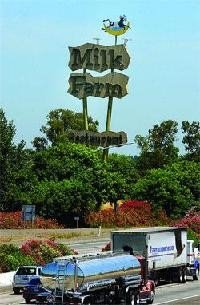
LAFCO on Monday approved Dixon's annexation of the 60-acre former Milk Farm site on I-80. (Rick Roach/The Reporter)
Long considered a Dixon landmark, the old Milk Farm restaurant property is now officially part of the city.
The Local Agency Formation Commission decided Monday to allow the annexation of the historic area to the city of Dixon.
Future plans for the property, which once was home to a restaurant where many travelers stopped en route between the Bay Area and Sacramento from the late 1930s to the late 1980s, likely will be related to highway commercial uses, including restaurants and shops.
"The (Milk Farm) project historically is the the 'front door to Dixon' because the city of Dixon wasn't visible at that time from the highways," explained Dixon City Manager Warren Salmons. "The redevelopment project will hopefully serve the traveling public and be even better than what it once was."
Milk Farm Associates have presented a conceptual plan for the 60 acres located north of Interstate 80 at the interchange of Curry Road and State Route 113. The proposal includes a possible research park, recreation facility and a hotel, among other provisions.
"It's a good economic development project for the city," said LAFCO Executive Officer Shaun Pritchard.
While Milk Farm Associates has clarified its vision for the property, commercial development of the area, which still needs water and sewer service, is not expected to begin until June 2007.
Topping concerns about the annexation were a number of environmental issues.
Commissioner Duane Kromm, a county supervisor, worried that development could encroach on prime agricultural land.
"90 percent of it (the plan) I agree with, but was concerned with adequate buffers on the western agricultural edge," Kromm said.
The project does call for some 30 acres of agricultural buffers as well as conservation easements, although there is still some uncertainty regarding agricultural zoning.
"I'm a farmer myself and I would like to keep part of it a farming operation," said Paul Moller, a general partner of Milk Farm Associates, better known as an aviation visionary for his research into flying vehicles.
Dixon Mayor and LAFCO commissioner Mary Ann Courville added that the city's general plan would provide protection to the area's open space.
In other action Monday, the commission annexed nearly 100 acres known as Mariani Packing Partnership to the city of Vacaville. The company occupies 57 acres of the site located at the northern end of Crocker Drive within the Interchange Business Park, completely surrounded by Vacaville.
There are no immediate plans for the undeveloped portion of the site. The annexation will allow the firm to connect with the city's Easterly Wastewater Treatment Plant, a matter to be considered tonight when the Vacaville City Council meets.
Erin Pursell can be reached at vacaville@thereporter.com.
By Erin Pursell/Staff Writer
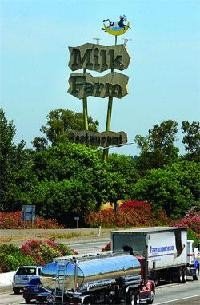
LAFCO on Monday approved Dixon's annexation of the 60-acre former Milk Farm site on I-80. (Rick Roach/The Reporter)
Long considered a Dixon landmark, the old Milk Farm restaurant property is now officially part of the city.
The Local Agency Formation Commission decided Monday to allow the annexation of the historic area to the city of Dixon.
Future plans for the property, which once was home to a restaurant where many travelers stopped en route between the Bay Area and Sacramento from the late 1930s to the late 1980s, likely will be related to highway commercial uses, including restaurants and shops.
"The (Milk Farm) project historically is the the 'front door to Dixon' because the city of Dixon wasn't visible at that time from the highways," explained Dixon City Manager Warren Salmons. "The redevelopment project will hopefully serve the traveling public and be even better than what it once was."
Milk Farm Associates have presented a conceptual plan for the 60 acres located north of Interstate 80 at the interchange of Curry Road and State Route 113. The proposal includes a possible research park, recreation facility and a hotel, among other provisions.
"It's a good economic development project for the city," said LAFCO Executive Officer Shaun Pritchard.
While Milk Farm Associates has clarified its vision for the property, commercial development of the area, which still needs water and sewer service, is not expected to begin until June 2007.
Topping concerns about the annexation were a number of environmental issues.
Commissioner Duane Kromm, a county supervisor, worried that development could encroach on prime agricultural land.
"90 percent of it (the plan) I agree with, but was concerned with adequate buffers on the western agricultural edge," Kromm said.
The project does call for some 30 acres of agricultural buffers as well as conservation easements, although there is still some uncertainty regarding agricultural zoning.
"I'm a farmer myself and I would like to keep part of it a farming operation," said Paul Moller, a general partner of Milk Farm Associates, better known as an aviation visionary for his research into flying vehicles.
Dixon Mayor and LAFCO commissioner Mary Ann Courville added that the city's general plan would provide protection to the area's open space.
In other action Monday, the commission annexed nearly 100 acres known as Mariani Packing Partnership to the city of Vacaville. The company occupies 57 acres of the site located at the northern end of Crocker Drive within the Interchange Business Park, completely surrounded by Vacaville.
There are no immediate plans for the undeveloped portion of the site. The annexation will allow the firm to connect with the city's Easterly Wastewater Treatment Plant, a matter to be considered tonight when the Vacaville City Council meets.
Erin Pursell can be reached at vacaville@thereporter.com.
DOWNTOWN TO STEP UP
DOWNTOWN TO STEP UP
Vallejo Leaders Are Hoping to Turn Their City's Potential Into Prominence
Dana Perrigan, Special to The Chronicle
Sunday, July 9, 2006
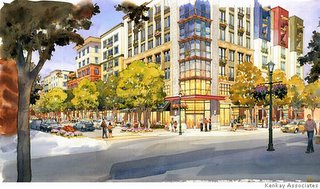
This corner shows how downtown Vallejo is expected to be renovated as part of a $500 million, 15-year project. Illustration courtesy of Kenkay Associates
On a warm afternoon in downtown Vallejo, workers inside the Empress Theatre on Virginia Street labor with a focused intensity to resurrect the 94-year-old Beaux Arts-style movie house in time for its anticipated reopening in early 2007.
Here, surrounded by sea-blue walls festooned with gilded golden clouds and scalloped scrollwork, generations of residents watched popular films of the day from the comfort of red velvet seats. In 1915, the big hit was D.W. Griffith's epic "Birth of a Nation."
But if the theater's marquee -- dark since the Loma Prieta earthquake of 1989 -- were to announce to residents what the civic leaders of today envision as the coming attraction, it would read: "Rebirth of a City."
The $4.7 million renovation of the Empress into a multi-purpose, 500-seat performing arts theater is just the opening credits.
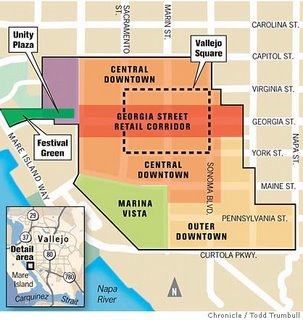
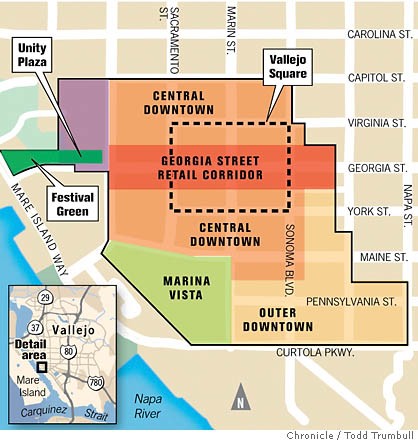
Later this summer, ground will be broken in the parking lot across the street from the theater, signaling the first phase of an ambitious $500 million, 15-year project designed to transform downtown Vallejo into the vibrant and thriving center it once was.
"Vallejo is this diamond in the rough," says Vallejo City Councilwoman Stephanie Gomes. "You hear the 'P' word used a lot; we've got 'potential.' Well, we're tired of hearing that."
If all goes according to plan -- a plan, nearly three years in the making that was approved by citizen committees and the City Council in January -- Vallejo residents won't have to hear it much longer. Under the terms of the partnership between the city and Seattle developer Triad Communities, 12 square blocks adjacent to the town's historic waterfront will be redeveloped.
Seven buildings, containing 100,000 square feet of office and retail space on the ground floors with about 1,000 residential units -- including studio lofts, live-work townhouses, one- and two-bedroom flats and penthouses above -- will be built. All are designed to have common areas, rooftop gardens, European-style paseos and courtyards. All are designed to receive Leadership in Energy and Environmental Design certification.
Architectural renderings by design firm GGLO of Sacramento show attractive, pedestrian-friendly, tree-lined streets with brick and granite sidewalks made for sauntering, canopied restaurant fronts with alfresco dining, fruit-market stalls, prominently paved mid-block crossings, flower beds bordered by iron railings, pedestrian-scale lighting, diagonal parking and other traffic-slowing devices.
Streets that have been cut off from the waterfront by previous development will be reconnected. Anchored by the Empress, an arts and entertainment district and office/employment and retail districts are planned.
And since the plan is expected to attract enough people who want to live, work and shop in the area to create a viable retail base, transportation is crucial. The city intends, by linking its ferry service with buses and BART, to create a transportation hub.
"If I were a young person looking at places to live in the Bay Area, a place where I could own something as I was starting out, I would seriously consider Vallejo," says Mayor Tony Intintoli. "To have a home here in Vallejo for $350,000 or so versus $750,000 in San Francisco would be an attractive alternative."
Intintoli is convinced that the downtown revival -- coupled with the town's sunny, temperate climate, historic architecture and location -- will spark a boom of the sort other Bay Area cities have experienced.
Five years ago, during a trip to Seattle to inspect the city's ferry service, the mayor decided to visit Triad executives. Triad had recently developed Hiddenbrooke Valley -- 2,400 homes, along with Hiddenbrooke Golf Club in Vallejo. He had been impressed with what he had seen of Triad's downtown developments in Seattle, which included transforming a dilapidated pier and 19th-century warehouse into high-tech offices.
"So they had a lot of experience with infill development," Intintoli says. "In that context, I said, 'you really should look at downtown Vallejo. We have an area which is centrally located, an expanding ferry service and an attractive historic area -- and we have this downtown that has gone nowhere.' "
When Triad's executive vice president Curt Johansen accepted the mayor's invitation, he liked what he saw.
"It has a lot of what we call good DNA," says Johansen. "They didn't get rid of the alleys. The grid was intact."
Johansen also liked the old buildings, but he noticed that, scattered throughout the downtown area, there were gaps, like missing teeth, where buildings had been removed. In their place were parking lots, sparsely used in the languishing town center.
"The bad news is that they tore the buildings down and put in parking lots," says Johansen. "The good news is that they didn't sell the land. When I finally realized what was troubling me, I said, 'Can I put the buildings back?' "
Under the terms of Triad's agreement with Vallejo, the city will sell the parking lots to Triad, says the city's downtown economic director, Craig Whittom. Triad will manage the retail space in its buildings and sell the residential units. The city will spend $10 million over the plan's two phases on infrastructure and other improvements.
"We are also committed to funding some business development and marketing," says Whittom. Working closely with the city and the Downtown Advisory Group, Triad, in its role as master developer, presented its plans three years later. The specific plan and design guidelines recently received awards from the American Planning Association.
"I think the Downtown Advisory Group was key to quickly getting approval," says Councilwoman Gomes. "Involving the community in a development plan is crucial. They (developers) don't know the town's warts and cracks like the people who live here do. And it's important that everyone has a stake in it."
Two years ago, Steve Bode bought a stake in downtown Vallejo when he purchased the building -- a restaurant with 14 apartments above it -- next to the Empress Theatre. The Sausalito resident had been looking for investment property in Marin, but most of what he found there he considered overpriced.
"Vallejo is kind of an ignored place," Bode says. "It's got all these great possibilities, but it has this stigma, a high crime rate, to it."
Despite the stigma, Bode says, property values have risen 50 percent during the last two years. And he expects more of the same as a result of the downtown redevelopment.
"I feel like I'm getting in on the beginning of a boom," he says. "And I think there's gonna be more opportunity here in the future."
He isn't alone.
"This is a very ambitious plan," Intintoli says. "It's a very exciting time here in Vallejo."
E-mail Dana Perrigan at perrigan2000@yahoo.com.
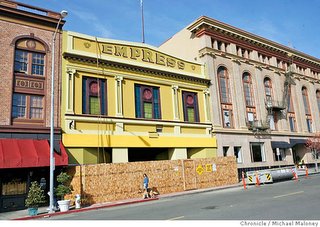
The Empress Theatre has been around for nearly a century, and now is being renovated for an expected reopening early next year. Chronicle photo by Michael Maloney

The Empress Theatre has been around for nearly a century, and now is being renovated for an expected reopening early next year. Illustration courtesy of Kenkay Associates
Vallejo Leaders Are Hoping to Turn Their City's Potential Into Prominence
Dana Perrigan, Special to The Chronicle
Sunday, July 9, 2006

This corner shows how downtown Vallejo is expected to be renovated as part of a $500 million, 15-year project. Illustration courtesy of Kenkay Associates
On a warm afternoon in downtown Vallejo, workers inside the Empress Theatre on Virginia Street labor with a focused intensity to resurrect the 94-year-old Beaux Arts-style movie house in time for its anticipated reopening in early 2007.
Here, surrounded by sea-blue walls festooned with gilded golden clouds and scalloped scrollwork, generations of residents watched popular films of the day from the comfort of red velvet seats. In 1915, the big hit was D.W. Griffith's epic "Birth of a Nation."
But if the theater's marquee -- dark since the Loma Prieta earthquake of 1989 -- were to announce to residents what the civic leaders of today envision as the coming attraction, it would read: "Rebirth of a City."
The $4.7 million renovation of the Empress into a multi-purpose, 500-seat performing arts theater is just the opening credits.
Later this summer, ground will be broken in the parking lot across the street from the theater, signaling the first phase of an ambitious $500 million, 15-year project designed to transform downtown Vallejo into the vibrant and thriving center it once was.
"Vallejo is this diamond in the rough," says Vallejo City Councilwoman Stephanie Gomes. "You hear the 'P' word used a lot; we've got 'potential.' Well, we're tired of hearing that."
If all goes according to plan -- a plan, nearly three years in the making that was approved by citizen committees and the City Council in January -- Vallejo residents won't have to hear it much longer. Under the terms of the partnership between the city and Seattle developer Triad Communities, 12 square blocks adjacent to the town's historic waterfront will be redeveloped.
Seven buildings, containing 100,000 square feet of office and retail space on the ground floors with about 1,000 residential units -- including studio lofts, live-work townhouses, one- and two-bedroom flats and penthouses above -- will be built. All are designed to have common areas, rooftop gardens, European-style paseos and courtyards. All are designed to receive Leadership in Energy and Environmental Design certification.
Architectural renderings by design firm GGLO of Sacramento show attractive, pedestrian-friendly, tree-lined streets with brick and granite sidewalks made for sauntering, canopied restaurant fronts with alfresco dining, fruit-market stalls, prominently paved mid-block crossings, flower beds bordered by iron railings, pedestrian-scale lighting, diagonal parking and other traffic-slowing devices.
Streets that have been cut off from the waterfront by previous development will be reconnected. Anchored by the Empress, an arts and entertainment district and office/employment and retail districts are planned.
And since the plan is expected to attract enough people who want to live, work and shop in the area to create a viable retail base, transportation is crucial. The city intends, by linking its ferry service with buses and BART, to create a transportation hub.
"If I were a young person looking at places to live in the Bay Area, a place where I could own something as I was starting out, I would seriously consider Vallejo," says Mayor Tony Intintoli. "To have a home here in Vallejo for $350,000 or so versus $750,000 in San Francisco would be an attractive alternative."
Intintoli is convinced that the downtown revival -- coupled with the town's sunny, temperate climate, historic architecture and location -- will spark a boom of the sort other Bay Area cities have experienced.
Five years ago, during a trip to Seattle to inspect the city's ferry service, the mayor decided to visit Triad executives. Triad had recently developed Hiddenbrooke Valley -- 2,400 homes, along with Hiddenbrooke Golf Club in Vallejo. He had been impressed with what he had seen of Triad's downtown developments in Seattle, which included transforming a dilapidated pier and 19th-century warehouse into high-tech offices.
"So they had a lot of experience with infill development," Intintoli says. "In that context, I said, 'you really should look at downtown Vallejo. We have an area which is centrally located, an expanding ferry service and an attractive historic area -- and we have this downtown that has gone nowhere.' "
When Triad's executive vice president Curt Johansen accepted the mayor's invitation, he liked what he saw.
"It has a lot of what we call good DNA," says Johansen. "They didn't get rid of the alleys. The grid was intact."
Johansen also liked the old buildings, but he noticed that, scattered throughout the downtown area, there were gaps, like missing teeth, where buildings had been removed. In their place were parking lots, sparsely used in the languishing town center.
"The bad news is that they tore the buildings down and put in parking lots," says Johansen. "The good news is that they didn't sell the land. When I finally realized what was troubling me, I said, 'Can I put the buildings back?' "
Under the terms of Triad's agreement with Vallejo, the city will sell the parking lots to Triad, says the city's downtown economic director, Craig Whittom. Triad will manage the retail space in its buildings and sell the residential units. The city will spend $10 million over the plan's two phases on infrastructure and other improvements.
"We are also committed to funding some business development and marketing," says Whittom. Working closely with the city and the Downtown Advisory Group, Triad, in its role as master developer, presented its plans three years later. The specific plan and design guidelines recently received awards from the American Planning Association.
"I think the Downtown Advisory Group was key to quickly getting approval," says Councilwoman Gomes. "Involving the community in a development plan is crucial. They (developers) don't know the town's warts and cracks like the people who live here do. And it's important that everyone has a stake in it."
Two years ago, Steve Bode bought a stake in downtown Vallejo when he purchased the building -- a restaurant with 14 apartments above it -- next to the Empress Theatre. The Sausalito resident had been looking for investment property in Marin, but most of what he found there he considered overpriced.
"Vallejo is kind of an ignored place," Bode says. "It's got all these great possibilities, but it has this stigma, a high crime rate, to it."
Despite the stigma, Bode says, property values have risen 50 percent during the last two years. And he expects more of the same as a result of the downtown redevelopment.
"I feel like I'm getting in on the beginning of a boom," he says. "And I think there's gonna be more opportunity here in the future."
He isn't alone.
"This is a very ambitious plan," Intintoli says. "It's a very exciting time here in Vallejo."
E-mail Dana Perrigan at perrigan2000@yahoo.com.
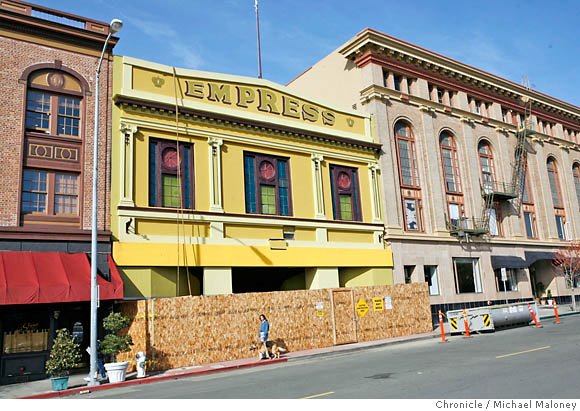
The Empress Theatre has been around for nearly a century, and now is being renovated for an expected reopening early next year. Chronicle photo by Michael Maloney

The Empress Theatre has been around for nearly a century, and now is being renovated for an expected reopening early next year. Illustration courtesy of Kenkay Associates
Monday, July 10, 2006
Solano's Grand Stands
Solano's Grand Stands
Local Produce Abounds at Countryside Stops
By Amanda Janis/Business Editor
Might Solano County's countryside eventually become a destination like Apple Hill or even Napa Valley?
Whether or not the county's various valleys, wineries, ranches and farms - and the regulations under which they operate - can fuel an agricultural tourism revolution remains to be seen.
In the meantime, Solano's existing farm and produce stands continue to sell bounties of fresh, locally-produced goods, from peppers and pears to pies and preserves.
The items offered, and the stands themselves, vary greatly. There are large operations that have dozens of employees, and smaller ones with just a few workers to weigh colorful produce and calculate its cost. Some stands resemble retail shops, while others are simple barns and shacks. Some sell only produce cultivated from their own farms, while others have no farm at all, but serve as an outlet for local farmers, as well as artisan goods like honey and roasted nuts.
If there is such a thing as a "blockbuster" produce stand, Larry's Produce in Suisun Valley - now in its 20th year of operation - fits the bill. As with many of the area's seasonal stands, Larry's opened several weeks later than usual this year due to the rainy spring. And when it opened July 1, the public pounced.
"They literally needed a traffic controller to direct traffic, there were so many people and cars out there," said Joe Murdaca, owner of Pietro's No. 1 in Vacaville.
Murdaca visits Larry's four to five times a week to purchase ingredients for use at his restaurant.
"I am a big fan of Larry's," he said, emphasizing the variety of fresh, high-quality items available at bargain prices. "For restaurants, if you're not using someone like that you're missing out."
Restaurateurs only make up about 10 percent of the stand's sales, said owner Larry Balestra, whose goal is to simply "sell what people need, the basics."
Most of his customers are locals like Suisun City resident Emily Gaskins, who has supplemented or replaced her regular grocery shopping for the past four years with the produce farmed on Balestra's 800-some acres in Suisun Valley.
"On the weekends, we get a lot of out-of-town people," Balestra said. But the out-of-towners pop in during the week, too.
Shirley Gini and her husband stop at Larry's Produce when traveling between their homes in Truckee and Bodega Bay.
"It's on our way, the prices are right and it's a fun place to come to," Gini said. They usually buy a "little bit of everything," she explained, because "in Truckee nothing grows but rocks, so it's like dying and going to heaven here."
The couple learned about Larry's several years ago from a neighbor in Bodega Bay who commutes back and forth from Davis, and also makes regular pilgrimages to the farm stand.
That's Larry's marketing tactic in a nutshell. "Word of mouth - I think that's the best," Balestra said.
Word of mouth has also propelled Vacaville's Aliki's Finest from a neighborhood "secret" to a widely-adored produce stand.
"We had been wholesaling since 1989 and going to farmers markets," explained owner Aliki Poulou. In 1996, as development enfolded the land located at Orchard Avenue and Fruitvale Road, a decision was made to open a produce stand.
"They built all around us, and we're the only orchard on Orchard Avenue, so we thought we'd open something for the neighborhood," Poulou recalled. Repeat customers who told friends who told friends who told more friends, she said, is how Aliki's became known well beyond its neighborhood.
Part of the appeal, Poulou explained, is that her fruits and vegetables are locally grown.
"Eighty percent of the stuff, we grow right where we are," she said. Other produce comes from local farmers who need an outlet for their commodities, such as peaches farmed in Gates Canyon by the Brazelton family.
Giving local farmers and artisans a place to sell their produce and products is the purpose behind Dixon's Pedrick Produce, which is popular among residents from Winters to Fairfield, and appeals to "anybody that drives down the highway," said owner Henry Barraza.
Located on freeway frontage just off Interstate-80, Pedrick Produce does not have its own farmland, but it has been selling a complete line of fruits and vegetables since 1989.
"As much as we can, we go local," said Barraza. For example, one the stand's most popular items - corn on the cob - comes from Dixon farmer Allen Simonis.
But because the stand stays open year-round and hopes to keep its customers from visiting supermarket produce aisles, Barraza noted, it supplements from other sources when items are out of season or unavailable locally.
The store also sells specialty items from the area, including tortillas from Woodland-based California Fresh Salsa, and pies baked by Vacaville's Pure Grain Bakery.
"We sell lots and lots of pies," Barraza said. "People try them and they come back for more."
Amanda Janis can be reached at business@thereporter.com.
* * * *
Finding farm-fresh goods
Heirloom tomatoes, tomatillos, sweet corn, kiwis, peaches and plums are just the tip of the iceberg when it comes to farm-fresh produce available at local farm stands. Here's a quick-guide to some of the county's popular stands:
ALIKI'S FINEST - Fruitvale Road and Orchard Avenue, Vacaville
CAL YEE FARMS - 5158 Clayton Road, Fairfield 425-5327
CASTA EDA BROTHERS PRODUCE - 4075 Green Valley Road, Fairfield, 207-0717
DIXON FRUIT MARKET - 7808 Batvia Road, Dixon
ELMIRA PRODUCE - 6083 California Pacific St., Elmira
ERICKSON RANCH - 2482 Cordelia Road, Fairfield, 864-0557
LARRY'S PRODUCE - Suisun Valley Road and Ledgewood Road, Fairfield 864-8068
MORNINGSUN HERB FARM - 6137 Pleasants Valley Road, Vacaville, 451-9406
PARKER FARM - 2710 Rockville Road, Fairfield, 422-2915
PEDRICK PRODUCE - 6850 Sievers Road, Dixon 678-1814
SAECHAO FAMILY FARM - 2707 Rockville Road, Fairfield, 422-6357
THE VEGETABLE PATCH - 2820 Rockville Road, Fairfield, 427-8164
WILLOTTA RANCH - 2423 Rockville Road, Fairfield, 864-0912
Local Produce Abounds at Countryside Stops
By Amanda Janis/Business Editor
Might Solano County's countryside eventually become a destination like Apple Hill or even Napa Valley?
Whether or not the county's various valleys, wineries, ranches and farms - and the regulations under which they operate - can fuel an agricultural tourism revolution remains to be seen.
In the meantime, Solano's existing farm and produce stands continue to sell bounties of fresh, locally-produced goods, from peppers and pears to pies and preserves.
The items offered, and the stands themselves, vary greatly. There are large operations that have dozens of employees, and smaller ones with just a few workers to weigh colorful produce and calculate its cost. Some stands resemble retail shops, while others are simple barns and shacks. Some sell only produce cultivated from their own farms, while others have no farm at all, but serve as an outlet for local farmers, as well as artisan goods like honey and roasted nuts.
If there is such a thing as a "blockbuster" produce stand, Larry's Produce in Suisun Valley - now in its 20th year of operation - fits the bill. As with many of the area's seasonal stands, Larry's opened several weeks later than usual this year due to the rainy spring. And when it opened July 1, the public pounced.
"They literally needed a traffic controller to direct traffic, there were so many people and cars out there," said Joe Murdaca, owner of Pietro's No. 1 in Vacaville.
Murdaca visits Larry's four to five times a week to purchase ingredients for use at his restaurant.
"I am a big fan of Larry's," he said, emphasizing the variety of fresh, high-quality items available at bargain prices. "For restaurants, if you're not using someone like that you're missing out."
Restaurateurs only make up about 10 percent of the stand's sales, said owner Larry Balestra, whose goal is to simply "sell what people need, the basics."
Most of his customers are locals like Suisun City resident Emily Gaskins, who has supplemented or replaced her regular grocery shopping for the past four years with the produce farmed on Balestra's 800-some acres in Suisun Valley.
"On the weekends, we get a lot of out-of-town people," Balestra said. But the out-of-towners pop in during the week, too.
Shirley Gini and her husband stop at Larry's Produce when traveling between their homes in Truckee and Bodega Bay.
"It's on our way, the prices are right and it's a fun place to come to," Gini said. They usually buy a "little bit of everything," she explained, because "in Truckee nothing grows but rocks, so it's like dying and going to heaven here."
The couple learned about Larry's several years ago from a neighbor in Bodega Bay who commutes back and forth from Davis, and also makes regular pilgrimages to the farm stand.
That's Larry's marketing tactic in a nutshell. "Word of mouth - I think that's the best," Balestra said.
Word of mouth has also propelled Vacaville's Aliki's Finest from a neighborhood "secret" to a widely-adored produce stand.
"We had been wholesaling since 1989 and going to farmers markets," explained owner Aliki Poulou. In 1996, as development enfolded the land located at Orchard Avenue and Fruitvale Road, a decision was made to open a produce stand.
"They built all around us, and we're the only orchard on Orchard Avenue, so we thought we'd open something for the neighborhood," Poulou recalled. Repeat customers who told friends who told friends who told more friends, she said, is how Aliki's became known well beyond its neighborhood.
Part of the appeal, Poulou explained, is that her fruits and vegetables are locally grown.
"Eighty percent of the stuff, we grow right where we are," she said. Other produce comes from local farmers who need an outlet for their commodities, such as peaches farmed in Gates Canyon by the Brazelton family.
Giving local farmers and artisans a place to sell their produce and products is the purpose behind Dixon's Pedrick Produce, which is popular among residents from Winters to Fairfield, and appeals to "anybody that drives down the highway," said owner Henry Barraza.
Located on freeway frontage just off Interstate-80, Pedrick Produce does not have its own farmland, but it has been selling a complete line of fruits and vegetables since 1989.
"As much as we can, we go local," said Barraza. For example, one the stand's most popular items - corn on the cob - comes from Dixon farmer Allen Simonis.
But because the stand stays open year-round and hopes to keep its customers from visiting supermarket produce aisles, Barraza noted, it supplements from other sources when items are out of season or unavailable locally.
The store also sells specialty items from the area, including tortillas from Woodland-based California Fresh Salsa, and pies baked by Vacaville's Pure Grain Bakery.
"We sell lots and lots of pies," Barraza said. "People try them and they come back for more."
Amanda Janis can be reached at business@thereporter.com.
* * * *
Finding farm-fresh goods
Heirloom tomatoes, tomatillos, sweet corn, kiwis, peaches and plums are just the tip of the iceberg when it comes to farm-fresh produce available at local farm stands. Here's a quick-guide to some of the county's popular stands:
ALIKI'S FINEST - Fruitvale Road and Orchard Avenue, Vacaville
CAL YEE FARMS - 5158 Clayton Road, Fairfield 425-5327
CASTA EDA BROTHERS PRODUCE - 4075 Green Valley Road, Fairfield, 207-0717
DIXON FRUIT MARKET - 7808 Batvia Road, Dixon
ELMIRA PRODUCE - 6083 California Pacific St., Elmira
ERICKSON RANCH - 2482 Cordelia Road, Fairfield, 864-0557
LARRY'S PRODUCE - Suisun Valley Road and Ledgewood Road, Fairfield 864-8068
MORNINGSUN HERB FARM - 6137 Pleasants Valley Road, Vacaville, 451-9406
PARKER FARM - 2710 Rockville Road, Fairfield, 422-2915
PEDRICK PRODUCE - 6850 Sievers Road, Dixon 678-1814
SAECHAO FAMILY FARM - 2707 Rockville Road, Fairfield, 422-6357
THE VEGETABLE PATCH - 2820 Rockville Road, Fairfield, 427-8164
WILLOTTA RANCH - 2423 Rockville Road, Fairfield, 864-0912
Friday, July 07, 2006
Boat Operators Eye Suisun City
Boat Operators Eye Suisun City
By Ian Thompson
SUISUN CITY - Three businesses want to dock an entertainment boat on Suisun City's waterfront, officials said.
One already made an appearance during the Fourth of July weekend. Daniel Thiemann brought his 45-foot vessel California Sunset, which he hopes will eventually have a home there.
"I am keeping my fingers crossed," Thiemann said. He spent the last two days cleaning up from non-stop cruises for those who came to the Old Town for the Independence Day festivities.
The profitable weekend and the fistful of business cards he had from people asking about charters proved an entertainment boat can make money operating out of Suisun City, Thiemann said.
"We made money and we had a safe operation," he added.
Thiemann was one of two potential boat operators who approached the Suisun City Council earlier this spring to explain what they felt they could offer the city. Thiemann is the president of Sacramento Steam Navigation Inc., which is based in Rancho Cordova.
The other was Mark Wirth, son of an Old Town business owner who has been expressing an interest in bringing a boat to Suisun City for more than two years.
A third established entertainment boat business surfaced earlier in June after Suisun City sent out requests for proposals to several potential boat operators.
Any other firms interested have until July 18 to send in their business proposals, which will be examined before they are sent to the City Council later this year.
"The city is open to all suggestions," Chief Building Official Dan Kasperson said. He's overseeing the proposals. "We are more concerned about having a successful and well-run operation that is an attraction to Suisun City."
That's not a problem, Thiemann said. His vessel, which started life was a whale-watching boat in 1971 before he rebuilt it, ran cruises down the Suisun Slough from 10 a.m. to 8 p.m. with little more than a sign taped to the dock announcing the boat's presence.
Mayor Jim Spering stressed earlier this year "that Suisun City can't afford another failure" and that whoever comes in better have a solid business plan in place.
The last boat to dock in Suisun City was the paddleboat Grand Romance which arrived in 1998 but didn't prove to be the waterfront attraction the city hoped for. That vessel sailed out of Suisun City for the last time in late 1999.
Reach Ian Thompson at 427-6976 or at ithompson@dailyrepublic.net.
By Ian Thompson
SUISUN CITY - Three businesses want to dock an entertainment boat on Suisun City's waterfront, officials said.
One already made an appearance during the Fourth of July weekend. Daniel Thiemann brought his 45-foot vessel California Sunset, which he hopes will eventually have a home there.
"I am keeping my fingers crossed," Thiemann said. He spent the last two days cleaning up from non-stop cruises for those who came to the Old Town for the Independence Day festivities.
The profitable weekend and the fistful of business cards he had from people asking about charters proved an entertainment boat can make money operating out of Suisun City, Thiemann said.
"We made money and we had a safe operation," he added.
Thiemann was one of two potential boat operators who approached the Suisun City Council earlier this spring to explain what they felt they could offer the city. Thiemann is the president of Sacramento Steam Navigation Inc., which is based in Rancho Cordova.
The other was Mark Wirth, son of an Old Town business owner who has been expressing an interest in bringing a boat to Suisun City for more than two years.
A third established entertainment boat business surfaced earlier in June after Suisun City sent out requests for proposals to several potential boat operators.
Any other firms interested have until July 18 to send in their business proposals, which will be examined before they are sent to the City Council later this year.
"The city is open to all suggestions," Chief Building Official Dan Kasperson said. He's overseeing the proposals. "We are more concerned about having a successful and well-run operation that is an attraction to Suisun City."
That's not a problem, Thiemann said. His vessel, which started life was a whale-watching boat in 1971 before he rebuilt it, ran cruises down the Suisun Slough from 10 a.m. to 8 p.m. with little more than a sign taped to the dock announcing the boat's presence.
Mayor Jim Spering stressed earlier this year "that Suisun City can't afford another failure" and that whoever comes in better have a solid business plan in place.
The last boat to dock in Suisun City was the paddleboat Grand Romance which arrived in 1998 but didn't prove to be the waterfront attraction the city hoped for. That vessel sailed out of Suisun City for the last time in late 1999.
Reach Ian Thompson at 427-6976 or at ithompson@dailyrepublic.net.
Wednesday, July 05, 2006
Tourism on Tap
Tourism on Tap
"Tourism at work in Solano County" is the topic of the Solano Economic Development Corporation's upcoming member-investor breakfast.
The event will feature Susan Wilcox, chief deputy director of the California Travel and Tourism Commission, as well as the Fairfield Hotel Association, Vacaville Conference & Visitors Bureau, Vallejo Convention & Visitors Bureau and Solano County Film Office.
Registration begins at 7:30 a.m. on July 13 at the Hilton Garden Inn, Fairfield. The program is from 8 a.m. to 9:30 a.m. The cost to attend is $25 for Solano EDC members who pre-register, and $35 for non-members or at the door.
For additional information, call 864-1855 or email pat@solanoedc.org.
"Tourism at work in Solano County" is the topic of the Solano Economic Development Corporation's upcoming member-investor breakfast.
The event will feature Susan Wilcox, chief deputy director of the California Travel and Tourism Commission, as well as the Fairfield Hotel Association, Vacaville Conference & Visitors Bureau, Vallejo Convention & Visitors Bureau and Solano County Film Office.
Registration begins at 7:30 a.m. on July 13 at the Hilton Garden Inn, Fairfield. The program is from 8 a.m. to 9:30 a.m. The cost to attend is $25 for Solano EDC members who pre-register, and $35 for non-members or at the door.
For additional information, call 864-1855 or email pat@solanoedc.org.
A Watering Hole for Businesses
A Watering Hole for Businesses -- Fairfield's Supply is in Demand
By Nathan Halverson

The filter gallery at the North Bay Regional Water Treatment Plant. (Christine Baker/Daily Republic)
FAIRFIELD - Business executives contemplate a lot of factors when considering where to locate their business: political climate, tax incentives, freeway access, land, living costs and more.
One little-known factor, which is a significant consideration for many businesses in Fairfield, is water quality.
For food and beverage manufacturers, water quality can impact production and taste of their products. Fortunately, Fairfield has access to high-quality water from Lake Berryessa.
"Water is an important ingredient in beer, and the purity, quality and consistency of the water at our breweries is very important to us," said Kevin Finger, Fairfield plant manager for Anheuser Busch, in an e-mail.
Fairfield Mayor Harry Price credits the city's high water quality for attracting business to the city.
"B. Gale Wilson, the former city manager, convinced Anheuser Busch to locate here. It was the quality of the water and reliable supply that attracted them," Price said.
Good water quality attracted other manufacturers such as NRE Bento, which produces millions of organic bento boxes that are shipped to Japan, Price said.
"Water is always a big issue in the manufacturing industry," he said. "If you were to talk to folks in the candy industry in Fairfield, they'd tell you it's the water here."
Price credits those who had the foresight to build such an abundant, clean source of water.
"They recognized the economic value of a good reliable water supply," Price said.
The need for water
Water first became an issue in Solano County around the time of the gold rush in the 1850s. Some people realized that feeding the rapidly expanding gold towns, rather than trying to find a gold lode, was the best business venture.
But while the growing season in Solano County is more than 240 days a year, 90 percent of the rain usually falls in the month period of December, January and February, so the dry climate limited both the type and quantity of produce farmers could grow. For those with a steady supply of water - such as a nearby creek - irrigation proved a boon to profits. But the rest were stuck farming dry land.
"It is dry land that yields $300 to $400 per acre. If I had water, the yield per acre would double," said Solano farmer Charles Knickerbock in 1948, according to "The Solano Water Story" - a book published by the Solano Irrigation District, which helps manage the county's water supply.
Business people realized they needed to develop a steady supply for the county. They formed the Solano Water Council and tried to drum up support from other counties to dam the Putah Creek at a narrow point in the valley known as Devil's Gate.
Frank Douglas, a Vacaville resident who was on the council, tried to get other counties on board, but ran into resistance.
"I couldn't budge Napa or Yolo. There was a guy in Napa County who owned the block brick business and was buying up a lot of land. He didn't want the dam. The sheriff said if he caught me in town, again he'd put me in jail.
"In Yolo County, a few influential people were the controlling factors in the Clear Lake Water Company. The last thing they wanted was competition from a federally subsidized dam," Douglas said, according to "The Solano Water Story."
Eventually, with the support of local chambers of commerce and both the Mare Island Naval Base and Travis Air Force Base, the Monticello Dam was built at the Devil's Gate and Lake Berryessa was formed. Construction began in 1953 and was finished in 1957.
A good source
"Everybody wants the best source they can get," said Rick Wood, Assistant Public Works Director for Water in Fairfield. "The Lake Berryessa supply tends to be steady in its water quality."
He agrees it has attracted business to the area.
"It has had a positive economic effect going back to the Anheuser Busch brewery," he said.
William Ma, quality assurance manager for NRE Bento, said water impact is important to his company.
"It's very important because we cook the rice with the water," he said. "It's important that the water out of the tap is good."
NRE Bento uses about 20,000 gallons a day to prepare vegetables, cook rice and to clean equipment, Ma said.
The Japanese-based company took water samples and analyzed them to ensure they were of a high enough quality, according to city officials. The water passed the test.
"People in Fairfield don't have to buy bottled water. Our standards exceeds the standards for most bottled water," Price said. "It's just the result of intelligent, long-range planning."
Nathan Halverson can be reached at 427-6934 or nhalverson@dailyrepublic.net.
By Nathan Halverson

The filter gallery at the North Bay Regional Water Treatment Plant. (Christine Baker/Daily Republic)
FAIRFIELD - Business executives contemplate a lot of factors when considering where to locate their business: political climate, tax incentives, freeway access, land, living costs and more.
One little-known factor, which is a significant consideration for many businesses in Fairfield, is water quality.
For food and beverage manufacturers, water quality can impact production and taste of their products. Fortunately, Fairfield has access to high-quality water from Lake Berryessa.
"Water is an important ingredient in beer, and the purity, quality and consistency of the water at our breweries is very important to us," said Kevin Finger, Fairfield plant manager for Anheuser Busch, in an e-mail.
Fairfield Mayor Harry Price credits the city's high water quality for attracting business to the city.
"B. Gale Wilson, the former city manager, convinced Anheuser Busch to locate here. It was the quality of the water and reliable supply that attracted them," Price said.
Good water quality attracted other manufacturers such as NRE Bento, which produces millions of organic bento boxes that are shipped to Japan, Price said.
"Water is always a big issue in the manufacturing industry," he said. "If you were to talk to folks in the candy industry in Fairfield, they'd tell you it's the water here."
Price credits those who had the foresight to build such an abundant, clean source of water.
"They recognized the economic value of a good reliable water supply," Price said.
The need for water
Water first became an issue in Solano County around the time of the gold rush in the 1850s. Some people realized that feeding the rapidly expanding gold towns, rather than trying to find a gold lode, was the best business venture.
But while the growing season in Solano County is more than 240 days a year, 90 percent of the rain usually falls in the month period of December, January and February, so the dry climate limited both the type and quantity of produce farmers could grow. For those with a steady supply of water - such as a nearby creek - irrigation proved a boon to profits. But the rest were stuck farming dry land.
"It is dry land that yields $300 to $400 per acre. If I had water, the yield per acre would double," said Solano farmer Charles Knickerbock in 1948, according to "The Solano Water Story" - a book published by the Solano Irrigation District, which helps manage the county's water supply.
Business people realized they needed to develop a steady supply for the county. They formed the Solano Water Council and tried to drum up support from other counties to dam the Putah Creek at a narrow point in the valley known as Devil's Gate.
Frank Douglas, a Vacaville resident who was on the council, tried to get other counties on board, but ran into resistance.
"I couldn't budge Napa or Yolo. There was a guy in Napa County who owned the block brick business and was buying up a lot of land. He didn't want the dam. The sheriff said if he caught me in town, again he'd put me in jail.
"In Yolo County, a few influential people were the controlling factors in the Clear Lake Water Company. The last thing they wanted was competition from a federally subsidized dam," Douglas said, according to "The Solano Water Story."
Eventually, with the support of local chambers of commerce and both the Mare Island Naval Base and Travis Air Force Base, the Monticello Dam was built at the Devil's Gate and Lake Berryessa was formed. Construction began in 1953 and was finished in 1957.
A good source
"Everybody wants the best source they can get," said Rick Wood, Assistant Public Works Director for Water in Fairfield. "The Lake Berryessa supply tends to be steady in its water quality."
He agrees it has attracted business to the area.
"It has had a positive economic effect going back to the Anheuser Busch brewery," he said.
William Ma, quality assurance manager for NRE Bento, said water impact is important to his company.
"It's very important because we cook the rice with the water," he said. "It's important that the water out of the tap is good."
NRE Bento uses about 20,000 gallons a day to prepare vegetables, cook rice and to clean equipment, Ma said.
The Japanese-based company took water samples and analyzed them to ensure they were of a high enough quality, according to city officials. The water passed the test.
"People in Fairfield don't have to buy bottled water. Our standards exceeds the standards for most bottled water," Price said. "It's just the result of intelligent, long-range planning."
Nathan Halverson can be reached at 427-6934 or nhalverson@dailyrepublic.net.
Friday, June 30, 2006
A Better Vision
A Better Vision
Genentech Fights Blindness
By Amanda Janis/Business Writer
TheReporter.Com
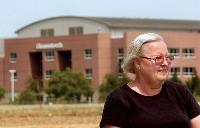
Rose Ketchum, of Winters, took part in the clinical trial for Lucentis, a drug developed by Genentech (pictured in the background). Ketchum's eyesight has improved since taking the drug. (Brad Zweerink/The Reporter)
A blindness-preventing drug developed by Genentech is expected to be approved by the Food and Drug Administration today, and one local resident has seen its merits firsthand.
Rose Ketchum lives just south of Winters. Prior to being entered into a clinical trial for the antibody fragment dubbed Lucentis, she was beginning to lose some of her vision.
"I would lie in bed before I got up and close one eye and look at the ceiling, and then close the other eye and look at the ceiling and I would see a great, big, huge black blob," she recalled.
Her ophthalmologist referred her to Bay Area Retina Associates, a group of specialists participating in one of two major clinical trials for Lucentis.
Lucentis is designed to block new blood vessel growth and blood vessel leakage, which cause wet age-related macular degeneration, or AMD. AMD scars the retina, which in turn causes progressive vision loss.
For people aged 60 and older, AMD is the leading cause of blindness, and the condition affects 1.7 million people in the United States, according to The National Eye Institute. That number is expected to grow to nearly 3 million by 2025.
Ketchum met with physicians at Bay Area Retina's Walnut Creek facility approximately two years ago, and was entered into the Lucentis study. The randomized study was organized so that some patients received Lucentis, while others were given mock injections.
"They don't tell you whether you're getting the drug or not," Ketchum explained. She was fairly positive, however, that she was one of the patients receiving Lucentis injections over the course of the two-year study, she said, because she saw "whirly lines" each time she was injected.
"When the trial was over they said I was getting the drug," she said.
Now, Ketchum said, "my vision's pretty good. I don't see the big black spots anymore."
Her experience is in keeping with the results from both clinical trials.
"Both pivotal studies showed 95 percent of patients maintained their vision and up to 40 percent of patients improved their vision," said Dawn Kalmar, Genentech spokeswoman.
Up to 40 percent of patients treated with Lucentis achieved vision of 20/40 or better, she added. That's important, she said, considering that 20/40 is the driving vision requirement in most states.
FDA approval, Kalmar said, is a moment Genentech has been eagerly awaiting.
"It's been over a year now since we had our first positive Lucentis data," she said, noting the company's excitement and eagerness to begin providing the drug to patients.
Ketchum would recommend Lucentis to people suffering from AMD.
"I'd say at least give it a try, although they tell me it's going to be $2,000 a shot," she said.
Genentech has yet to set a price, and will not until all details of the label are negotiated with the FDA, Kalmar said.
"Everybody's speculating," she said, and emphasized the company's commitment to providing drugs to those unable to afford them, or unable to afford co-payments (which may be the case for some Medicare patients who will be treated with Lucentis).
"Last year $200 million was given out in Genentech drugs to patients who couldn't afford it," she said, which equated to helping a total of about 18,000 patients. "We are prepared to do the same thing for patients who can't afford Lucentis."
Amanda Janis can be reached at business@thereporter.com.
Genentech Fights Blindness
By Amanda Janis/Business Writer
TheReporter.Com

Rose Ketchum, of Winters, took part in the clinical trial for Lucentis, a drug developed by Genentech (pictured in the background). Ketchum's eyesight has improved since taking the drug. (Brad Zweerink/The Reporter)
A blindness-preventing drug developed by Genentech is expected to be approved by the Food and Drug Administration today, and one local resident has seen its merits firsthand.
Rose Ketchum lives just south of Winters. Prior to being entered into a clinical trial for the antibody fragment dubbed Lucentis, she was beginning to lose some of her vision.
"I would lie in bed before I got up and close one eye and look at the ceiling, and then close the other eye and look at the ceiling and I would see a great, big, huge black blob," she recalled.
Her ophthalmologist referred her to Bay Area Retina Associates, a group of specialists participating in one of two major clinical trials for Lucentis.
Lucentis is designed to block new blood vessel growth and blood vessel leakage, which cause wet age-related macular degeneration, or AMD. AMD scars the retina, which in turn causes progressive vision loss.
For people aged 60 and older, AMD is the leading cause of blindness, and the condition affects 1.7 million people in the United States, according to The National Eye Institute. That number is expected to grow to nearly 3 million by 2025.
Ketchum met with physicians at Bay Area Retina's Walnut Creek facility approximately two years ago, and was entered into the Lucentis study. The randomized study was organized so that some patients received Lucentis, while others were given mock injections.
"They don't tell you whether you're getting the drug or not," Ketchum explained. She was fairly positive, however, that she was one of the patients receiving Lucentis injections over the course of the two-year study, she said, because she saw "whirly lines" each time she was injected.
"When the trial was over they said I was getting the drug," she said.
Now, Ketchum said, "my vision's pretty good. I don't see the big black spots anymore."
Her experience is in keeping with the results from both clinical trials.
"Both pivotal studies showed 95 percent of patients maintained their vision and up to 40 percent of patients improved their vision," said Dawn Kalmar, Genentech spokeswoman.
Up to 40 percent of patients treated with Lucentis achieved vision of 20/40 or better, she added. That's important, she said, considering that 20/40 is the driving vision requirement in most states.
FDA approval, Kalmar said, is a moment Genentech has been eagerly awaiting.
"It's been over a year now since we had our first positive Lucentis data," she said, noting the company's excitement and eagerness to begin providing the drug to patients.
Ketchum would recommend Lucentis to people suffering from AMD.
"I'd say at least give it a try, although they tell me it's going to be $2,000 a shot," she said.
Genentech has yet to set a price, and will not until all details of the label are negotiated with the FDA, Kalmar said.
"Everybody's speculating," she said, and emphasized the company's commitment to providing drugs to those unable to afford them, or unable to afford co-payments (which may be the case for some Medicare patients who will be treated with Lucentis).
"Last year $200 million was given out in Genentech drugs to patients who couldn't afford it," she said, which equated to helping a total of about 18,000 patients. "We are prepared to do the same thing for patients who can't afford Lucentis."
Amanda Janis can be reached at business@thereporter.com.
Wednesday, June 28, 2006
Fairfield Eyes New Medical Offices
Fairfield Eyes New Medical Offices
Fairfield Planning Commission set to vote tonight on a $32-million, three-story building planned by the Sutter Regional Medical Group.
By Reporter Staff
TheReporter.Com
Sutter Regional Medical Group hopes to continue its growth pattern in Fairfield with a proposal to go before the Fairfield Planning Commission tonight.
Commissioners will be asked to approve construction of an approximately 69,200 square foot, three-story medical office and related parking and landscaping project on about 5 acres of land on the north side of Low Court.
The $32-million project will allow for a new medical office building on the site which is part of a larger
Sutter Fairfield Medical Campus that includes an outpatient surgery facility and a diagnostic and imaging center.
The Sutter Fairfield Medical Campus is part of the Sutter Health family of facilities, one of the nation's leading not-for-profit networks of hospitals. It includes two state-of-the-art centers, the Sutter Fairfield Surgery Center and the Sutter Fairfield Diagnostic Imaging Center, as well as many of the Sutter Regional Medical Foundation services and medical offices.
"Having all of these services in one location ... makes it easier and more convenient for patients by eliminating the need to travel from one facility to another," states the company's Web site.
Sutter CEO John Ray said the new building will allow for Sutter to unite all of its services in one location. The company hopes to break ground this fall and be moved into the site by October 2007, just in time for a move from temporary offices in Vacaville.
The Planning Commission meets at 7:30 p.m. in the City Council Chamber, 1000 Webster St., Fairfield.
Fairfield Planning Commission set to vote tonight on a $32-million, three-story building planned by the Sutter Regional Medical Group.
By Reporter Staff
TheReporter.Com
Sutter Regional Medical Group hopes to continue its growth pattern in Fairfield with a proposal to go before the Fairfield Planning Commission tonight.
Commissioners will be asked to approve construction of an approximately 69,200 square foot, three-story medical office and related parking and landscaping project on about 5 acres of land on the north side of Low Court.
The $32-million project will allow for a new medical office building on the site which is part of a larger
Sutter Fairfield Medical Campus that includes an outpatient surgery facility and a diagnostic and imaging center.
The Sutter Fairfield Medical Campus is part of the Sutter Health family of facilities, one of the nation's leading not-for-profit networks of hospitals. It includes two state-of-the-art centers, the Sutter Fairfield Surgery Center and the Sutter Fairfield Diagnostic Imaging Center, as well as many of the Sutter Regional Medical Foundation services and medical offices.
"Having all of these services in one location ... makes it easier and more convenient for patients by eliminating the need to travel from one facility to another," states the company's Web site.
Sutter CEO John Ray said the new building will allow for Sutter to unite all of its services in one location. The company hopes to break ground this fall and be moved into the site by October 2007, just in time for a move from temporary offices in Vacaville.
The Planning Commission meets at 7:30 p.m. in the City Council Chamber, 1000 Webster St., Fairfield.
'Net Pitch Out to Sell Nut Tree
'Net Pitch Out to Sell Nut Tree
By Amanda Janis/Business Writer
TheReporter.Com

Workers with Tilton Pacific Construction, of Rocklin, work Tuesday on new retail buildings going up at the Nut Tree site. Best Buy, Sports Chalet, Borders, HomeGoods, PetsMart, Beverages & More!, Old Navy, Justice for Girls, Fenton's Creamery, Rubio's Fresh Mexican Grill and Amici's East Coast Pizzeria are among the Nut Tree's confirmed tenants. (Brad Zweerink/The Reporter)
A slick online video geared toward attracting retail tenants to the new Nut Tree debuted Tuesday.
Historic photographs and film snippets - accompanied by period music and narration by Vacaville Museum Director Shawn Lum - paint a vivid picture of the Nut Tree's rich, seven-decade past in a segment labeled "From Fruit Stand to Legend," while the voice of Mayor Len Augustine offers similar insight into the city of Vacaville, which he calls a "Norman Rockwell scene."
A montage of TV news segments on the landmark's re-development, artist renderings and site plans work together to provide tangible shape to the 80-acre mixed use project under way from Larkspur-based master developer Snell & Co., in conjunction with San Francisco-based developer Westrust and private real estate investment firm Rockwood Capital Corporation.
"There will be restaurants, shops, two hotels, a conference center, 180 town houses, office space, (and) several parks including a kiddy park that will bring back that famous train," an anonymous narrator purrs as corresponding images flash across the screen.
The online video even features a "3-D Fly Through," a computerized tour, of the project's two retail components, the Nut Tree Village and Market Pavilion, the latter of which will be an open-air complex emphasizing artisan goods and seasonal, specialty foods, akin to San Francisco's Ferry Building.
Sean Whiskeman, Westrust's vice president for leasing for Northern California, told The Reporter the video's "primary focus was to reach the retail community to generate interest for the remaining vacancies."
Though Whiskeman noted that approximately 50,000 square feet of space is currently in leasing negotiations with various businesses, the list of confirmed tenants grows longer each week.
In addition to the previously announced anchor tenants - Best Buy, Sport Chalet, Borders, HomeGoods and PetsMart - Beverages & More! and clothing stores Old Navy and Justice for Girls will join the lineup of large retailers.
As will Fenton's Creamery, Rubio's Fresh Mexican Grill, and Amici's East Coast Pizzeria.
Panera Bread Company, Peet's Coffee, and Jamba Juice are also among the franchises that will populate the Nut Tree, Whiskeman confirmed. And a new shop for Fairfield's Jelly Belly Candy Co. will open its doors.
Westrust has been "very pleased" with leasing activity thus far, according to Whiskeman. Though the firm continues its marketing efforts and negotiations, he was unable to disclose further information about possible tenants.
The Reporter has independently confirmed that companies in negotiations include Famous Dave's Legendary Barbecue, Mariani Dried Fruits, and The Athenian Grill.
"We are in negotiations, but we're still working out details," confirmed Shelly Kontogiannis, owner of The Athenian, as it's known on the Suisun waterfront. "It's not 100 percent for sure that we're going to be going in there," she emphasized.
At a "State of the City" address to the Vacaville Chamber of Commerce in March, City Manager David Van Kirk listed several probable tenants, includ-ing Marin French Cheese Co., Stonehouse California Olive Oil Co., and PF Chang's China Bistro. Rumors have also circulated that Elephant Bar & Grill is considering a Nut Tree location, along with the Buckhorn Grill and Ikeda's Produce Market.
None of those reports could be confirmed by The Reporter, save for the latter two - neither business will be coming to the Nut Tree, after all.
The Buckhorn Restaurant Group will continue to open Buckhorn Grills in extremely high-density, inner-city situations, said John Pickerel, one of the group's partners.
And Ikeda Produce Market instead will focus its energies on a new Davis store, said owner Glen Ikeda.
In the video, Augustine estimates that 3 million people will visit the new Nut Tree in its first year alone. Those visits will begin soon, with some of the larger retailers, like PetsMart, set to open in late July. Best Buy's grand opening will be Aug. 11, while Aug. 18 is opening day for BevMo! and Old Navy has a tentative opening date of Sept. 14.
"They're going to kind of roll open," Whiskeman explained, "and then a lot of the smaller shops will open this fall."
Amanda Janis can be reached at business@thereporter.com.
* * * *
If you are experiencing difficulty in opening the video, here's the manual option:
1. Download QuickTime Player.
2. Open QuickTime
3. Click on File in the Menu Bar
4. Click on Open URL
5. Copy & Paste the URL into the field: http://www.westrust.com/video/NutTree_300.mov
6. Click OK
By Amanda Janis/Business Writer
TheReporter.Com
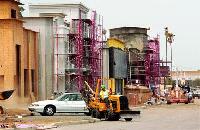
Workers with Tilton Pacific Construction, of Rocklin, work Tuesday on new retail buildings going up at the Nut Tree site. Best Buy, Sports Chalet, Borders, HomeGoods, PetsMart, Beverages & More!, Old Navy, Justice for Girls, Fenton's Creamery, Rubio's Fresh Mexican Grill and Amici's East Coast Pizzeria are among the Nut Tree's confirmed tenants. (Brad Zweerink/The Reporter)
A slick online video geared toward attracting retail tenants to the new Nut Tree debuted Tuesday.
Historic photographs and film snippets - accompanied by period music and narration by Vacaville Museum Director Shawn Lum - paint a vivid picture of the Nut Tree's rich, seven-decade past in a segment labeled "From Fruit Stand to Legend," while the voice of Mayor Len Augustine offers similar insight into the city of Vacaville, which he calls a "Norman Rockwell scene."
A montage of TV news segments on the landmark's re-development, artist renderings and site plans work together to provide tangible shape to the 80-acre mixed use project under way from Larkspur-based master developer Snell & Co., in conjunction with San Francisco-based developer Westrust and private real estate investment firm Rockwood Capital Corporation.
"There will be restaurants, shops, two hotels, a conference center, 180 town houses, office space, (and) several parks including a kiddy park that will bring back that famous train," an anonymous narrator purrs as corresponding images flash across the screen.
The online video even features a "3-D Fly Through," a computerized tour, of the project's two retail components, the Nut Tree Village and Market Pavilion, the latter of which will be an open-air complex emphasizing artisan goods and seasonal, specialty foods, akin to San Francisco's Ferry Building.
Sean Whiskeman, Westrust's vice president for leasing for Northern California, told The Reporter the video's "primary focus was to reach the retail community to generate interest for the remaining vacancies."
Though Whiskeman noted that approximately 50,000 square feet of space is currently in leasing negotiations with various businesses, the list of confirmed tenants grows longer each week.
In addition to the previously announced anchor tenants - Best Buy, Sport Chalet, Borders, HomeGoods and PetsMart - Beverages & More! and clothing stores Old Navy and Justice for Girls will join the lineup of large retailers.
As will Fenton's Creamery, Rubio's Fresh Mexican Grill, and Amici's East Coast Pizzeria.
Panera Bread Company, Peet's Coffee, and Jamba Juice are also among the franchises that will populate the Nut Tree, Whiskeman confirmed. And a new shop for Fairfield's Jelly Belly Candy Co. will open its doors.
Westrust has been "very pleased" with leasing activity thus far, according to Whiskeman. Though the firm continues its marketing efforts and negotiations, he was unable to disclose further information about possible tenants.
The Reporter has independently confirmed that companies in negotiations include Famous Dave's Legendary Barbecue, Mariani Dried Fruits, and The Athenian Grill.
"We are in negotiations, but we're still working out details," confirmed Shelly Kontogiannis, owner of The Athenian, as it's known on the Suisun waterfront. "It's not 100 percent for sure that we're going to be going in there," she emphasized.
At a "State of the City" address to the Vacaville Chamber of Commerce in March, City Manager David Van Kirk listed several probable tenants, includ-ing Marin French Cheese Co., Stonehouse California Olive Oil Co., and PF Chang's China Bistro. Rumors have also circulated that Elephant Bar & Grill is considering a Nut Tree location, along with the Buckhorn Grill and Ikeda's Produce Market.
None of those reports could be confirmed by The Reporter, save for the latter two - neither business will be coming to the Nut Tree, after all.
The Buckhorn Restaurant Group will continue to open Buckhorn Grills in extremely high-density, inner-city situations, said John Pickerel, one of the group's partners.
And Ikeda Produce Market instead will focus its energies on a new Davis store, said owner Glen Ikeda.
In the video, Augustine estimates that 3 million people will visit the new Nut Tree in its first year alone. Those visits will begin soon, with some of the larger retailers, like PetsMart, set to open in late July. Best Buy's grand opening will be Aug. 11, while Aug. 18 is opening day for BevMo! and Old Navy has a tentative opening date of Sept. 14.
"They're going to kind of roll open," Whiskeman explained, "and then a lot of the smaller shops will open this fall."
Amanda Janis can be reached at business@thereporter.com.
* * * *
If you are experiencing difficulty in opening the video, here's the manual option:
1. Download QuickTime Player.
2. Open QuickTime
3. Click on File in the Menu Bar
4. Click on Open URL
5. Copy & Paste the URL into the field: http://www.westrust.com/video/NutTree_300.mov
6. Click OK
Monday, June 26, 2006
Pleasant Chore
Pleasant Chore
Solano Enjoys a Healthy Budget With Spending Choices

When Solano County supervisors come to the table Monday morning to discuss next year's spending plan, they will find themselves with an enviable mission: Determining how to best spend money.
Solano County expects its general fund coffers to reach a very comfortable $40.3 million by the end of the month, thanks to about $16 million in increased county revenue and $4 million in departmental savings.
Even after you factor in a modest 8 percent spending increase, there's still a considerable amount of money to spend, save or dog-ear for future projects.
And, as you might guess, supervisors have a wide range of proposals before them, ranging from county park programs to a substantial jail expansion. Supervisors are likely to follow through with a number of staff recommendations following the discussion Monday, but there is adequate time to raise questions and perhaps add or delete some spending propositions.
We are particularly encouraged to see a proposed $14 million maintenance fund for county buildings.
Solano's new, state-of-the-art Government Center has been its biggest investment to date. Ensuring that it is well maintained could save repair work down the line.
Other county-owned properties could benefit from regular work as well. Perhaps the county's many Veterans Halls wouldn't be in such shoddy shape today had the county paid attention to maintenance of all its buildings in years past. But, as a grand jury report noted recently, most - and Vacaville's fine facility is an exception - are in need of major repair. Some significant money should be put toward their restoration.
Another wise idea is the proposal to set aside $4.7 million to cover unplanned county retirements. In the past, unplanned retirements forced the county to leave some positions vacant for long periods of time, just to offset the cost. No department functions well when short-handed.
We also commend a plan to donate $300,000 to insure 97 percent of all children in Solano County.
One of the biggest expenses in the $866 million spending plan is construction of a new $37 million Health and Social Services center in Vallejo. In addition, a major chunk of change will be needed to add space for an additional 224 beds at the Clay Bank jail, which frequently suffers from overcrowding.
Some improvements included in this year's budget reflect the use of state and federal funds.
For example, the county plans to add 85 new jobs, with many of them in the mental health services division. That funding comes from a voter-approved state initiative.
Some park improvement programs also come from state money. One proposal would construct a nature and interpretive center at Lake Solano Park.
Supervisors will consider using county money to open Lynch Canyon and fund a full-time park ranger and a part-time volunteer coordinator.
On the downside, we haven't seen any funds ear-marked yet to improve transportation. Right now the county is on an 80-year maintenance schedule. Anyone who has driven on rural roads knows that simply is not sufficient.
Of course we understand the county's reluctance to commit what may be a one-time surplus to ongoing costs, such as salaries or regularly scheduled repairs.
It appears that this year's budget reflects a good use of the county's surplus funds, while taking advantage of state and federal money as well.
Want to comment? Visit www.thereporter.com online and click on today's editorial at the bottom of our home page. You'll find a "comment" prompt at the bottom.
Solano Enjoys a Healthy Budget With Spending Choices

When Solano County supervisors come to the table Monday morning to discuss next year's spending plan, they will find themselves with an enviable mission: Determining how to best spend money.
Solano County expects its general fund coffers to reach a very comfortable $40.3 million by the end of the month, thanks to about $16 million in increased county revenue and $4 million in departmental savings.
Even after you factor in a modest 8 percent spending increase, there's still a considerable amount of money to spend, save or dog-ear for future projects.
And, as you might guess, supervisors have a wide range of proposals before them, ranging from county park programs to a substantial jail expansion. Supervisors are likely to follow through with a number of staff recommendations following the discussion Monday, but there is adequate time to raise questions and perhaps add or delete some spending propositions.
We are particularly encouraged to see a proposed $14 million maintenance fund for county buildings.
Solano's new, state-of-the-art Government Center has been its biggest investment to date. Ensuring that it is well maintained could save repair work down the line.
Other county-owned properties could benefit from regular work as well. Perhaps the county's many Veterans Halls wouldn't be in such shoddy shape today had the county paid attention to maintenance of all its buildings in years past. But, as a grand jury report noted recently, most - and Vacaville's fine facility is an exception - are in need of major repair. Some significant money should be put toward their restoration.
Another wise idea is the proposal to set aside $4.7 million to cover unplanned county retirements. In the past, unplanned retirements forced the county to leave some positions vacant for long periods of time, just to offset the cost. No department functions well when short-handed.
We also commend a plan to donate $300,000 to insure 97 percent of all children in Solano County.
One of the biggest expenses in the $866 million spending plan is construction of a new $37 million Health and Social Services center in Vallejo. In addition, a major chunk of change will be needed to add space for an additional 224 beds at the Clay Bank jail, which frequently suffers from overcrowding.
Some improvements included in this year's budget reflect the use of state and federal funds.
For example, the county plans to add 85 new jobs, with many of them in the mental health services division. That funding comes from a voter-approved state initiative.
Some park improvement programs also come from state money. One proposal would construct a nature and interpretive center at Lake Solano Park.
Supervisors will consider using county money to open Lynch Canyon and fund a full-time park ranger and a part-time volunteer coordinator.
On the downside, we haven't seen any funds ear-marked yet to improve transportation. Right now the county is on an 80-year maintenance schedule. Anyone who has driven on rural roads knows that simply is not sufficient.
Of course we understand the county's reluctance to commit what may be a one-time surplus to ongoing costs, such as salaries or regularly scheduled repairs.
It appears that this year's budget reflects a good use of the county's surplus funds, while taking advantage of state and federal money as well.
Want to comment? Visit www.thereporter.com online and click on today's editorial at the bottom of our home page. You'll find a "comment" prompt at the bottom.
Friday, June 23, 2006
Perspectives on Solano Real Estate
Perspectives on Solano Real Estate
By Nathan Halverson
FAIRFIELD - A lot can happen in a year.
That's what many of Solano County's leading real estate professionals talked about as they gathered at The Clubhouse at Paradise Valley Golf Course in Fairfield Thursday morning as part of the Solano Economic Development Corporation's 2006 Real Estate Round-Up.
The keynote speakers agreed the real estate market has changed significantly from a year ago when construction companies were churning out houses and people lined up to buy them, even bidding up the prices.
Discussions centered around what to do in a real estate market where costs are increasing, demand is shrinking, and inventory is getting larger. But the tone was not pessimistic. Rather the focus centered around what was next for a county expected to have the largest population growth in the Bay Area and to experience double digit economic growth in the coming decades.
"One thing is clear, this county is growing," said Pete Beucke, vice president of sales and marketing for Lennar Homes in San Francisco. Lennar Homes is developing Mare Island.
While the county is growing economically and in population size, downward pressures such as increased costs and rising interest rates are slowing things down.
"Building costs have escalated dramatically," said Jim Randolph, a senior vice president with Cornish & Carey - the brokerage firm representing The Nut Tree Village in Vacaville.
Randolph and Beucke were keynote speakers at the event along with three others. Jim Shepherd, also with Cornish & Carey, addressed the retail market such as increasing rental costs for retail space.
"The rents are definitely on the way up, and that's a good sign," Shepherd said.
Higher rental rates encourage more commercial and retail developments by offsetting increased costs.
Brooks Pedder, a managing partner with Colliers International in Fairfield, discussed business and industrial parks in Solano County.
Joseph McNeil, who manages a real estate portfolio for CalPERS valued in the billions, spoke about real estate investments. He said rates of returns on most real estate investments have been decreasing. But he suggested refocusing investments into areas such as retirement homes which can return high yields. CalPERS, which manages the pension fund for state employees, expects a return of 20 percent on investments in retirement homes, he said.
Beucke addressed residential development in the county.
"It wasn't that long ago we had people lined up outside our sales offices waiting to buy our homes," said Beucke. "We're definitely seeing the market tighten up."
Beucke said the slow down requires real estate professionals to adjust their attitudes, but the county's real estate outlook remains positive.
"We really view Solano as healthy and growing," he said.
Nathan Halverson can be reached at 427-6934 or nhalverson@dailyrepublic.net
By Nathan Halverson
FAIRFIELD - A lot can happen in a year.
That's what many of Solano County's leading real estate professionals talked about as they gathered at The Clubhouse at Paradise Valley Golf Course in Fairfield Thursday morning as part of the Solano Economic Development Corporation's 2006 Real Estate Round-Up.
The keynote speakers agreed the real estate market has changed significantly from a year ago when construction companies were churning out houses and people lined up to buy them, even bidding up the prices.
Discussions centered around what to do in a real estate market where costs are increasing, demand is shrinking, and inventory is getting larger. But the tone was not pessimistic. Rather the focus centered around what was next for a county expected to have the largest population growth in the Bay Area and to experience double digit economic growth in the coming decades.
"One thing is clear, this county is growing," said Pete Beucke, vice president of sales and marketing for Lennar Homes in San Francisco. Lennar Homes is developing Mare Island.
While the county is growing economically and in population size, downward pressures such as increased costs and rising interest rates are slowing things down.
"Building costs have escalated dramatically," said Jim Randolph, a senior vice president with Cornish & Carey - the brokerage firm representing The Nut Tree Village in Vacaville.
Randolph and Beucke were keynote speakers at the event along with three others. Jim Shepherd, also with Cornish & Carey, addressed the retail market such as increasing rental costs for retail space.
"The rents are definitely on the way up, and that's a good sign," Shepherd said.
Higher rental rates encourage more commercial and retail developments by offsetting increased costs.
Brooks Pedder, a managing partner with Colliers International in Fairfield, discussed business and industrial parks in Solano County.
Joseph McNeil, who manages a real estate portfolio for CalPERS valued in the billions, spoke about real estate investments. He said rates of returns on most real estate investments have been decreasing. But he suggested refocusing investments into areas such as retirement homes which can return high yields. CalPERS, which manages the pension fund for state employees, expects a return of 20 percent on investments in retirement homes, he said.
Beucke addressed residential development in the county.
"It wasn't that long ago we had people lined up outside our sales offices waiting to buy our homes," said Beucke. "We're definitely seeing the market tighten up."
Beucke said the slow down requires real estate professionals to adjust their attitudes, but the county's real estate outlook remains positive.
"We really view Solano as healthy and growing," he said.
Nathan Halverson can be reached at 427-6934 or nhalverson@dailyrepublic.net
Double-digit Housing Growth Foreseen
Double-digit Housing Growth Foreseen
By Amanda Janis/Business Writer
TheReporter.Com
The status of Solano County real estate was the topic du jour Thursday in Fairfield at the Solano Economic Development Corporation's member-investor breakfast.
"It's a dynamic market, changing every year," said Michael Ammann, president of the organization whose purpose is to attract and retain business within the county.
A panel of local industry experts offered the 150 in attendance an insight into topics including business and industrial parks, retail and residential development.
Peter Beucke, senior vice president of Lennar Homes, noted a tightening of the residential retail market in the past 12 months, calling its current situation "unique."
Around the same time last year, he said, people in the home building industry were giddy, things were going so well.
"A lot of them were out playing golf at this time - you don't see so many builder-golfers these days," he quipped.
Current market conditions can be characterized by "seven I's," according to Beucke: rising interest rates, increased inventory, increased order cancellations, enhanced incentives, increased construction costs, investors selling their properties, and intense cost reduction initiatives by home builders.
Despite all that, Beucke said, "We really view Solano County as a great opportunity down the road - it's ideal for home buyers and businesses."
Not only is it strategically located, he said, but "each of the county's 7 cities is looking at double digit growth over the next 18 years. The big three along I-80 will lead the way - Vacaville, Fairfield and Vallejo. We see that as a huge opportunity for brokers and new home buyers."
As do institutional investors, according to Jose McNeil, industrial real estate portfolio manager for CalPERS.
McNeil explained that the majority of the state employee pension fund's $5.87 billion housing portfolio investments are "tri-coastal," that is, they're focused on the western, eastern and southern coasts of the United States.
Brooks Pedder, managing partner of Colliers International's Fairfield office and Solano EDC chairman, characterized Solano's business and industrial park market as "tight."
Vacancy rates have increased to 15 percent county-wide, he said, attributable to many tenants becoming owner-users.
"Our land values are skyrocketing, in certain circumstances they've more than doubled in the last 12 months, and our inventories are starting to disappear," Pedder said.
Unless cities create new opportunities and consider annexation, he said, "we're going to be out of land."
A flurry of new retail development is also taking place throughout the county, said Jim Randolph, senior vice president and director of retail real estate in the Bay Area for Cornish & Carey.
He expects home-furnishings tenants to occupy a portion of the proposed 700,000 square foot Vacaville Pavilion, which will be located off the I-80/505 interchange. Kornwaser Development has not disclosed who will be the center's anchors, Randolph said, "but they seem to slowly be gaining momentum on this."
A Longs Drugs will anchor the 33,000 square foot Hillside Terrace shopping center under construction on North Texas Street in Fairfield, he said, which is scheduled to be finished this fall.
In the Cordelia area, two new 80-plus room hotels are under construction in Green Valley Center, Randolph noted, and nearby, the former truck stop site will be developed into a 450,000 square foot shopping center.
"We have probably a good full year of entitlement to go through and we have to get it anchored," he said, "but this will probably be the largest center in Fairfield to be built in the next couple of years."
Amanda Janis can be reached at business@thereporter.com.
By Amanda Janis/Business Writer
TheReporter.Com
The status of Solano County real estate was the topic du jour Thursday in Fairfield at the Solano Economic Development Corporation's member-investor breakfast.
"It's a dynamic market, changing every year," said Michael Ammann, president of the organization whose purpose is to attract and retain business within the county.
A panel of local industry experts offered the 150 in attendance an insight into topics including business and industrial parks, retail and residential development.
Peter Beucke, senior vice president of Lennar Homes, noted a tightening of the residential retail market in the past 12 months, calling its current situation "unique."
Around the same time last year, he said, people in the home building industry were giddy, things were going so well.
"A lot of them were out playing golf at this time - you don't see so many builder-golfers these days," he quipped.
Current market conditions can be characterized by "seven I's," according to Beucke: rising interest rates, increased inventory, increased order cancellations, enhanced incentives, increased construction costs, investors selling their properties, and intense cost reduction initiatives by home builders.
Despite all that, Beucke said, "We really view Solano County as a great opportunity down the road - it's ideal for home buyers and businesses."
Not only is it strategically located, he said, but "each of the county's 7 cities is looking at double digit growth over the next 18 years. The big three along I-80 will lead the way - Vacaville, Fairfield and Vallejo. We see that as a huge opportunity for brokers and new home buyers."
As do institutional investors, according to Jose McNeil, industrial real estate portfolio manager for CalPERS.
McNeil explained that the majority of the state employee pension fund's $5.87 billion housing portfolio investments are "tri-coastal," that is, they're focused on the western, eastern and southern coasts of the United States.
Brooks Pedder, managing partner of Colliers International's Fairfield office and Solano EDC chairman, characterized Solano's business and industrial park market as "tight."
Vacancy rates have increased to 15 percent county-wide, he said, attributable to many tenants becoming owner-users.
"Our land values are skyrocketing, in certain circumstances they've more than doubled in the last 12 months, and our inventories are starting to disappear," Pedder said.
Unless cities create new opportunities and consider annexation, he said, "we're going to be out of land."
A flurry of new retail development is also taking place throughout the county, said Jim Randolph, senior vice president and director of retail real estate in the Bay Area for Cornish & Carey.
He expects home-furnishings tenants to occupy a portion of the proposed 700,000 square foot Vacaville Pavilion, which will be located off the I-80/505 interchange. Kornwaser Development has not disclosed who will be the center's anchors, Randolph said, "but they seem to slowly be gaining momentum on this."
A Longs Drugs will anchor the 33,000 square foot Hillside Terrace shopping center under construction on North Texas Street in Fairfield, he said, which is scheduled to be finished this fall.
In the Cordelia area, two new 80-plus room hotels are under construction in Green Valley Center, Randolph noted, and nearby, the former truck stop site will be developed into a 450,000 square foot shopping center.
"We have probably a good full year of entitlement to go through and we have to get it anchored," he said, "but this will probably be the largest center in Fairfield to be built in the next couple of years."
Amanda Janis can be reached at business@thereporter.com.
Revival on Track
Revival on Track
Nut Tree's Miniature Train is Restored for its Return to Vacaville
By Bethany Clough -- Fresno Bee

The restored Nut Tree train gets a final inspection before its test run Wednesday. Fresno Bee/Christian Parley
Aside from its flair for food, the former Nut Tree restaurant on Interstate 80 was known for its restaurant, toy shop and the miniature railroad with the black-and-red engine that chugged across its grounds.
On Wednesday, the little red train -- which has sat neglected since the Nut Tree was closed in 1996 -- was back on track, at least in Reedley. A shiny, refurbished version chugged back and forth on 250 feet of track at 5 mph, tooting all three of its whistles.
It's the handiwork of Sean and Melissa Bautista and their team of workers who've been restoring the 44-year-old train at their business, the Hillcrest Christmas Tree Farm in Reedley, for the past six months.
The Nut Tree, which closed after 75 years in business, will reopen beginning this fall in phases that include a family park, children's rides, bocce courts and a "village" that will include restaurants, housing and a hotel and stores like Borders and Old Navy.
Hillcrest workers will start installing 1,800 feet of track later this week at the Vacaville site. The train will be finished in August and open to the public in September.
After shipping the train to Reedley on trucks, workers took apart every piece of metal and examined every lever and bolt. Workers cut layers of rusted metal off the side of the cars.
The innards of the engine were replaced, air brakes were added and a new transmission and wheels were installed. Six cars were restored and two new ones were added. Powered by gasoline, the engine is designed to look like a steam engine.
A group of Nut Tree Railroad fans, including Vacaville's mayor and two former engineers, gathered Wednesday to test drive the restored train.
The narrow-gauge railroad once shuttled visitors to and from the private Nut Tree airport, parking lot and buildings. The train, which started running in 1952, carried its one-millionth passenger in 1964, said Shawn Lum, executive director of the Vacaville museum and a former Nut Tree employee.
On Wednesday, Jim Holtz, 59, a former Nut Tree maintenance worker from Vacaville, drove the train in a blue-and-white-striped hat and overalls.
The ride brought back memories for Phil Martin, 70, of Suisun City, who ran the train its last four years.
"The tunnel was always the best part because the kids would scream, and I was always in favor of blowing the whistle," he said.
About the writer:
The Fresno Bee's Bethany Clough can be reached at bclough@fresnobee.com or (559)441-6431.

Hillcrest Christmas Tree Farm did the work in Reedley for the longtime restaurant attraction. Fresno Bee/Christian Parley
Nut Tree's Miniature Train is Restored for its Return to Vacaville
By Bethany Clough -- Fresno Bee

The restored Nut Tree train gets a final inspection before its test run Wednesday. Fresno Bee/Christian Parley
Aside from its flair for food, the former Nut Tree restaurant on Interstate 80 was known for its restaurant, toy shop and the miniature railroad with the black-and-red engine that chugged across its grounds.
On Wednesday, the little red train -- which has sat neglected since the Nut Tree was closed in 1996 -- was back on track, at least in Reedley. A shiny, refurbished version chugged back and forth on 250 feet of track at 5 mph, tooting all three of its whistles.
It's the handiwork of Sean and Melissa Bautista and their team of workers who've been restoring the 44-year-old train at their business, the Hillcrest Christmas Tree Farm in Reedley, for the past six months.
The Nut Tree, which closed after 75 years in business, will reopen beginning this fall in phases that include a family park, children's rides, bocce courts and a "village" that will include restaurants, housing and a hotel and stores like Borders and Old Navy.
Hillcrest workers will start installing 1,800 feet of track later this week at the Vacaville site. The train will be finished in August and open to the public in September.
After shipping the train to Reedley on trucks, workers took apart every piece of metal and examined every lever and bolt. Workers cut layers of rusted metal off the side of the cars.
The innards of the engine were replaced, air brakes were added and a new transmission and wheels were installed. Six cars were restored and two new ones were added. Powered by gasoline, the engine is designed to look like a steam engine.
A group of Nut Tree Railroad fans, including Vacaville's mayor and two former engineers, gathered Wednesday to test drive the restored train.
The narrow-gauge railroad once shuttled visitors to and from the private Nut Tree airport, parking lot and buildings. The train, which started running in 1952, carried its one-millionth passenger in 1964, said Shawn Lum, executive director of the Vacaville museum and a former Nut Tree employee.
On Wednesday, Jim Holtz, 59, a former Nut Tree maintenance worker from Vacaville, drove the train in a blue-and-white-striped hat and overalls.
The ride brought back memories for Phil Martin, 70, of Suisun City, who ran the train its last four years.
"The tunnel was always the best part because the kids would scream, and I was always in favor of blowing the whistle," he said.
About the writer:
The Fresno Bee's Bethany Clough can be reached at bclough@fresnobee.com or (559)441-6431.
Hillcrest Christmas Tree Farm did the work in Reedley for the longtime restaurant attraction. Fresno Bee/Christian Parley
Thursday, June 22, 2006
Starbucks Near to Opening
Starbucks Near to Opening
By Times-Herald staff
Vallejo Times Herald
BENICIA - Coffee giant Starbucks, an upscale jewelry business and a wine selling company are expected to open businesses on First Street in the next several months.
Starbucks is targeting a Fourth of July opening, said Benicia Downtown Asset Manager Stan Houston. The Jewelry Box could open by early August, and Wine Miles Inc. could open around September, he said.
All the new businesses are included in the new mixed use Harbor Walk development at 129 First Street.
Houston said Harbor Walk commercial property officials still are negotiating to fill the last business spot, which could be an anchor restaurant. He said development officials are "actively considering" a French bistro from Contra Costa County for the site. He had no more details on the restaurant.
By Times-Herald staff
Vallejo Times Herald
BENICIA - Coffee giant Starbucks, an upscale jewelry business and a wine selling company are expected to open businesses on First Street in the next several months.
Starbucks is targeting a Fourth of July opening, said Benicia Downtown Asset Manager Stan Houston. The Jewelry Box could open by early August, and Wine Miles Inc. could open around September, he said.
All the new businesses are included in the new mixed use Harbor Walk development at 129 First Street.
Houston said Harbor Walk commercial property officials still are negotiating to fill the last business spot, which could be an anchor restaurant. He said development officials are "actively considering" a French bistro from Contra Costa County for the site. He had no more details on the restaurant.
Colon Cancer Drug Receives Approval
Colon Cancer Drug Receives Approval
By Reporter Staff
TheReporter.Com
One of the drugs manufactured at Genentech's Vacaville facility has been approved by the Food and Drug Administration for yet another use, the South San Francisco-based biotech company announced this week.
The go-ahead has been given to use blockbuster drug Avastin in combination with a specific type of chemotherapy as second-line treatment for metastatic colon cancer, the second leading cause of cancer death in the United States, and the third most frequently diagnosed cancer. The combination has already been
FDA-approved as a first-line treatment for that type of cancer.
"Avastin is the only biologic therapy with a demonstrated survival benefit in colorectal cancer, and this new indication offers patients who have received a previous treatment regimen a new option to help fight their disease," said Hal Barron, Genentech's senior vice president of development and chief medical officer, in a written statement.
The new approval is based on results of a study that showed patients receiving Avastin in conjunction with a chemotherapy regimen called FOLFOX4 had a 25 percent reduction in their risk of death equating to a 33 percent improvement in overall survival as compared to patients receiving the chemotherapy alone.
"We are encouraged by new treatments and options that are leading to increased survival for patients," said Amy E. Kelly, co-founder and executive director of the Colon Cancer Alliance, in a press release. "We believe Avastin is an important advance that offers hope for prolonging survival for patients, including those who have already been through first-line treatment."
Barron voiced similar sentiment.
"Avastin used in combination with chemotherapy has become an important component of care for patients with metastatic colorectal cancer," he said, and noted Genentech's continuing research on Avastin and how it may effect other cancers including kidney, breast, pancreatic, non-small cell lung, prostate and ovarian.
By Reporter Staff
TheReporter.Com
One of the drugs manufactured at Genentech's Vacaville facility has been approved by the Food and Drug Administration for yet another use, the South San Francisco-based biotech company announced this week.
The go-ahead has been given to use blockbuster drug Avastin in combination with a specific type of chemotherapy as second-line treatment for metastatic colon cancer, the second leading cause of cancer death in the United States, and the third most frequently diagnosed cancer. The combination has already been
FDA-approved as a first-line treatment for that type of cancer.
"Avastin is the only biologic therapy with a demonstrated survival benefit in colorectal cancer, and this new indication offers patients who have received a previous treatment regimen a new option to help fight their disease," said Hal Barron, Genentech's senior vice president of development and chief medical officer, in a written statement.
The new approval is based on results of a study that showed patients receiving Avastin in conjunction with a chemotherapy regimen called FOLFOX4 had a 25 percent reduction in their risk of death equating to a 33 percent improvement in overall survival as compared to patients receiving the chemotherapy alone.
"We are encouraged by new treatments and options that are leading to increased survival for patients," said Amy E. Kelly, co-founder and executive director of the Colon Cancer Alliance, in a press release. "We believe Avastin is an important advance that offers hope for prolonging survival for patients, including those who have already been through first-line treatment."
Barron voiced similar sentiment.
"Avastin used in combination with chemotherapy has become an important component of care for patients with metastatic colorectal cancer," he said, and noted Genentech's continuing research on Avastin and how it may effect other cancers including kidney, breast, pancreatic, non-small cell lung, prostate and ovarian.
Subscribe to:
Posts (Atom)
Solano's Got It!

The Best That Northern California Has To Offer.


