Monday, August 21, 2006

Open for Business

Open for Business
Furniture firm finds footing in Fairfield
By Amanda Janis/Business Editor
TheReporter.Com



Ashley Furniture HomeStore held its grand opening Wednesday in Fairfield. It's the first of nine area stores to be opened in the next few years. (Brad Zweerink/The Reporter)

A small group of entrepreneurs decided to dip its toes in Solano County, testing the waters a bit before further immersing itself in the Bay Area's retail furniture market.
Though a small roof fire Tuesday afternoon threatened to damper its grand opening festivities the following day, Ashley Furniture HomeStore in Fairfield celebrated as planned, confirmed one of its four owners, Roy Corn.

"We worked all through the night," Corn said. "And the fire department's effort was tremendous - they really did a lot to help us keep the integrity of the store."

In fact, Wednesday morning visitors to the 50,000-square-foot store would've been hard-pressed to find any evidence of a fire at all. Clearly present, however, were some of the features Corn feels make Ashley HomeStores special, including an in-store cafe, children's play area complete with video games, and - adjacent to the kids zone - an area Corn imagines will be frequented by fathers, husbands and boyfriends: Rows of armchairs and recliners arranged in front of a large-screen TV tuned to sporting events.

"What makes us most unique," he said, "is we have just as much invested in accessories as we do in furniture." Because of the volume of Ashley Furniture's purchases, he explained, its stores are able to sell accessories from around the world that compliment its vast line of home furnishings. Its merchandise, Corn said, is a "high-end look at affordable prices."

Each Ashley HomeStore is independently owned and operated by a licensee affiliated with Arcadia, Wis.-based Ashley Furniture, which, Corn noted, is now the No. 1 selling brand of furniture in America, as well as the No. 1 domestic furniture manufacturer and the country's No. 1 furniture retailer. Corn described the merchandise as having, "a high-end look at affordable prices."

Napa resident Britta Wallace concurred. She stopped at the store Wednesday to peruse its stock, and noted, "The prices are great and the quality's good, middle-of-the road." Though she doesn't shop often for furniture, Wallace said, the store's open floorplan and design makes it easy to navigate.

Corn, along with partners Ed and Christine Corn and Darrin Martheas, already owns a HomeStore in southern California, has another in Rhonert Park scheduled to open within a few weeks, and will soon open a distribution facility in the Santa Rosa area.

The partners' first big foray into the Bay Area market, Corn said, is the new Fairfield store, and a 69,000-square-foot distribution center near Vacaville's Nut Tree Airport that will also serve as the distribution center and call center for future Bay Area stores. The two local facilities will employ more than 100 people when all positions are filled, he said.

"We wanted to come and hit some of the growth areas first," Corn explained. "The growth of the region is similar to where we have our first store in Murrieta, where there's sort of a sister-cities situation." That made the partners comfortable in their decision to locate first in Solano, he said.

In the next three years, they plan to open eight more 50,000 square foot Ashley HomeStores Bay Area cities. Though they've yet to decide upon locations, Corn said they hope to open a Fremont location in May 2007.

Amanda Janis can be reached at business@thereporter.com.

Job Growth in Solano Beats Labor Pool Gain

Job Growth in Solano Beats Labor Pool Gain
By Kathleen L'Ecluse

FAIRFIELD - The number of jobs in Solano County grew at a faster pace than the number of workers in the past five years, perhaps indicating some success in efforts to bring a better jobs/housing balance to the area, according to statistics released by the state Friday.

Solano County's labor force grew 6.6 percent since 2001, increasing by about 13,000 to reach 210,200 people in 2005, according to the state Employment Development Department.

At the same time, the number of jobs in the county grew by 8 percent, adding 10,000 jobs primarily in trade, transportation and utilities; construction and financial activities, reaching a total of about 130,000.

But the numbers aren't quite as simple as saying Solano County added more jobs than workers here, said Cynthia Solorio, the Napa-Solano-Sonoma labor market consultant for the state. The types of jobs added - and what they pay - can make all the difference.

"You have construction, which has higher pay, and there are some higher-paying jobs in finance," she said, referring to two areas of job growth in Solano County. "But the bulk of the growth came in trade and that's wholesale trade and retail trade, a lot of entry-level jobs."

Not the kind of jobs with salaries which will enable people to buy homes.

Still, Solano County does have some advantages. Its proximity to other Bay Area counties and its lower housing costs - compared to those counties - makes it an attractive place for businesses. And the existing biotech industry here could be on the verge of expanding, bring more higher paying jobs to the area, she said.

And other county's problems may be Solano County's fortune, Solorio added.

"I did notice that leisure and hospitality jobs are gaining in Solano County (this summer) when they've basically stalled in Sonoma County," she said. "Perhaps with the gas prices, people are just taking day trips rather than going and staying in those expensive hotels."

The state also released employment numbers for the month of July, which showed a total increase of 3,200 jobs compared to July 2005, an increase of 2.5 percent. The biggest job gains came in educational and health services, professional and business services, and trade, transportation and utilities. The only drop came in information jobs.

The unemployment rate increased for the second month in a row, growing from 4.5 percent in May to 5.2 percent in July. It's still below the July 2005 rate of 5.8 percent and its on par with the statewide rate.

Unemployment in Fairfield was at 5.6 percent, second to Vallejo, at 6.5 percent unemployment. Suisun City had a jobless rate of 5.3 percent, Vacaville was 3.7 percent, Dixon was 4.1 percent, Rio Vista was 3.7 percent and Benicia was 3.1 percent.

Reach Kathleen L'Ecluse at klecluse@dailyrepublic.net or 427-6933.

Sunday, August 20, 2006

Nut Tree regains air ambulance

Article Launched: 8/19/2006 07:30 AM

Nut Tree regains air ambulance

By Robin Miller/City Editor
TheReporter.Com

Air ambulance service is returning to the Nut Tree Airport.

County officials confirmed Friday that CALSTAR, a regional, public nonprofit helicopter ambulance service headquartered in McClellan Park, will station a helicopter at the Vacaville airport beginning in September.

County Administrator Michael Johnson signed the contract with CALSTAR, ending a two-year effort to bring an air ambulance back to Vacaville. The

University of California, Davis Medical Center's Life Flight program left the local airport in October 2004 in a multimillion-dollar cost-saving maneuver.

The move resulted in longer air ambulance response times to local emergencies. In December 2004, county Emergency Medical Services officials said response times for air medics to local incidents had increased to 10 to 15 minutes from an earlier two to three minutes.

The new program, which will be known as CALSTAR 8, will "halve the response time to reach critically injured patients in central Solano and the Interstate 80 corridor, greatly increasing the rate of survival and recovery," read a notice sent out Friday. "Currently, the closest medical helicopters are based in Concord and Lodi."

Supervisor Mike Reagan rejoiced at the news.

"We have been working to get this service since UC Davis pulled out," he said. "This is an very important service in terms of trauma response and it will have a huge impact, particularly for more regional areas like Rio Vista, where it can take so long to get to an emergency room."

For trauma victims, medical treatment within one hour, often referred to as the "golden hour," can prevent potential deaths and dramatically reduce hospitalization times.

Nut Tree Airport Manager Andy Swanson was equally pleased with the news.

"This is a great thing for the community and for Solano County," he said.

Founded in 1984 as a nonprofit community service to provide helicopter ambulance service to the San Francisco Bay Region, CALSTAR now operates seven helicopter programs throughout Central and Northern California, plus an airplane operation. Crews respond from fixed bases in Auburn, Concord, Gilroy, Salinas, Santa Maria, South Lake Tahoe and Ukiah, according to the company's Web site.

The company employs only critical care registered nurses as caregivers, officials noted, and has posted a perfect operational safety record.

Robin Miller can be reached at citydesk@thereporter.com.

Friday, August 18, 2006

"Vallejo Crossroads" project, a 25,000 square foot mix-use Vallejo commercial complex

August 18, 2006

North Vallejo plan for Sonoma site taking shape

By RACHEL RASKIN-ZRIHEN/Times-Herald staff writer

Development of a three-acre lot on Sonoma Boulevard between Wal-Mart and Vallejo Garbage should begin next year, city and project officials said.

The "Vallejo Crossroads" project, not to be confused with Gary Mandarich's northeast Vallejo "Crossroads" project, will be a 25,000 square foot mix-use commercial complex, said project manager Kam Shadan and assistant city planner Darren Goon. The site will include 100 parking spaces, he said.

"It will be a mini-mall with a gas station, convenience store, a fast-food restaurant and other retail stores," Goon said.

Comprised of four buildings, the estimated $15-plus million development will also include a courtyard, a water feature, and "a place to sit down, relax and shop," said Shadan, president of Mill Valley-based Gannett Fleming Project Development Corporation.

Owned by 580BPG, LLC, a Marin County-based private development group, the project is among several the firm's done or is doing in the Bay Area, Shadan said. One smaller, though similar to the Vallejo project, is planned for Livermore, Shadan said.

"We are always looking in the North Bay. Our motto is to work in the community we work and live in, to benefit the community and keep us close to our communities." he said. "This will be a very nice feature for the community."

Shadan said the project "will be a nice commercial retail service implementation for that part of town, and it will help create a little focal center for locals and those who travel along Highway 29."

Plus, he said, Vallejo needs this type of development.

It's too early to tell what types of businesses may go into the new complex, but discussions

with various kinds of businesses are under way, Shadan said.

The company plans to use local contractors wherever possible, Shadan said.

Though still in the planning stages and awaiting the results of an environmental impact study, the project will be good for Vallejo, agreed city spokesman Mark Mazzaferro.

"It takes a piece of property and puts it on the tax rolls, to produce sales tax revenues and some jobs, so it's positive," Mazzaferro said. "And it seems like an appropriate use for the spot.

The spot in question, at Sonoma Boulevard and Broadway Street, is poised for change, as Wal-Mart is expected to move to a larger store and a Home Depot has expressed interest in taking over the present Wal-Mart site, the men said.

Shadan said his partners had no idea another project with an almost identical name was planned for the northeastern part of Vallejo. But it was reported earlier this month that Mandarich Developments proposed a new commercial center, including a hotel, condominiums and offices on about 128 acres northeast of Interstate 80 and Columbus Parkway in Vallejo. It would be built near where a Lowe's home improvement store is slated for development.

* E-mail Rachel Raskin-Zrihen at RachelZ@thnewsnet.com

Wednesday, August 16, 2006

Nutrition Center is Unveiled

Nutrition Center is Unveiled
Diet and Obesity Researchers Get New Digs at UC Davis.
By Pamela Martineau -- Bee Staff Writer

Billed as a cutting-edge facility that will house a diverse array of research projects on nutrition and obesity, federal officials on Tuesday dedicated a new home for the Western Human Nutrition Research Center on the UC Davis campus.
The $25 million facility is under the auspices of the U.S. Department of Agriculture. Its researchers work closely with UC Davis researchers from many fields to enhance the understanding of nutrition and obesity.

"It moves us into the 21st century in terms of nutritional research," said Antionette Betschart, associate administrator with the Agricultural Research Service in Washington, D.C.

Betschart was one of many dignitaries to attend the dedication ceremony Tuesday. The new center is one of six USDA nutrition research centers in the nation, but the only one at a land-grant university.

Both campus and federal officials praised the project's location at UC Davis, saying it allows some of the university's world-renowned researchers in such fields as nutrition, genetics, agriculture and other areas to work on experiments at the center with federal researchers.

The USDA center has been operating at UC Davis since it moved there in 1999 from the Presidio in San Francisco. Researchers have worked in a number of buildings scattered throughout the campus. The new center will allow researchers to work together in updated facilities that allow a broader range of experiments.

For instance, the new facility contains a hospital-like in-patient laboratory for research subjects to live in for days or even weeks when they are taking part in experiments. The overnight quarters allow for better controls in experiments because participants can be monitored more closely.

Charles Hess, a professor emeritus at UC Davis, emphasized how research into good nutrition and obesity brings results other than simply better health for individuals.

"It's a very effective way to reduce health care costs through prevention with better diets," said Hess.

Researchers at the center plan to test the effects of nutritional interventions and their impact on maintaining healthy body weight and preventing inflammation and chronic disease. They also plan to further study the role the environment and genotypes play in nutrition. Some of their research will be used to update the national nutritional guidelines in 2010.

Researchers at the center already have documented clear links between nutrition and the immune system.

They've found that antioxidants from fruits, herbs and spices killed infant leukemia cells in cell culture. They've also discovered that fatty acids in fish help reduce inflammation.

Many speakers at the dedication talked about how they hope the research at the facility will yield tangible results that change people's lives and health. One cited how research into the harmful effects of smoking helped dramatically reduce the number of smokers in the United States.

"This is a problem-solving, mission-driven agency," said Lindsay Allen, director of the Western Human Nutrition Research Center.

Staff and researchers plan to move into the new facility in September. Some 87 staff will work at the facility, including 15 lead scientists, post- and pre-doctoral students as well as physicians, nurses and dietitians.

Details on the new facility are available online at www.whnrc.usda.gov. Call (530) 752-5268 for information on employment opportunities at the center or volunteering for a study.

New Facilities for AmCan to be Discussed at Council Meeting

New Facilities for AmCan to be Discussed at Council Meeting
By DAN JUDGE/Times-Herald staff writer
Vallejo Times Herald

AMERICAN CANYON - The construction of more than a thousand new homes, a community center, sports complex and school in American Canyon are all part of a plan that the City Council will consider Thursday.
The council is scheduled to receive an update on the master plan for the Oat Hill area, American Canyon's largest chunk of undeveloped land.

It will also be asked to determine if a financing plan should be put in place for public facilities in the nearly 364-acre project, and an environmental impact report prepared.

Some of those who live and work in the Oat Hill area say they're still unsure of the plan.

Longtime Hess Road resident Fran Lemos, who said a 29-acre sports complex is being planned for a portion of the 30 acres she owns with a brother-in-law, is finding herself in that camp.

Despite being a tireless cheerleader for the city since it incorporated in 1992, Lemos said she may need to obtain legal consultation before the matter is finished.

"The land was given to me and I wanted to pass it on to my children," she said Tuesday. "I want the best thing for the city - I always have - but it looks like I'm going to have to get an attorney to make sure my interests are protected."

Helene Marshall, who along with her husband Spencer owns the nearby Marshall's Farm honey producing facility, said she's concerned because their four-and-a-half acre parcel was meant to provide a retirement nest egg.

"We want to make sure when we decide to exit that we get a fair return," she said.

The Oat Hill plan proposes a combination of residential, commercial, open space and public uses.

The project site consists of about 72 parcels owned by more than 30 individuals, corporations and public entities. Steven Brock and Rick Hess are the main developers.

Existing commercial uses would remain with the addition of new commercial activities on the site's eastern portion of the site, according to interim Planning Director Sandra Cleisz' report to the council.

The balance of the development would consist of about 140 acres of various forms of residential development, 33 acres of public roadway, 69 acres of open space and 20 acres of public and semi-public uses, Cleisz wrote. Those public uses would include a new fire station, community center, elementary school, church and the existing water tanks on the top of Oat Hill.

Residential development would provide a variety of housing types, including townhouses, single-family detached homes, cluster homes, hillside homes and residential estates. The master plan proposes up to 1,428 new dwelling units.

The open space would be interspersed with residential development to preserve existing views and natural features, while supplying recreational opportunities within walking distance of the new homes, the report states.

If the council approves the plan, it will be asked to direct staff to draw up a financing plan for facilities like the new school and fire station. The city's planning staff also will request an OK for an environmental impact report.

Mayor Cecil Shaver said he has briefly reviewed the plan but already has some issues with it.

He voiced concern about the location of earthquake faults on the property and the city's ability to provide water to homes built on top of Oat Hill, which would be above existing water tanks.

Shaver said he would prefer to see the top of the hill kept as open space or a large park.

"I have to look at some of the population figures, too," Shaver said. "They keep trying to overload that area with housing and I'm not really happy with that."

The council will consider the matter at its regular meeting at 7:30 p.m. Thursday in the Recreation Center, 2185 Elliott Dr.

Tuesday, August 15, 2006

UC Davis and some other California universities have admitted more freshmen than they have room for . . .

State campuses struggle with enrollment surge
-
Tanya Schevitz, Chronicle Staff Writer
Monday, August 14, 2006

UC Davis and some other California universities have admitted more freshmen than they have room for and now are scrambling to find extra bed space, hire more instructors, and expand student academic and health services.

In some cases, for example, it will mean shoehorning a third student into a dorm room meant for two.

The minicrisis, from Davis to San Diego, stems from a surge in the number of students who accepted offers of admission, in some cases wildly exceeding the universities' predictions. UC Davis overshot its target by 745 students in a class of 5,838 students.

It will have to spend $1 million to add just over 100 extra classes and another $350,000 for additional beds, mattresses, dressers, desks, lamps and chairs. Much of it will come from student fees and state funding.

"It was a surprise, but overall we've tried to make sure we are going to deliver the same program we promised," said John Meyer, vice chancellor for resource management and planning at UC Davis. "It did take the efforts of many, many people to ensure the students have a good experience."

In the University of California system, UC San Diego is about 350 freshmen over its target and UC Irvine is about 400 over. In the CSU system, most campuses are still enrolling students, but at least one, San Diego State University, has several hundred more students than officials counted on. And in the Bay Area, the private Santa Clara University is also embracing about 150 more students than officials planned on.

It's a miscalculation not unique to California. Colleges from Pennsylvania to New Hampshire and Rhode Island also found their campuses to be more popular than they expected and are now scurrying to add dorm rooms, hire new faculty to teach extra classes, and expand hours and space for students services like academic counseling, and psychiatric and health services.

University officials say a big part of the problem is that they can no longer rely on historical trends for enrolling students because the whole process has been turned on its head by online application services.

Fueled by an increasing competition and the ease of applying over the Internet, students are applying to more and more colleges.

In 2005, a freshman study by the Higher Education Research Institute at UCLA found that 26.1 percent of students applied to six or more schools, up from 17.7 percent in 1995 and just 11.8 percent in 1985.

Nearly 1 in 10 students send applications to between eight and 11 schools. Some apply to more than two dozen, leaving college admissions officers scratching their heads about who will come if they are admitted.

To complicate things, even when students say they will attend a school, they don't always mean it, officials said. Some colleges have seen an increase in the number of students who put down deposits -- often hundreds of dollars -- at multiple colleges and wait until the last minute before making a final choice.

"We start each year trying to predict the decision making of 9,000 18-year-olds and their parents," said Mark Rubinstein, vice president for student and academic affairs at the University of New Hampshire, which got almost 400 more students than it planned for. "And if you've ever tried to predict the behavior of even one teenager, you know how difficult it can be."

Everything from a good year by a football team to a shuffling of national rankings can tip the enrollment scales at a school after acceptances have been sent, said Barmak Nassirian, associate executive director of the American Association of Collegiate Registrars and Admissions Officers.

"Ten years ago, (enrollment management) was one of the more mundane activities in the admissions office. Over the years, it has become a little more stressful," he said.

Last year, UC Davis came up short, enrolling about 350 fewer students than it wanted. So it began a statewide marketing campaign, sending its chancellor and other administrators on the road to recruit students. It also campaigned harder for potential students to visit the campus. It then extended more offers of admissions. It got back a bumper crop of acceptances.

UC Davis officials said they are doing everything they can to integrate the extra 745 students smoothly. They established a "strike team" that met weekly to ensure the campus was staying on top of the problem.

Among other things, the campus is converting standard double rooms into triples and turning common areas into student housing. It has set up plans to extend drop-in hours into the evening in the learning skills center, to add more group study review sessions, to expand the undergraduate advising centers in the dorms, and to add staff in the counseling and psychological services.

Campus administrators also decided to rely more on an "e-nurse" service, which allows nurses to diagnose ailments and make appointments online.

It all makes incoming freshman Amy Balmain, 18, of Colfax (Placer County), who came from a high school of just 1,000 students, a little nervous.

Although she is excited to meet a lot of new people, she was frustrated recently when she was trying to get the classes she wanted during a registration session at Davis.

"It does weigh on my mind," said Balmain, who is a clinical nutrition major but is thinking of switching to history. "It is difficult just because there are so few slots, so you get whatever is open."

What makes her even more nervous is the housing lottery. UC Davis' housing office will soon tell students whether they will be among the 1,250 students sharing a triple room or living in a converted common area.

"I kind of just want one roommate ... being three or four of us crammed into a room might get complicated," she said. "Having two or even three roommates might be a lot to handle."

The ripple effect will be felt throughout the next several years as the bulge of students makes its way through college. That means the schools have to plan for new housing and classes not just this year but for the next several years.

At UC Davis, the campus is already renovating some facilities to ensure that there are enough laboratories in coming years.

"One of our big objectives on campus now is 'Out in four,' assuring our students and families that this is the class of 2010, and we wanted to make sure this did not cause any blocks," Meyer said.

For some schools, like Santa Clara University, which have sought to increase their enrollment in recent years, an extra 150 students over the projection of 1,200 was a welcome affirmation of their efforts to raise the profile of the campus. But it was a surprise.

"I think everybody was pleased because we were working toward that," said Sandra Hayes, associate vice provost for enrollment management and dean of admission at Santa Clara. "But we didn't expect that kind of bump in one year."

E-mail Tanya Schevitz at tschevitz@sfchronicle.com.

Page A - 1
URL: http://sfgate.com/cgi-bin/article.cgi?file=/c/a/2006/08/14/MNGCIKHTRS1.DTL

Innovative Approach

Innovative Approach
Project Helps Solano's Most Needy Tenants
By Amanda Janis/Business Editor


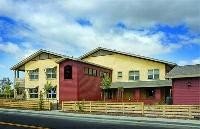
The Laurel Garden Apartments in Fairfield is a collaborative housing project of two Bay Area non-profit agencies. (Courtesy photos)

In an area where the median home price is approaching half a million dollars and apartment rents start in the $800-per-month range, the term "affordable housing" is an oxymoron for many Solano County residents, particularly those with very low incomes and/or disabilities.

A new breed of apartment complex was recently constructed in Fairfield specifically for such residents, offering reasonable rents coupled with various on-site support services.

Located on Alaska Avenue, Laurel Gardens Apartments is a collaborative housing project conceived by Berkeley-based Resources for Community Development, a non-profit organization dedicated to affordable housing, and Caminar/CLC, a non-profit social rehabilitation agency headquartered in San Mateo. The concept was quickly embraced by the city of Fairfield, which helped the organizations locate a suitable property within its North Texas Street Redevelopment Area.

"It's very well designed and very well run," remarked Lark Ferrell, housing project finance manager with the city's community development department. "It's very inviting, and very much a community."

Laurel Garden's 30 units are expressly earmarked for low-income individuals with disabilities and the formerly homeless. Twenty-one units make use of Section 8 assistance, while eight units are subsidized by the Housing and Urban Development Supportive Housing Program. Residents pay one-third of their income toward rent - which equates to monthly payments of $30 to $460 - and benefit from on-site supportive services like case management, counseling, job seeking assistance and health care referrals.


The kitchen area inside one of the Laurel Garden Apartments in Fairfield features modern appliances and new cabinetry. (Courtesy photos)

The purpose behind the project is to provide affordable housing for tenants, enabling them to live independently rather than in group homes and assisted living facilities, or remain homeless, explained James Coles, senior project manager for Resources for Community Development. It caters to individuals with both physical and mental disabilities.

"It's unique to Solano County," Coles said, noting that within a month of its June grand opening, Laurel Gardens was fully leased. "There's just a great need for supportive housing for people with disabilities."

Laurel Gardens apartments are constructed for residents with special needs in mind. There are units with features tailored to hearing- and visually-impaired residents, such as doorbells that activate strobe lights and thermostats with tactile controls.

Most ground floor units are designed to be wheelchair-accessible, with plenty of room for maneuvering, Coles said.

"Some of the kitchen cabinets are removable so you can get a wheelchair underneath the counter," he explained. Additional wheelchair-oriented kitchen features include frontal range controls on stoves and ovens that are located at manageable heights.

The complex also boasts a computer lab, a recreation building for gatherings and events, and a basketball court that converts to a badminton or volleyball court.

Sandy Carson, Caminar's housing director and Laurel Gardens' on-site service coordinator, said the project is a tremendous success.

"The county loves it. The redevelopment (agency) loves it because it helps fill their affordable housing quotas," she said. "We've gotten some people off the streets."

A touching example of one such resident, Carson recounted, is a working mother of three - with another child on the way - who was abruptly left by her husband. Prior to arriving at Laurel Gardens, the woman couldn't afford rent and had been living in her car with her children.

"It's been wonderful to see families come in and start blossoming again," Carson remarked.

Secure, affordable housing and assistance, she said, effectively raise residents' confidence and self-esteem.

"There's people that haven't worked in years that are going out searching for jobs now," Carson noted. "They have worth again."

Developments similar to Laurel Gardens are likely to become more prevalent in Solano County.

"We're looking forward to doing more," Carson said. "We're working with the City of Fairfield to do another project like this, whether it be rehab or new construction," she said.

The two organizations also hope to build a community to aid Vallejo's disabled, low-income residents, she said.

In Vacaville, a supportive housing community geared toward seniors may be on the horizon.

"We are in the early stages of looking for opportunities in Vacaville," Coles confirmed.


Amanda Janis can be reached at business@thereporter.com.
Nut Tree in Bloom

Nut Tree in Bloom
By Elizabeth Wright

VACAVILLE -An old farm and tourist stop is a destination again, especially if you're in the market for a new computer.

New stores are gradually opening near the Nut Tree Family Park, in the shopping center off East Monte Vista Avenue in Vacaville. The development began as a family farm and fruit stand 85 years ago, and grew to become a popular roadside stop, including a restaurant, railroad, toy shop and, for a time, a giant walnut tree.

Now a Best Buy, the electronics retailer, is already open on a redeveloped part of the Nut Tree site, and later this month, several other chain stories will begin filling some of the 325,000 square feet of retail space. Beverages & More, the wine and liquor chain, has plans for a series of opening events beginning at 9 a.m. Aug. 18, and PetSmart, a pet supply store, will open its doors Aug. 28, with a formal opening Sept. 9. A Sport Chalet will open this month as well.

A Borders bookstore is also planned, and in the future, town homes and office space will also be a part of the development.

As for the Nut Tree Family Park itself, the small amusement park across from the shops will include train rides, a small roller coaster, bumper cars and a carrousel. Most rides are completed, and marketing director Ilana Minkoff expects the park will open in mid-to-late September.

"Things are progressing along nicely," she said.

The park is also in the process of hiring for 125 positions in areas such as gardening, maintenance, operating rides and party planning.

For more information, visit the Web site at www.nuttreeusa.com.

Forum scheduled

Forum scheduled

A "Higher Education Breakfast Forum" featuring Congressman George Miller, D-Solano, is being hosted by the Solano Economic Development Corporation, Touro University, California Maritime Academy, Solano Community College, Vallejo Chamber of Commerce and the Vallejo Times-Herald.

Miller will discuss the Democratic Party's "Innovation Agenda," a proposal to educate 100,000 new workers in science, math, engineering and high technology.

Friday, August 11, 2006

Vacaville-Dixon Greenbelt to Expand

Vacaville-Dixon Greenbelt to Expand
By The Reporter, Vacaville
Vallejo Times Herald

The Vacaville-Dixon Greenbelt is growing.
A newly completed project in Solano County will shield permanently 237 acres of farmland from development and expand the greenbelt, officials with the Solano Land Trust announced Tuesday.

Grants from the California Department of Conservation and the USDA Natural Resources Conservation Service made it possible for the land trust to create an agricultural conservation easement on the acreage, which adjoins the greenbelt, north of Interstate 80 near Dixon Avenue.

"We're pleased that this family farm will always remain in agricultural use,' said Mike Chrisman, state secretary for resources. "Protecting valuable agricultural land helps communities plan effectively for local development, keeps wildlife habitat available, and contributes to a strong economy."

The Escano family farmed the acreage until retiring in the early 1990s. The property then was leased to Tom Galindo, a tenant farmer.

The Solano Land Trust purchased the first 152 acres from the Escanos in 2003. It purchased the remaining 85 acres and sold the farm to the Galindo family in July, with an agricultural conservation easement in place.

Developer's Plans Thrill Vallejo Mayor

Developer's Plans Thrill Vallejo Mayor
By Chris G. Denina/Times-Herald, Vallejo
TheReporter.Com

A developer Tuesday unveiled what Vallejo officials called an ambitious pitch to turn part of the city's northeast area into a new commercial center including a hotel, condominiums and offices.
The so-called Crossroads project was one of two plans presented Tuesday to the Vallejo City Council. The council was asked to comment on the projects, which are in the early stages of development and still need future approvals. Both are scheduled for key sites considered major entrances to the city.

"It's a thrilling idea," Mayor Tony Intintoli Jr. told developer Gary Mandarich about his

Crossroads concept for about 128 acres northeast of Interstate 80 and Columbus Parkway.

Mandarich said he wants to create a statement with his newest project, which follows his work in the city's northeast area developing housing including condominiums and an auto mall.

"It is the most visible piece of land in the city," Mandarich said.

In the next few years, Mandarich said he hopes to develop the hotel and conference center, plus offices, high-rise condo buildings and parks.

Another project in the same area, however, may get built sooner. City staff said a Lowe's home improvement store is in the works just east of Crossroads.

The Crossroads plan is still in the early stages, Mandarich said.

Meanwhile, another developer pitched plans to develop 285 townhomes on about 13 acres between Sonoma Boulevard and Broadway, south of Mini Drive.

"We're very excited to be entering the Vallejo market," Project Manager Dan Huertas said.

Before the project can move forward, however, the company would need to seek a zoning change to allow homes. The land is zoned for such uses as stores, automotive projects and even scrap operations.

The city should seek commercial uses for the land, Councilman Gerald Davis said. To the north of Vallejo, American Canyon is seeing plenty of new stores being built along the corridor, he said.

Unlike a residential project, a commercial venture would benefit the cash-strapped city since stores generate sales tax revenues, Davis said.

"In a city that is struggling financially, that has to be a factor," Davis said.

Dixon Smooths Outlook to Finish Repaving Work

Dixon Smooths Outlook to Finish Repaving Work
By Melissa Murphy/Staff Writer
TheReporter.Com

Diligent efforts to speed progress on a repaving project onHighway 113 in Dixon have paid off.
The Dixon City Council approved a plan this week that will allow Ghilotti Brothers Construction to finish the project by October rather than November.

Reconstruction of the road has been in the works by Caltrans for a few years. Currently, crews have been rebuilding a stretch of

Highway 113 through downtown Dixon by digging up small, one or two city-block-long sections of the the old road in order to provide a new roadway, according to City Engineer Royce Cunningham.

During early construction however, contractors discovered several utility conflicts, one of which was a Pacific Gas and Electric gas line that wasn't buried as deep as PG&E thought.

Work had to stop to move the line and bury it deeper, causing the project to be delayed at least a month, Cunningham said.

Under the new plan, the construction crews will be able to work on longer sections all at once, instead of just one- or two-block sections at a time. The move will accelerate the work and city and Caltrans officials say it will be complete by Oct. 6, instead of November, as previously thought.

"Let's hope it gets done as fast as they hope," said Angela Meisenheimer, executive director of the Downtown Dixon Business Association. "We're very appreciative and we owe many thanks to the officials and Supervisor Mike Regan."

After phone calls and letters were sent to county supervisors, Reagan knew something had to be done.

"That road has been beat to mush over the years by the traffic and it's been a significantly emotional process," he said.

Reagan said he made a few phone calls to people he knew and that Caltrans was eager to help.

Highway 113 runs north-south through downtown and the construction project that started in May gradually has had the effect of moving the center of downtown, preventing customers from accessing businesses.

Janet Koster, analyst in the city's engineering department, said the new plan significantly will shorten the schedule.

"People wanted us to speed up the construction," she said. "And this gets us to that goal."

A meeting scheduled for Monday will allow Caltrans, the contractor and the city to sit down and figure out how the businesses along 113 will have continuous access during construction.

Every effort will be made to minimize the impacts and accommodate access to the businesses fronting on the construction, Cunningham said in a staff report.

"The streetscape improvements to the historic downtown Dixon will reap benefits to the community for years to come," Reagan said in a thank you letter to Caltrans.

"And thanks to Caltrans' cooperation, the merchants will not have to risk closure today for tomorrow's dream."

Melissa Murphy can be reached at dixon@thereporter.com.

Group: Fairfield Home Among Top 10 Percent in USA

Group: Fairfield Home Among Top 10 Percent in USA
By Andrea E. Garcia

FAIRFIELD - A Fairfield nursing home is ranked among the top 10 percent by a consumer group.

The Laurel Creek Health Center, an independent nonprofit located in Paradise Valley Estates, achieved that distinction in a report by the Consumer Union published this week in Consumer Reports.

More than 16,000 nursing homes were studied across the United States by Consumer Reports, revealing the best and worst facilities in the country.

"We have a policy of maintaining the highest quality of care within our community, but it really goes back to the staff and their diligence of performing their duties," said Ron Ridley, executive director of Paradise Valley Estates.

The report, based on an analysis of the three most recent state inspection reports along with three key quality indicators, also identified that other factors play a role in quality care.

Their findings show that nonprofit and independently run homes are more likely to provide good care versus for-profits and chains. Laurel Creek Health Center is nonprofit and run independently.

Conversely, the report also concluded there has been very little change since the passage of a federal law two decades ago to clean up the nation's homes. In the Consumer Union's analysis, which began in 2000, poor care persists nationwide mainly in small-town, for-profit homes.

"One of the problems that confines the care or the limits of care is the reimbursement level, particularly by the state with their medical program," Ridley said. "The rate is so low that they can't afford to pay the salaries and have adequate staffing to provide the quality of care we do.

Ridley also said that the health center has competitive rates.

Currently, nursing homes need to have 3.2 nursing aides/nurses per day per resident. According to Ridley, Laurel Creek Health Center has 5 nursing aides/nurses per day per resident for direct patient care, which is close to double the required amount.

Another way Laurel Creek Health Center provides care is to have students from the nursing programs at Solano Community College in Rockville and Touro University in Vallejo visit the facility at least four times a week.

The report listed 45 homes in California on the "consider" list based on their good performance. Meanwhile, 26 facilities were listed statewide as homes to avoid, none in Solano County.

The analysis looked at the number of more serious deficiencies cited such as those given for substandard quality of care; patients in immediate jeopardy; hours of nursing care per patient per day; and incidences of bedsores or urinary tract infections.

For a listing of nursing homes to consider or avoid, visit their Web site at www.ConsumerReports.org/nursinghomes.

Reach Andrea E. Garcia at 427-6953 or agarcia@dailyrepublic.net.

Thursday, August 10, 2006

Lowe's Might Open Vallejo Store

Lowe's Might Open Vallejo Store
By RACHEL RASKIN-ZRIHEN, Times-Herald staff writer
Vallejo Times Herald

Closing Vallejo's Yardbirds store earlier this year made The Home Depot just about the only home improvement game in town. But that may not be true for long.
Discussions are under way with home improvement retail giant Lowe's for a store in north Vallejo, city officials said.

Lowe's is considering building a store next to the Mandarich development slated for the city's north area, said Vallejo's development services director, Brian Dolan.

"Lowe's had expressed interest in Vallejo a couple of years ago, and then we heard nothing," Dolan said. "Then we met with them a week ago and they told us they were pursuing the Ted Lee property."

Vallejo public information officer Mark Mazzaferro said, "Lowe's has told the city they're coming to Vallejo, to locate on Columbus Parkway near the new Auto Mall."

The Home Depot bought out Petaluma-based Yardbirds late last year and closed the Vallejo store among others.

Lowe's representatives plan to submit a building application, soon, Dolan and Mazzaferro said.

A location in the city's northeast quadrant would put a Lowe's only a short distance from Vallejo's Admiral Callaghan Lane Home Depot store. This is fairly typical for Lowe's, a company spokeswoman said.

"From what we've experienced across the county, more than 70 percent of our stores are operating within 10 miles of a competitor, so this would not be uncommon," said Lowe's spokeswoman Karen Cobb. She added that while it is against company policy to talk about specific stores until an actual real estate deal has closed, Lowe's stores are multiplying nationwide.

"We've been in business 60 years and we're in the midst of the largest expansion in the company's history," Cobb said. "We're opening an average of one store every three days."

With this expansion, Lowe's is "evaluating many potential sites" nationwide, she said.

Lowe's opened 140 new stores in 2004, 150 last year, and expects to open 155 this year, Cobb said. Next year, the company anticipates opening 150 to 160 new stores, in addition to its first location in Canada, Cobb said. There are 1,275 Lowe's stores nationwide now, 74 of which are in California, she said.

Solano County's only Lowe's is in Vacaville. There are three in Alameda County and one in Sonoma County, Cobb said. There are no Lowe's stores in Napa or Contra Costa counties, she said.

Lowe's considers community growth, population and home ownership when deciding whether and where to locate stores, Cobb said.

A couple of years ago, Lowe's expressed some interest in American Canyon's Napa Junction project, but opted out, said American Canyon Chamber of Commerce Executive Director Dale Osmond. The center is getting a Wal-Mart instead, he said.

"Lowe's expressed interest at one time, but have backed off," Osmond said. "And that project is the only location in the city that would be available to them. It's not like we sought out Wal-Mart. They were the only ones who wanted the space."

Local Weather Stations Helping Farmers

Local Weather Stations Helping Farmers
By Barry Eberling

FAIRFIELD - Five small, automated Suisun Valley weather stations are providing data to help farmers farm and perhaps even help the region gain recognition as a world-class grape-growing area.

A phone number to the automatic voice system on the stations and the information is available. Farmers can get up-to-date readings on temperatures, dew points, rainfall and other factors that affect their crops.

Or they can go to an Internet site to get daily, hourly and historical information.

About 15 farmers gathered Wednesday morning at the Clayton Road firehouse in Suisun Valley to learn more about the weather stations. Four of the stations are new, giving farmers a much better idea of what's happening in their specific area.

"The purpose for most farmers is irrigation management," said Paul Lum, irrigation specialist for the Solano Irrigation District.

Irrigated crops lose water to evaporation and from release of vapor by the vegetation. Farmers can use the weather data to decide how much water the crops need for replenishment.

Roger King of the Suisun Valley Grape Growers Association thinks the stations will do still more: Provide the data proving that the valley's microclimates are ideal for premium wine grapes. The valley has produced award-winning wines, but is still lacks the cache of nearby Sonoma and Napa counties.

"It's a sales tool," King said.

Suisun Valley cools down enough at night to allow the fruit to retain acids, King said. Yet he's heard people lump the valley with Bakersfield in terms of climate.

Suisun Valley has areas suited for warm-climate grapes and areas suited for cool-climate grapes, all within eight miles, King said. He expects the weather station data to help local grape growers make their case.

The four new stations cost about $5,000 each. The Solano County Agricultural Water Conservation Committee paid for one and the Suisun Valley Fund - a joint venture between the Solano Irrigation District and Fairfield - paid for the others.

Suisun Valley might seem like one location, in need of only one station. But the weather varies in ways that matter to crops.

For example, the north Abernathy Road station in June recorded an average high temperature of 86.5 degrees and an average low of 55.3 degrees. The station in upper Suisun Valley recorded an average high of 91.2 degrees and an average low of 55.5 degrees.

A sixth Suisun Valley weather station is located at Solano Community College and is run by the state.

Weather station data is available at the Web site www.westernwx.com/sid/. Also, Don Schukraft of Western Weather Group talked at the presentation about how farmers can get weather forecasts from his company.

Reach Barry Eberling at 425-4646 Ext. 232 or at beberling@dailyrepublic.net.

Wednesday, August 09, 2006

'Bully' for Jelly Belly!

'Bully' for Jelly Belly!
Fairfield Jelly Bean Maker's Sweet Rocks Line Cashes in on Animated Film
By RACHEL RASKIN-ZRIHEN, Times-Herald staff writer


A PHOTOGRAPHER snaps a picture as children gather near a promotion for the animated movie 'The Ant Bully' at the Jelly Belly Candy Co. factory in Fairfield. The picture is made of jelly beans. Photo: J.L. Sousa/Times-Herald

Four-year-old Brianna Todero of Vallejo has no desire to try jelly beans that taste like lawn clippings or ants, although she may give the caterpillar-flavored ones a try.

Those are among the flavors Jelly Belly Candy Co. of Fairfield developed for its Sweet Rocks line, based on the newly released Warner Bros. Pictures and Legendary Pictures film, "The Ant Bully."

The film won Brianna's unqualified endorsement. "I saw it," she said during a stop at the visitors' center at the Jelly Belly factory. "My mommy took me. It was good!"

It's the first movie marketing tie-in with which Jelly Belly was directly involved, said company spokeswoman Tomi Holt.


The film's main character appears on a Sweet Rocks package. Photo: J.L. Sousa/Times-Herald

The movie, featuring the voices of Tom Hanks and Gary Goetzman ("The Polar Express"), opened July 28. It is a 3D animated feature about a 10-year-old boy who "embarks on a remarkable adventure," in which he joins an ant colony, according to a Jelly Belly statement.

Jelly Belly's new Sweet Rocks contain 20 movie-inspired flavors. They include ant hill, alka root, lawn clippings and caterpillar, Holt said.

David Sansone of Vallejo, 7, a second-grader at St. Basil's Elementary School, said he doesn't plan to try any of them. "It doesn't sound so good," he said.

However, he added, he may see the movie.

On the other hand, 13-year-old Geraldine O'Mara of Vallejo said ant hill and lawn clippings sound


POSTERS promoting 'The Ant Bully' hang above the crowd at the visitors' center at Jelly Belly Candy Co. in Fairfield. J.L. Sousa/Times-Herald

OK, but you're not going to get her to try caterpillar-flavored anything. "It's a bug," the St. Basil's eighth-grader said.

Jelly Belly's ant hill flavor has "an earthy, grainy quality," Holt said, while the lawn clippings variety tastes remarkably like grass.

While this is Jelly Belly's first direct movie tie-in, the firm has been mentioned in several films and developed some flavors for a line of Harry Potter-inspired Bertie Bott's jelly beans for Napa's Cap Candy Co. These include bacon, booger, ear wax, rotten egg, soap and vomit-flavored beans.

Sweet Rocks is not the only project keeping Jelly Belly officials busy lately, Holt said. Several new jelly bean lines and flavors have been developed in the past couple of years, she said.

Among these, the company's Smoothie Blend flavors include strawberry-banana, pineapple-pear and cherry-passion fruit. The smoothie line was rolled out in January and hit stores nationwide in spring, Holt said.

In May, the firm introduced a line of Soda Pop Shoppe jelly beans based on the Cadbury Schweppes Americas Beverages brands of sodas, like 7UP, Orange Crush, Dr. Pepper and A&W Root Beer.

Jelly Belly also recently added two flavors - Fruit Punch and Berry Blue - to its Sports Bean line, which it introduced last year, Holt said.

Scientifically formulated for sports performance, the Sports Beans are an energy product containing carbohydrates, electrolytes for hydration and vitamins to replenish nutrients lost through perspiring, Holt said. They also contain Vitamin C, thiamin, riboflavin, niacin and three B vitamins to promote metabolism of fats and carbs.

Sports Beans are packaged in 100-calorie, single-serving, 1-ounce packets and contain an informational guide with tips on how to use them, Holt said.


--------------------------------------------------------------------------------

Jelly Belly Candy Company

Owners: Gustav Goelitz family; Herman Rowland, chairman

Type: Candy manufacturer, tours and retail

First opened: 1976

Location: One Jelly Belly Lane, Fairfield

Hours: 9 a.m. to 5 p.m. daily, free tours 9 a.m. to 4 p.m. Wheelchair accessible.

Phone/web: (800) 522-3267 or 1-800-9-JELLYBEAN (1-800-953-5592), web: www.JellyBelly.com

New Projects Slated for City

New Projects Slated for City
Council Offers Guidance to North End Developers
By CHRIS G. DENINA, Times-Herald staff writer
Vallejo Times Herald

A developer Tuesday unveiled what Vallejo officials called an ambitious pitch to turn part of the city's northeast area into a new commercial center including a hotel, condominiums and offices.
The so-called Crossroads project was one of two plans presented to the Vallejo City Council on Tuesday night. The council was asked to comment on the projects, which are in the early stages of development and still need future approvals. Both are slated for key sites considered major entrances to the city.

"It's a thrilling idea," Mayor Tony Intintoli Jr. told developer Gary Mandarich about his Crossroads concept for about 128 acres northeast of Interstate 80 and Columbus Parkway in Vallejo.

Mandarich said he wants to create a statement with his newest project, which follows his work in the city's northeast area developing housing, condos and an auto mall.

"It is the most visible piece of land in the city," Mandarich said.

In the next few years, Mandarich said he hopes to develop the hotel and conference center, plus offices, high-rise condo buildings and parks.

Another project, however, may get built sooner. City staff said a Lowe's home improvement store is in the works just east of Crossroads.

The Crossroads plan is still in the early stages, Mandarich said, noting he's still working on the designs.

Meanwhile, another developer pitched its plans to develop 285 townhomes on about 13 acres between Sonoma Boulevard and Broadway south of Mini Drive in Vallejo.

"We're very excited to be entering the Vallejo market," Project Manager Dan Huertas told the council.

Before the project can move forward, however, the company would need to seek a zoning change to allow homes. The land is now zoned for such intensive uses as stores, automotive projects and even scrap operations.

The city should seek commercial uses for the land, Councilmember Gerald Davis said. To the north of Vallejo, American Canyon is seeing plenty of new stores being built along the corridor, he said.

Unlike a residential project, a commercial venture would benefit the cash-strapped city since stores generate sales tax revenues for the city, Davis said.

"In a city that is struggling financially, that has to be a factor," Davis said.

--------------------------------------------------------------------------------

Crossroads at a glance

Mandarich Developments proposes developing a new city center on about 128 acres northeast of Interstate 80 and Columbus Parkway in Vallejo. The concept includes:

- hotel including a parking structure, a conference center of as much as 30,000 square feet and as many as 350 condos averaging about 1,000 square feet on the upper floors

- office buildings with underground parking

- restaurants

- retail and office spaces

- four high-rise condo buildings

- parks that may include a soccer field, baseball diamond or dog park

- 100 acres of open space

*Source: Mandarich Developments

- E-mail Chris G. Denina at cdenina@thnewsnet.com or call 553-6835

Touchdown at Travis

Touchdown at Travis
Solano Base Scores First of its 13 C-17s
By Jason Massad/Staff Writer
TheReporter.Com


Dignitaries from the United States Air Force, local government officials, Air Force personnel and their families sit Tuesday on the flight line at Travis Air Force Base in Fairfield to welcome the first new C-17 Globemaster III to the base. (Joel Rosenbaum/The Reporter)

All eyes at Travis Air Force Base were focused Tuesday on a hulking gray plane as it slipped down through a somewhat hazy sky and touched down with a bit of white smoke swirling around its landing gear.
While it's certainly not unusual for aircraft to take off and land around the clock at Travis, this particular arrival had a very special significance.

After taxiing, Travis' first C-17, a nimble cargo hauler which is gaining quite a reputation for its versatility on the war fronts, rested proudly on the flight line.

A large appreciative crowd of military personnel, federal, state and local officials and Air Force veterans were present to welcome the C-17.

"Did anyone else have a lump in their throat like I did when (it) landed?" said U.S. Rep. Ellen Tauscher, D-Solano, who has helped the local base obtain the new aircraft.

Travis' first C-17 has been christened Spirit of Solano, a nod to the local community that has supported the base over the years. The Travis insignia, emblazoned on the plane's tail fin, seemed to make the base the C-17s home official.

The aircraft was piloted Tuesday from a Boeing production facility in Long Beach to Travis by Maj. Gen. Thomas Kane, a former wing commander at the base.

To show the base's air mobility clout, a flyover was conducted involving all three of the base's "weapons systems," now including the C-17.

A C-5, a massive cargo hauler, whined overhead and a streamlined KC-10 refueler aircraft made an appearance, followed by the "new toy," as one military leader called it.

Kane, piloting the C-17, put the airplane through its paces in the flyover, as he sharply banked the northbound aircraft as the crowd gawked.

"What you see is American spirit and industrial ingenuity," said Col. Robert Millman, acting commander of the 349th Air Mobility Wing, the reserve wing at the base that will share the incoming fleet of C-17s.

Now that the first C-17 has arrived at Travis, the base will begin accepting one of the $237 million aircraft every month, until the full squadron of 13 planes graces the base's flight line.

In the meantime, the Spirit of Solano will spend most of its time in the sky. The plane is scheduled for an overseas mission this week, according to base officials.

The C-17s, after they all have arrived, essentially will replace a squadron of C-5 haulers that have been stationed elsewhere.

With the C-17, the base has three distinct missions. The C-17 is used to send troops and equipment, such as the M1 Abrams tank, directly to the front lines in places like Kandahar, Afghanistan.

The C-5 performs "strategic airlift" and moves supplies and troops to major hubs around the world. The KC-10, meanwhile, is versatile in that it refuels fighters and cargo planes alike.

Rick Tubbs, an activated reservist with the 349th, summed up the feelings, no doubt, of many of the military personnel who gathered for the ceremony. The C-17 had instantly become his new favorite, he said.

"The plane you're flying is always your favorite plane," Tubbs said.

Jason Massad can be reached atcounty@thereporter.com.


Air Force Col. Steve Arquiette (left), commander of the 60th Air Mobilty Wing at Travis, and Air Force Reserve Col. Robert Millmann, acting commander of the 349th Air Mobility Wing, high-five each other after unveiling the Spirit of Solano, a C-17 Globemaster. It's the first of 13 new high-tech military aircraft to be assigned to the base.

C-17 Casts First Big Shadow at Travis

C-17 Casts First Big Shadow at Travis
Globemaster Makes Debut at Base Amid Much Hoopla
By Ian Thompson


TRAVIS AIR FORCE BASE - More than two years of waiting ended Tuesday when the newest addition to Travis Air Force Base's aircraft arsenal arrived amid much celebration.

"All the efforts have been worth it," said C-17 Globemaster pilot Maj. Rick Tubbs of all the training, construction and organization at Travis in preparation for its newest aircraft.

Travis' first C-17 Globemaster III landed flawlessly, accompanied by the cheers and applause of a host of Air Force servicemembers and local community leaders.

"What a magnificent day! Travis is again making its mark," said Maj. Gen. Thomas Kane, who flew the C-17 past the crowds, landed it and taxied in with flags flying from above the cockpit.

The Spirit of Solano is the first of 13 C-17s slated to arrive at Travis over the next year. Travis' active-duty and Air Force Reserve C-17 flying squadrons, formed earlier, have been flying other bases' C-17s.

"Twelve more will be arriving at Travis between now and next June," Boeing Vice President Dave Bowman said.

It is the second Spirit of Solano to call the base home. The first was a B-52 Stratofortress bomber, the first of its kind at Travis in the late 1950s.

The C-17 was added to the Air Force transport fleet in 1993 and has logged more than a million flight hours carrying military cargo, transporting wounded and flying humanitarian relief missions all over the world.

Acting 349th Air Mobility Wing commander Col. Robert Millman described the C-17 as "America's spirit and industry at its best."

This arrival gives Travis a third type of aircraft in addition to the C-5 Galaxy transport and the KC-10 Extender air tanker.

"This will make Travis an all-inclusive air mobility location," 60th AMW commander Col. Steve Arquiette said, adding that Travis is now the only Air Force base with three major types of aircraft stationed there.

"It is a major countrywide accomplishment that is long in the coming," Fairfield Mayor Harry Price said. "The concerted efforts by the cities, the county and the Travis Consortium resulted in a great victory for Solano County today."

Price said local leaders have to continue to work to continue to increase the number of missions at Travis - for example, to convince Washington, D.C., to move the Coast Guard C-130 detachment to Travis from what was once McClellan Air Force Base in Sacramento.

"A lot has been done, but a lot more needs to be done," Price said.

The C-17s' arrival will make up for the shrinkage of Travis' C-5 fleet. Half of the three dozen C-5s on the base were transferred elsewhere and two of the C-5 squadrons reorganized as C-17 squadrons.

The base spent the last two years getting ready for the C-17s, undertaking 18 military construction projects worth more than $180 million to put up buildings and put in infrastructure that will support the aircraft.

Travis also formed the 860th and 945th Aircraft Maintenance Squadrons to keep the aircraft flying.

Local leaders lobbied long and hard to bring the C-17s to Travis, using that move as part of their arsenal to keep Travis out of the recent round of base closures.

Their efforts to further expand the Air Force's C-17 fleet beyond 180 aircraft proved less successful, despite support from Congress to add another 42. Boeing recently told the Air Force it will begin shutting its C-17 production line down and tell its suppliers to stop sending parts.

The C-17s destined for Travis are among the last Globemasters Boeing will make, not counting C-17 orders for Canada, Great Britain and Australia.

Ellen Tauscher (D-Walnut Creek) and other Congressmembers have been fighting to keep the Boeing production line open and recently got $300 million to build three C-17s. She continues to push past Pentagon opposition to expand the fleet to see if Boeing can build more C-17s for NATO allies.

"We know we need more C-17s. The C-17 is undeniably the best airlift platform," Tauscher said of the heavy workload being put on Air Force transports. "It is also more affordable to keep the production line open than to shut it down and then have to start it up again."

The Spirit of Solano is not being allowed to rest on its laurels.

Sometime today, the C-17 is taking off for Europe and then somewhere in Southwest Asia to support American operations in Iraq.

Reach Ian Thompson at 427-6976 or at ithompson@dailyrepublic.net.

To see an audio slideshow of Tuesday's events at Travis, visit www.dailyrepublic.com.

C-17 GloBEmaster

Arrival at Travis Air Force Base: Tuesday

Total scheduled for Travis: 13

Total in Air Force: 180

First Air Force C-17s: Began flying in 1993

Price tag of improvements at Travis to prepare: $180 million (approximately)

Solano's Got It!

Solano's Got It!
The Best That Northern California Has To Offer.