July 23, 2006
SCC starts unique careers program
By Susan Winlow
FAIRFIELD - This fall a unique statewide program called the California Insurance Careers Program will be offered in full at Solano Community College which brings the community college system and the local workforce together.
Offered as a two-year associate degree, the program is unique in that SCC will be the only community college this fall to offer the full curriculum needed - six insurance classes included in the approximately 31 credits plus general education classes - to graduate with a two-year degree in the Insurance Careers Program.
Put together because of an industry-wide demand for qualified entry-level workers, the program is partially funded by a grant from the Department of Labor. SCC is in the forefront in administrating and overseeing the grant for all the California community colleges.
"We're the lead school in developing the insurance careers associates degree program," said John Urrutia, the dean of business and computer science at SCC. "We see a need and we feel that we can have a significant impact in our local insurance community."
The idea of the program at SCC is to provide a model that can be used by any other college in the state, Urrutia said.
"Any community college can grab the curriculum and not have to go through the hoops like we had to do," he said.
The idea for the program came about two years ago.
"We surveyed insurance trade organizations to better understand what are the issues and dilemnas in recruiting entry level workers and what type of skills they wouldn't need," said Jeff Stephens, outreach manager for the California Insurance Careers Program.
The result is a series of six classes, such as classes in property and liability insurance and personal insurance, designed to prepare students for behind-the scenes employment opportunities in the insurance industry. Within the six classes will be a paid internship.
Urrutia said this is not designed to teach students how to sell insurance but rather teach them about back-office functions that the insurance industry has problems finding qualified people to fill.
Tuesday, July 25, 2006
Trilogy's impact on Rio Vist
July 24, 2006
Jury still out on Trilogy's impact
By Mike Corpos
Mitch and Sandy Reed of Hesperia look at a map of the area while eating lunch at BettyÕs Slider Cafe in downtown Rio Vista. (Zachary Kaufman/Daily Republic)
FAIRFIELD - Several years after the Trilogy retirement housing development opened in Rio Vista, the community's effect on the rest of the town is still being determined.
Depending on whom you ask, the growth has helped, hurt, or not affected the downtown area.
Some businesses have seen a real boost since folks began moving into Trilogy in the late 1990s, while others have seen little - if any - effect.
Betty Marlowe, owner of Betty's Slider Cafe on Main Street said the Trilogy residents have been a huge boon to this rural town of less than 8,000.
"It definitely brings us more business - and they're very pleasant people," said Marlowe, who's been in business for seven years. "We have a lot of regular business form there. It's been a boost for me."
Marlowe said she's thankful for the Trilogy residents, and added that she feels, "We're going in the right direction."
"Before Trilogy opened, you knew exactly where you were," Marlowe said of the town's rural setting. "There's not much that brings people up here - the bass derby and that whale that came up the river."
"It brings new life to the community," Marlowe said. "It's refreshing to meet new people."
She added that since Trilogy opened, she's seen more businesses open downtown.
More Local News;
Jury still out on Trilogy's impact
By Mike Corpos
Solano County Fair manager says attendance shoots up 20 percent
By Audrey Wong
Challenging the master at laser tag
By Stephanie Jucar
Supes set to decide on orderly growth
By Mike Corpos
"There's especially a lot more real estate offices - one just opened up across the street," she said. "I think it's boosted a lot of people's businesses."
James Witt, owner of Rio Vista Auto Repair, said he wasn't entirely sure that trilogy has helped the downtown area much.
"It's helped my business," he said. "I've had more people to draw from."
Witt said that while his business has increased, the limited choice of auto shops in town ensures that he'll be busy. He added that he's not sure how much other businesses are benefiting from Trilogy or other new developments in town
"I don't think it's increased things much," he said. "They're good people to work for, though - that's for sure."
Witt added that his wife and mother both own businesses in the Downtown area, and neither has seen much increase in business in recent years.
Witt said he real concern was not so much new housing developments, but rather the potential for new retail along Highway 12.
"My only concerns is that they keep building out there," he said. "The downtown is going to get neglected - especially if they start putting strip malls up out there."
Even with the influx of new residents, Witt said he's concerned that the growth will hurt older parts of town.
"It happened to Fairfield and Suisun," he said.
In his 15 years living in Rio Vista, Witt said he's seen a lot of change. In that time, he's seen the population of Rio Vista double.
"You used to be able to walk across Highway 12 - now you have to run," he said.
A new housing development under construction in the Gibbs Ranch are on the north side of town will only speed up the change, he added.
"That's going to have a big impact," Witt said. "Two other shops have opened up in town, and it hasn't slowed down."
Others think Trilogy has had a decidedly negative impact on the riverside community.
Steven Bissell, a longtime downtown businessman, said the retirement community could contribute more to the rest of the town.
"There's been a major negative impact," Bissell said, noting that a recent golf tournament at Trilogy did not include anybody from other parts of Rio Vista. "It separates the community. They're good people out there though."
If the downtown area is to be preserved, Bissell said the city needs to take a more active role in preserving it.
"If they don't start promoting the businesses they won't stay," Witt said.
Bissell agreed with Witt on the possibility of new retail on Highway 12: "A big store out there would be a major drain on downtown."
Trilogy resident and Rio Vista Vice-Mayor Ron Jones said he feels that the gated community has had an overall positive impact on the town as a whole.
Jones, who's lived in Rio Vista for eight years, said he feels the fact that trilogy is a few miles from downtown, and it's a gated community can give people the impression of two separate communities.
Through his work on the city council, Jones said he's tried to make it clear to residents that Rio Vista is one community.
"We're all from Rio Vista, some of us just happen to live in a development called Trilogy," he said.
As for how downtown has been impacted, Jones said it's been largely a positive impact.
"A lot of businesses in town have increased their patronage as a result of the population increase," he said. "We have more dentists, more real estate offices and agents."
Jones said he didn't think any business has not seen an increase.
"I really think the town has also benefited through volunteerism," he said, adding that because all of Trilogy's residents are older than 55 and most are retired, they have a lot of time to give.
Along with Jan Vick, Jones is one of two city council members from Trilogy.
Others still are neutral on whether Trilogy has changed life in downtown.
Sara Whitton said she's lived in Rio Vista for about four years - not far from the municipal boat launch in downtown.
"I've worked at a bar down here for about eight months," she said. "It mostly just the same old regulars. There also a lot of people from out of town."
Reach Mike Corpos at 427-6977 or mcorpos@dailyrepublic.net.
Jury still out on Trilogy's impact
By Mike Corpos
Mitch and Sandy Reed of Hesperia look at a map of the area while eating lunch at BettyÕs Slider Cafe in downtown Rio Vista. (Zachary Kaufman/Daily Republic)
FAIRFIELD - Several years after the Trilogy retirement housing development opened in Rio Vista, the community's effect on the rest of the town is still being determined.
Depending on whom you ask, the growth has helped, hurt, or not affected the downtown area.
Some businesses have seen a real boost since folks began moving into Trilogy in the late 1990s, while others have seen little - if any - effect.
Betty Marlowe, owner of Betty's Slider Cafe on Main Street said the Trilogy residents have been a huge boon to this rural town of less than 8,000.
"It definitely brings us more business - and they're very pleasant people," said Marlowe, who's been in business for seven years. "We have a lot of regular business form there. It's been a boost for me."
Marlowe said she's thankful for the Trilogy residents, and added that she feels, "We're going in the right direction."
"Before Trilogy opened, you knew exactly where you were," Marlowe said of the town's rural setting. "There's not much that brings people up here - the bass derby and that whale that came up the river."
"It brings new life to the community," Marlowe said. "It's refreshing to meet new people."
She added that since Trilogy opened, she's seen more businesses open downtown.
More Local News;
Jury still out on Trilogy's impact
By Mike Corpos
Solano County Fair manager says attendance shoots up 20 percent
By Audrey Wong
Challenging the master at laser tag
By Stephanie Jucar
Supes set to decide on orderly growth
By Mike Corpos
"There's especially a lot more real estate offices - one just opened up across the street," she said. "I think it's boosted a lot of people's businesses."
James Witt, owner of Rio Vista Auto Repair, said he wasn't entirely sure that trilogy has helped the downtown area much.
"It's helped my business," he said. "I've had more people to draw from."
Witt said that while his business has increased, the limited choice of auto shops in town ensures that he'll be busy. He added that he's not sure how much other businesses are benefiting from Trilogy or other new developments in town
"I don't think it's increased things much," he said. "They're good people to work for, though - that's for sure."
Witt added that his wife and mother both own businesses in the Downtown area, and neither has seen much increase in business in recent years.
Witt said he real concern was not so much new housing developments, but rather the potential for new retail along Highway 12.
"My only concerns is that they keep building out there," he said. "The downtown is going to get neglected - especially if they start putting strip malls up out there."
Even with the influx of new residents, Witt said he's concerned that the growth will hurt older parts of town.
"It happened to Fairfield and Suisun," he said.
In his 15 years living in Rio Vista, Witt said he's seen a lot of change. In that time, he's seen the population of Rio Vista double.
"You used to be able to walk across Highway 12 - now you have to run," he said.
A new housing development under construction in the Gibbs Ranch are on the north side of town will only speed up the change, he added.
"That's going to have a big impact," Witt said. "Two other shops have opened up in town, and it hasn't slowed down."
Others think Trilogy has had a decidedly negative impact on the riverside community.
Steven Bissell, a longtime downtown businessman, said the retirement community could contribute more to the rest of the town.
"There's been a major negative impact," Bissell said, noting that a recent golf tournament at Trilogy did not include anybody from other parts of Rio Vista. "It separates the community. They're good people out there though."
If the downtown area is to be preserved, Bissell said the city needs to take a more active role in preserving it.
"If they don't start promoting the businesses they won't stay," Witt said.
Bissell agreed with Witt on the possibility of new retail on Highway 12: "A big store out there would be a major drain on downtown."
Trilogy resident and Rio Vista Vice-Mayor Ron Jones said he feels that the gated community has had an overall positive impact on the town as a whole.
Jones, who's lived in Rio Vista for eight years, said he feels the fact that trilogy is a few miles from downtown, and it's a gated community can give people the impression of two separate communities.
Through his work on the city council, Jones said he's tried to make it clear to residents that Rio Vista is one community.
"We're all from Rio Vista, some of us just happen to live in a development called Trilogy," he said.
As for how downtown has been impacted, Jones said it's been largely a positive impact.
"A lot of businesses in town have increased their patronage as a result of the population increase," he said. "We have more dentists, more real estate offices and agents."
Jones said he didn't think any business has not seen an increase.
"I really think the town has also benefited through volunteerism," he said, adding that because all of Trilogy's residents are older than 55 and most are retired, they have a lot of time to give.
Along with Jan Vick, Jones is one of two city council members from Trilogy.
Others still are neutral on whether Trilogy has changed life in downtown.
Sara Whitton said she's lived in Rio Vista for about four years - not far from the municipal boat launch in downtown.
"I've worked at a bar down here for about eight months," she said. "It mostly just the same old regulars. There also a lot of people from out of town."
Reach Mike Corpos at 427-6977 or mcorpos@dailyrepublic.net.

State's $3.4 billion solar power bill slated for August vote
State's $3.4 billion solar power bill slated for August vote
East Bay Business Times - July 21, 2006
by Mavis Scanlon
California's solar power industry is one step closer to a $3.4 billion windfall, with only one vote to go.
In January, the California Public Utilities Commission created the California Solar Initiative. The 10-year, $3.4 billion program, the largest solar program in the country, was designed to make solar power a mainstream option for Californians.
A bill codifying the program and making statutory changes to expand the scope of the initiative, is wending its way through the Legislature, and will next go to the Senate energy committee in early August for a vote on amendments made by the Assembly in June. In the latest version of the bill, SB 1, amendments important to the solar industry relating to solar thermal have been reinstated.
The most recent amendments allocate up to $100.8 million in incentives for solar thermal and solar water heating devices, which save fossil fuel, reduce utility costs and produce clean energy.
In previous iterations of the bill, introduced by Sen. Kevin Murray, D-Los Angeles, provisions for solar thermal were taken out.
"It's a major positive development" for the solar industry, said Les Nelson, executive director of the California Solar Energy Industries Association.
Solar thermal heating systems generally are less expensive than solar electric systems. That means a home or business owner who doesn't have $10,000 or more to spend on solar electric can make a smaller investment - $2,000 to $4,000 - and still realize the benefits.
"It greatly widens the market base," said Gary Gerber, president of solar installation company Sun Light & Power Co. in Berkeley."
mscanlon@bizjournals.com | 925-598-1405
East Bay Business Times - July 21, 2006
by Mavis Scanlon
California's solar power industry is one step closer to a $3.4 billion windfall, with only one vote to go.
In January, the California Public Utilities Commission created the California Solar Initiative. The 10-year, $3.4 billion program, the largest solar program in the country, was designed to make solar power a mainstream option for Californians.
A bill codifying the program and making statutory changes to expand the scope of the initiative, is wending its way through the Legislature, and will next go to the Senate energy committee in early August for a vote on amendments made by the Assembly in June. In the latest version of the bill, SB 1, amendments important to the solar industry relating to solar thermal have been reinstated.
The most recent amendments allocate up to $100.8 million in incentives for solar thermal and solar water heating devices, which save fossil fuel, reduce utility costs and produce clean energy.
In previous iterations of the bill, introduced by Sen. Kevin Murray, D-Los Angeles, provisions for solar thermal were taken out.
"It's a major positive development" for the solar industry, said Les Nelson, executive director of the California Solar Energy Industries Association.
Solar thermal heating systems generally are less expensive than solar electric systems. That means a home or business owner who doesn't have $10,000 or more to spend on solar electric can make a smaller investment - $2,000 to $4,000 - and still realize the benefits.
"It greatly widens the market base," said Gary Gerber, president of solar installation company Sun Light & Power Co. in Berkeley."
mscanlon@bizjournals.com | 925-598-1405
Major profit for Dixon-based First Northern Community Bancorp
Article Launched: 07/25/2006 07:38:46 AM PDT
Major profit for local bank
Dixon-based First Northern Community Bancorp, holding company for First Northern Bank, announced a 16.9 percent jump in earnings compared to the same period last year.
Year-to-date net income as of June 30 was reported at $4.70 million, up 16.9% over the $4.02 million earned in the same fiscal period last year. Net income for the second quarter, however, was $2.29 million, down 1.3% from the $2.32 million earned in the same period in 2005. (Second quarter 2005 net income was increased through a $265,000, net of tax, recovery of provision for loan losses from a prior period.) The company also announced the opening of its sixth real estate loan office in Folsom.
Major profit for local bank
Dixon-based First Northern Community Bancorp, holding company for First Northern Bank, announced a 16.9 percent jump in earnings compared to the same period last year.
Year-to-date net income as of June 30 was reported at $4.70 million, up 16.9% over the $4.02 million earned in the same fiscal period last year. Net income for the second quarter, however, was $2.29 million, down 1.3% from the $2.32 million earned in the same period in 2005. (Second quarter 2005 net income was increased through a $265,000, net of tax, recovery of provision for loan losses from a prior period.) The company also announced the opening of its sixth real estate loan office in Folsom.
Open for Business
Open for Business
Green Valley Centerpiece Debuts
By Amanda Janis/Business Editor
TheReporter.Com
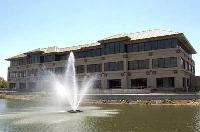
The exterior of the new luxury offices in Green Valley built by developers Wiseman Co. is shown. In addition to offices, the building will feature Sticky Rice, a Chinese restaurant that overlooks the pond. (Ryan Chalk/The Reporter)
More than 12 months and $12 million later, Green Valley Executive Center is open for business. The 50,000-square-foot luxury office building - the ground floor will be anchored by an upscale Chinese bistro overlooking a large pond - is the brainchild of Fairfield-based developer The Wiseman Company, in conjunction with the city of Fairfield.
"It's really intended to be a signature building at the entrance of the office park, and it fits in nicely with the (adjacent) library," said Curt Johnston, Fairfield's assistant community development director.
Johnston explained that the city - its redevelopment agency owns Green Valley Corporate Park - had long-envisioned a restaurant at the corner of Business Center Drive and Green Valley Road. When The Wiseman Co. proposed an upscale office building which would also house a restaurant, it was determined that the site wouldn't allow for enough parking.
To make the deal work, Johnston said, the original 1.4-acre parcel was expanded by approximately an acre, and the site's retention pond was shrunk and reconstructed.
"The city spent about $800,000 taking all the old liner out of the pond, putting in the fountain, a recirculating system, and the pathway," said Doyle Wiseman, president of The Wiseman Co. The city is also in the process of landscaping the pathway that circles the pond and which will be dotted by benches.
"They wanted it to be an amenity for the community," he said. "The pond becomes the amenity for the restaurant, as well."
Scheduled to open in August, Sticky Rice Chinese Bistro and Bar's dining rooms and terrace will afford guests an outstanding view of the pond that is populated by turtles and frogs.
"This was actually the first and only place we looked," said Molly Tou, who is opening the restaurant along with her restaurateur uncle, James Jang. "We like the location so much, especially with the outdoor dining overlooking the pond. It's perfect for us."
The bistro - which will incorporate a 22-foot long bar and lounge area, as well as a private banquet room - will be decidedly upscale and contemporary, with modern decor, she said.
"With this great location, we really saw the opportunity to set a restaurant in here that will set us apart from all the other Chinese restaurants in Solano County," Tou said. "It's going to be a totally different atmosphere, and a totally different dining experience."
Though Tou was hesitant to call it fusion cuisine because it will stay true to Chinese flavors, she said the menu will incorporate a variety of dishes, with a focus on organic meats and vegetables. "It's a more healthy approach," she said.
In addition to Sticky Rice, Green Valley Executive Center's three floors will be populated by about 15 businesses, including The Wiseman Co., Express Personal Services and Waterview Dental Care.
About half of the building has been leased thus far, Wiseman said. And he expects to lease the remainder of the space during the next year.
"The big thing about this building is the location," he said. "This Green Valley area is one-of-a-kind, unique."
That, combined with its proximity to the intersection of Interstate 80 and I-680, he said, make it an ideal location for businesses.
Amanda Janis can be reached at business@thereporter.com.
Green Valley Centerpiece Debuts
By Amanda Janis/Business Editor
TheReporter.Com

The exterior of the new luxury offices in Green Valley built by developers Wiseman Co. is shown. In addition to offices, the building will feature Sticky Rice, a Chinese restaurant that overlooks the pond. (Ryan Chalk/The Reporter)
More than 12 months and $12 million later, Green Valley Executive Center is open for business. The 50,000-square-foot luxury office building - the ground floor will be anchored by an upscale Chinese bistro overlooking a large pond - is the brainchild of Fairfield-based developer The Wiseman Company, in conjunction with the city of Fairfield.
"It's really intended to be a signature building at the entrance of the office park, and it fits in nicely with the (adjacent) library," said Curt Johnston, Fairfield's assistant community development director.
Johnston explained that the city - its redevelopment agency owns Green Valley Corporate Park - had long-envisioned a restaurant at the corner of Business Center Drive and Green Valley Road. When The Wiseman Co. proposed an upscale office building which would also house a restaurant, it was determined that the site wouldn't allow for enough parking.
To make the deal work, Johnston said, the original 1.4-acre parcel was expanded by approximately an acre, and the site's retention pond was shrunk and reconstructed.
"The city spent about $800,000 taking all the old liner out of the pond, putting in the fountain, a recirculating system, and the pathway," said Doyle Wiseman, president of The Wiseman Co. The city is also in the process of landscaping the pathway that circles the pond and which will be dotted by benches.
"They wanted it to be an amenity for the community," he said. "The pond becomes the amenity for the restaurant, as well."
Scheduled to open in August, Sticky Rice Chinese Bistro and Bar's dining rooms and terrace will afford guests an outstanding view of the pond that is populated by turtles and frogs.
"This was actually the first and only place we looked," said Molly Tou, who is opening the restaurant along with her restaurateur uncle, James Jang. "We like the location so much, especially with the outdoor dining overlooking the pond. It's perfect for us."
The bistro - which will incorporate a 22-foot long bar and lounge area, as well as a private banquet room - will be decidedly upscale and contemporary, with modern decor, she said.
"With this great location, we really saw the opportunity to set a restaurant in here that will set us apart from all the other Chinese restaurants in Solano County," Tou said. "It's going to be a totally different atmosphere, and a totally different dining experience."
Though Tou was hesitant to call it fusion cuisine because it will stay true to Chinese flavors, she said the menu will incorporate a variety of dishes, with a focus on organic meats and vegetables. "It's a more healthy approach," she said.
In addition to Sticky Rice, Green Valley Executive Center's three floors will be populated by about 15 businesses, including The Wiseman Co., Express Personal Services and Waterview Dental Care.
About half of the building has been leased thus far, Wiseman said. And he expects to lease the remainder of the space during the next year.
"The big thing about this building is the location," he said. "This Green Valley area is one-of-a-kind, unique."
That, combined with its proximity to the intersection of Interstate 80 and I-680, he said, make it an ideal location for businesses.
Amanda Janis can be reached at business@thereporter.com.
Solano County Sees Boost in Construction Jobs in June
Solano County Sees Boost in Construction Jobs in June
By Ian Thompson
FAIRFIELD - The number of people without jobs in Solano County in June was higher than in May, but lower than June 2005 due to rises in construction, business, hospitality and health services jobs.
The 500 construction jobs added from May to June is probably an understatement, according to Business Manager Lou Franchimon of the Napa-Solano Building Trades Council.
"We have got some major projects going on, Genentech being one of them with 1,200 to 1,400 people working there," Franchimon said.
The rise was offset by job losses in the areas of government, according to figures released by the state Employment Development Department.
That area's decrease is a normal drop because that is the time when schools and community colleges traditionally end the school year and some school employees are temporarily without jobs.
Solano County's unemployment rate rose to 5.1 percent in June. In May, the unemployment rate stood at 4.6 percent. It was still below the 5.6 percent unemployment rate of last June.
In the construction area, Solano County is profiting from a host of job-creating projects ranging from work on the Benicia Bridge to building a new high school in Dixon.
"It is just very, very busy," Franchimon said. "Solano County is a growing community with a lot of projects. It is very encouraging and the future looks very good."
Fairfield had the highest unemployment rate of the county's major cities with 5.6 percent of its residents out of work while Benicia had the lowest with only 3.1 percent of its residents out of work.
Reach Ian Thompson at 427-6976 or at ithompson@dailyrepublic.net.
By Ian Thompson
FAIRFIELD - The number of people without jobs in Solano County in June was higher than in May, but lower than June 2005 due to rises in construction, business, hospitality and health services jobs.
The 500 construction jobs added from May to June is probably an understatement, according to Business Manager Lou Franchimon of the Napa-Solano Building Trades Council.
"We have got some major projects going on, Genentech being one of them with 1,200 to 1,400 people working there," Franchimon said.
The rise was offset by job losses in the areas of government, according to figures released by the state Employment Development Department.
That area's decrease is a normal drop because that is the time when schools and community colleges traditionally end the school year and some school employees are temporarily without jobs.
Solano County's unemployment rate rose to 5.1 percent in June. In May, the unemployment rate stood at 4.6 percent. It was still below the 5.6 percent unemployment rate of last June.
In the construction area, Solano County is profiting from a host of job-creating projects ranging from work on the Benicia Bridge to building a new high school in Dixon.
"It is just very, very busy," Franchimon said. "Solano County is a growing community with a lot of projects. It is very encouraging and the future looks very good."
Fairfield had the highest unemployment rate of the county's major cities with 5.6 percent of its residents out of work while Benicia had the lowest with only 3.1 percent of its residents out of work.
Reach Ian Thompson at 427-6976 or at ithompson@dailyrepublic.net.
Solano County Gets Award of Excellence for Annual Report
Solano County Gets Award of Excellence for Annual Report
By Daily Republic staff
FAIRFIELD - Solano County continues to rake in the awards - this time for its newly formed public information department.
The National Association of County Information Officers has recognized Solano County with two awards for public information in its 2006 Awards of Excellence Competition.
The county's 2005 Annual Report received an "Award of Excellence" in the annual reports magazine format, while a county press release on tourism received a "Meritorious Award" for news release writing.
"It is important for the public to be aware of the activities of its government," said County Administrator Michael Johnson, in a written statement. "The efforts of our staff to inform, and the quality of information they provide to the public, is exemplified by these awards."
The Solano County 2005 Annual Report was a 24-page document that highlighted the achievements of county government in 2005. Material for the magazine was provided from all county departments.
The national competition is conducted annually by the association. This year there were more than 500 entries in 34 categories.
The awards will be presented during the annual National Association of Counties conference on Aug. 4 in Chicago.
By Daily Republic staff
FAIRFIELD - Solano County continues to rake in the awards - this time for its newly formed public information department.
The National Association of County Information Officers has recognized Solano County with two awards for public information in its 2006 Awards of Excellence Competition.
The county's 2005 Annual Report received an "Award of Excellence" in the annual reports magazine format, while a county press release on tourism received a "Meritorious Award" for news release writing.
"It is important for the public to be aware of the activities of its government," said County Administrator Michael Johnson, in a written statement. "The efforts of our staff to inform, and the quality of information they provide to the public, is exemplified by these awards."
The Solano County 2005 Annual Report was a 24-page document that highlighted the achievements of county government in 2005. Material for the magazine was provided from all county departments.
The national competition is conducted annually by the association. This year there were more than 500 entries in 34 categories.
The awards will be presented during the annual National Association of Counties conference on Aug. 4 in Chicago.
Monday, July 24, 2006
Together for tourism - Solano set to unveil '80 on 80' campaign
Article Launched: 7/17/2006 06:24 AM
Together for tourism
Solano set to unveil '80 on 80' campaign
TheReporter.Com
While cities within Solano County can engage in healthy competition at times, there are more times when it is best to collaborate and cooperate for the greater good. And that includes tourism, a potential economic boon to local communities.
There are indications that we "get it" now, that if we work together to maximize precious financial resources we can do a better job of creating jobs related to tourism, of increasing sales tax dollars from those who live outside our region.
Solano Economic Development Corp. hosted a panel discussion last week that focused on how tourism can become one of the pistons driving our economic engine locally. And the message and call for action was simple: Let's do it, and let's do it as a team.
To that end, we endorse the soon-to-be launched marketing effort comprising communities up and down Interstate 80, from the Carquinez Strait to the Yolo Causeway. Dubbed "80 on 80," the billboard and Internet campaign will draw attention to myriad festivals and events - at least 80, and probably more - that occur along the asphalt ribbon that dissects Solano County and leads to two great population centers: Sacramento and San Francisco.
By Labor Day, there should be a cooperative effort under way to garner some of the $88 billion annually infused into the California economy by tourism, adding to the 912,000 jobs related to tourism that exist today in the Golden State. In fact, "80 on 80" could be - and should be - the beginning of partnerships that lure visitors to our cities.
The three steps to success were clearly defined and need to be embraced by county and the civic leaders on the seven city councils and the county's Board of Supervisors.
First, we need to identify our target audience, those most likely to visit our communities via the interstate system.
Second, an economic study is necessary to show the potential of a comprehensive tourism marketing effort, including what return on our investment would be. (The state of California says it gets back $19 for $1 it spends on marketing the Golden State.)
And finally, there needs to be an exhaustive "destination audit," to clearly and candidly identify our weaknesses and how to overcome them, and our strengths and how to capitalize on them.
With an integrated approach, Solano County can become better at pulling people off Interstate 80 and getting their dollars spent here, rather than somewhere down the highway. We are growing our cultural venues, such as museums and festivals. We are adding new commercial attractions such as the Nut Tree Family Park to the well-known institutions like Jelly Belly and Six Flags.
It will work if we work together.
Reader Comments
Use the comment link to share your thoughts on our editorial. We ask that readers refrain from profanity, name-calling and derogatory statements. The Reporter is not responsible for reader comments. We ask that readers help us police the site by reporting any inappropriate content.
Together for tourism
Solano set to unveil '80 on 80' campaign
TheReporter.Com
While cities within Solano County can engage in healthy competition at times, there are more times when it is best to collaborate and cooperate for the greater good. And that includes tourism, a potential economic boon to local communities.
There are indications that we "get it" now, that if we work together to maximize precious financial resources we can do a better job of creating jobs related to tourism, of increasing sales tax dollars from those who live outside our region.
Solano Economic Development Corp. hosted a panel discussion last week that focused on how tourism can become one of the pistons driving our economic engine locally. And the message and call for action was simple: Let's do it, and let's do it as a team.
To that end, we endorse the soon-to-be launched marketing effort comprising communities up and down Interstate 80, from the Carquinez Strait to the Yolo Causeway. Dubbed "80 on 80," the billboard and Internet campaign will draw attention to myriad festivals and events - at least 80, and probably more - that occur along the asphalt ribbon that dissects Solano County and leads to two great population centers: Sacramento and San Francisco.
By Labor Day, there should be a cooperative effort under way to garner some of the $88 billion annually infused into the California economy by tourism, adding to the 912,000 jobs related to tourism that exist today in the Golden State. In fact, "80 on 80" could be - and should be - the beginning of partnerships that lure visitors to our cities.
The three steps to success were clearly defined and need to be embraced by county and the civic leaders on the seven city councils and the county's Board of Supervisors.
First, we need to identify our target audience, those most likely to visit our communities via the interstate system.
Second, an economic study is necessary to show the potential of a comprehensive tourism marketing effort, including what return on our investment would be. (The state of California says it gets back $19 for $1 it spends on marketing the Golden State.)
And finally, there needs to be an exhaustive "destination audit," to clearly and candidly identify our weaknesses and how to overcome them, and our strengths and how to capitalize on them.
With an integrated approach, Solano County can become better at pulling people off Interstate 80 and getting their dollars spent here, rather than somewhere down the highway. We are growing our cultural venues, such as museums and festivals. We are adding new commercial attractions such as the Nut Tree Family Park to the well-known institutions like Jelly Belly and Six Flags.
It will work if we work together.
Reader Comments
Use the comment link to share your thoughts on our editorial. We ask that readers refrain from profanity, name-calling and derogatory statements. The Reporter is not responsible for reader comments. We ask that readers help us police the site by reporting any inappropriate content.
Home sales decline but prices don't
Article Launched: 7/20/2006 07:07 AM
Home sales decline but prices don't
By Reporter Staff
TheReporter.Com
Solano County's June home sales dropped more than 36 percent compared to June 2005 and median home prices rose 7.3 percent for the same period, DataQuick Information Systems reported Wednesday. But that doesn't mean the real estate market is headed for trouble, said Marshall Prentice, the real estate information service's president.
"The market is definitely slowing but can only be considered 'slow' when compared to the hot market of 2004 and 2005," he said in a written statement. "In reality, today's market is pretty normal and balanced, right between the grim times of 1993 to 1995 and the frenzies of 1999 and 2004-2005. ... It looks like prices could flatten out sometime this fall. What happens after that is anyone's guess."
Though all Bay Area counties experienced a year-over decline in June home sales, Solano's was the largest at 36 percent. Sonoma County followed close behind with a 32 percent drop for the same periods, while Marin County experienced the least amount of change with a 4 percent decline. Bay Area home sales, as a whole, were down 24 percent, DataQuick said.
Meanwhile, the Bay Area's median home prices rose from June 2005 to June 2006, but at the slowest rate in three years, according to DataQuick. Solano's median home price experienced the greatest year-over increase among the nine Bay Area counties - it rose 7.3 percent, from $449,000 to $482,000. Marin County's home prices remain the region's highest - June's median average was $829,000.
Home sales decline but prices don't
By Reporter Staff
TheReporter.Com
Solano County's June home sales dropped more than 36 percent compared to June 2005 and median home prices rose 7.3 percent for the same period, DataQuick Information Systems reported Wednesday. But that doesn't mean the real estate market is headed for trouble, said Marshall Prentice, the real estate information service's president.
"The market is definitely slowing but can only be considered 'slow' when compared to the hot market of 2004 and 2005," he said in a written statement. "In reality, today's market is pretty normal and balanced, right between the grim times of 1993 to 1995 and the frenzies of 1999 and 2004-2005. ... It looks like prices could flatten out sometime this fall. What happens after that is anyone's guess."
Though all Bay Area counties experienced a year-over decline in June home sales, Solano's was the largest at 36 percent. Sonoma County followed close behind with a 32 percent drop for the same periods, while Marin County experienced the least amount of change with a 4 percent decline. Bay Area home sales, as a whole, were down 24 percent, DataQuick said.
Meanwhile, the Bay Area's median home prices rose from June 2005 to June 2006, but at the slowest rate in three years, according to DataQuick. Solano's median home price experienced the greatest year-over increase among the nine Bay Area counties - it rose 7.3 percent, from $449,000 to $482,000. Marin County's home prices remain the region's highest - June's median average was $829,000.
East Bay continues to be a jobs powerhouse
Posted on Fri, Jul. 21, 2006
EAST BAY BIZ BUZZ
East Bay continues to be a jobs powerhouse
By George Avalos
CONTRA COSTA TIMES
The East Bay job market showed no signs of a slowdown in June, as it accounted for a huge chunk of the jobs created in the Bay Area and California during the last 12 months.
What's more, this is an expansion being fueled by businesses, an analysis of the job trends in the Alameda-Contra Costa region shows. The private sector has powered the growth of the East Bay economy, and the government sector has become a virtual non-factor in the expansion.
The employment gains in the East Bay are so strong that the region accounted for 55 percent of the new jobs in the Bay Area during the 12 months that ended in June. The East Bay also produced 10 percent of the jobs created in the entire state over the year.
"The East Bay is looking quite good," said Howard Roth, chief economist with the state's Department of Finance. "The East Bay is one of the strongest regions in the state."
Over the 12 months that ended in June, the number of jobs in the East Bay grew 2.4 percent. That was far ahead of the 1.6 percent growth rate for all of California during the same period.
"Labor markets continue to be pretty healthy in the East Bay, and the growth in that region is feeding over into other parts of the Central Valley," said Sean Snaith, director, of the Stockton-based Business Forecasting Center at University of the Pacific. "Certainly, Stockton has benefited from the growth of the East Bay, and to a lesser extent, Stanislaus County has gained as well."
EAST BAY BIZ BUZZ
East Bay continues to be a jobs powerhouse
By George Avalos
CONTRA COSTA TIMES
The East Bay job market showed no signs of a slowdown in June, as it accounted for a huge chunk of the jobs created in the Bay Area and California during the last 12 months.
What's more, this is an expansion being fueled by businesses, an analysis of the job trends in the Alameda-Contra Costa region shows. The private sector has powered the growth of the East Bay economy, and the government sector has become a virtual non-factor in the expansion.
The employment gains in the East Bay are so strong that the region accounted for 55 percent of the new jobs in the Bay Area during the 12 months that ended in June. The East Bay also produced 10 percent of the jobs created in the entire state over the year.
"The East Bay is looking quite good," said Howard Roth, chief economist with the state's Department of Finance. "The East Bay is one of the strongest regions in the state."
Over the 12 months that ended in June, the number of jobs in the East Bay grew 2.4 percent. That was far ahead of the 1.6 percent growth rate for all of California during the same period.
"Labor markets continue to be pretty healthy in the East Bay, and the growth in that region is feeding over into other parts of the Central Valley," said Sean Snaith, director, of the Stockton-based Business Forecasting Center at University of the Pacific. "Certainly, Stockton has benefited from the growth of the East Bay, and to a lesser extent, Stanislaus County has gained as well."
Dixon, Davis get big boost for greenbelt
Article Launched: 7/21/2006 07:01 AM
Dixon, Davis get big boost for greenbelt
By Melissa Murphy/Staff Writer
TheReporter.Com
With a joint effort having completed a farmland preservation project, establishment of a greenbelt is moving forward between the cities of Dixon and Davis along Interstate 80.
The two cities and the Solano Land Trust have come together and purchased a nearly $2 million agricultural conservation easement on the 146-acre Ebey-Laughtin property north of I-80, just off the
Kidwell Road exit in Solano County.
Saving acreage for greenbelt purposes represents a philosophy that Dixon has included in its general plan, said City Manager Warren Salmons.
To maintain agricultural land, while minimizing developmental growth is just one characteristic of the city's plan. For every acre of current development, one acre of agricultural land must be preserved.
The California Department of Conservation contributed toward the $2 million cost of the property with $971,500 through the California Farmland
Conservancy Program. Davis contributed $810,000, the Solano Land Trust $115,000, followed by Dixon with $20,000, according to a press release.
The money to purchase the Ebey-Laughtin property is left from the purchase of the 300-acre McConeghy Farm in December, in which Dixon played a vital financial role, according to Salmons.
Solano Land Trust, which works with farmers, environmentalists, developers and local government to preserve the "agricultural legacy and natural landscapes of Solano County," participated in the collaboration between parties.
"We're very pleased to have been a partner helping to ensure that this historic farmland, on prime soils, is permanently preserved," said Marilyn Farley, executive director for the Solano Land Trust in a press release.
Salmons has been pleased with the pivotal role Solano Land Trust has played and believes the city will be involved in other greenbelt establishments in the future.
In establishing greenbelt areas, Salmons pointed out reasons why the city is eager to participate.
"We want to preserve our agricultural land because of it's value," he said.
Salmons also said that the soil found in the city is some of the finest in the country and is environmentally one of the best places to grow.
"Not all of us are farmers," he said. "But agriculture is our economic fabric."
Dixon also benefits from the way the greenbelt land shapes growth in desired areas.
"Greenbelts help us push development in the city," Salmons said. "The city already has the infrastructure that can support the growth.
It really shapes the city and shapes the urban growth."
Another benefit greenbelts have is psychological, Salmons said.
"There is a value in distinguishing between the cities," he said. "It gives you much more of a sense of home. It's not like Los Angeles. You know when you're home and you know when you're not."
Melissa Murphy can be reached at dixon@thereporter.com.
Dixon, Davis get big boost for greenbelt
By Melissa Murphy/Staff Writer
TheReporter.Com
With a joint effort having completed a farmland preservation project, establishment of a greenbelt is moving forward between the cities of Dixon and Davis along Interstate 80.
The two cities and the Solano Land Trust have come together and purchased a nearly $2 million agricultural conservation easement on the 146-acre Ebey-Laughtin property north of I-80, just off the
Kidwell Road exit in Solano County.
Saving acreage for greenbelt purposes represents a philosophy that Dixon has included in its general plan, said City Manager Warren Salmons.
To maintain agricultural land, while minimizing developmental growth is just one characteristic of the city's plan. For every acre of current development, one acre of agricultural land must be preserved.
The California Department of Conservation contributed toward the $2 million cost of the property with $971,500 through the California Farmland
Conservancy Program. Davis contributed $810,000, the Solano Land Trust $115,000, followed by Dixon with $20,000, according to a press release.
The money to purchase the Ebey-Laughtin property is left from the purchase of the 300-acre McConeghy Farm in December, in which Dixon played a vital financial role, according to Salmons.
Solano Land Trust, which works with farmers, environmentalists, developers and local government to preserve the "agricultural legacy and natural landscapes of Solano County," participated in the collaboration between parties.
"We're very pleased to have been a partner helping to ensure that this historic farmland, on prime soils, is permanently preserved," said Marilyn Farley, executive director for the Solano Land Trust in a press release.
Salmons has been pleased with the pivotal role Solano Land Trust has played and believes the city will be involved in other greenbelt establishments in the future.
In establishing greenbelt areas, Salmons pointed out reasons why the city is eager to participate.
"We want to preserve our agricultural land because of it's value," he said.
Salmons also said that the soil found in the city is some of the finest in the country and is environmentally one of the best places to grow.
"Not all of us are farmers," he said. "But agriculture is our economic fabric."
Dixon also benefits from the way the greenbelt land shapes growth in desired areas.
"Greenbelts help us push development in the city," Salmons said. "The city already has the infrastructure that can support the growth.
It really shapes the city and shapes the urban growth."
Another benefit greenbelts have is psychological, Salmons said.
"There is a value in distinguishing between the cities," he said. "It gives you much more of a sense of home. It's not like Los Angeles. You know when you're home and you know when you're not."
Melissa Murphy can be reached at dixon@thereporter.com.
Tuesday, July 18, 2006
JENSEN PRECAST OPENS FIFTH CALIFORNIA FACILITY IN FAIRFIELD, CA
For Immediate Release
JENSEN PRECAST OPENS FIFTH CALIFORNIA FACILITY IN
SAN FRANCISCO BAY AREA’S FAIRFIELD, CA
http://www.ci.fairfield.ca.us
http://www.jensenprecast.com
Fairfield, Calif., July 18, 2006 —Jensen Precast, a manufacturer of precast concrete products and related fabrication steel products, primarily for underground utilities/infrastructure construction, has opened a production facility in Fairfield, CA. Jensen, headquartered in Sparks, Nevada has 11 facilities throughout the Western United States. The Fairfield location at 299 Beck Avenue in Solano Office Park is the fifth site for the company in California.
The Jensen facility in Fairfield is a 226,000-square-foot building located on a 14-acre site. The building complex is unique to precast plants because it houses a modern, high quality, high capacity, semi-automated computer controlled concrete panel fabrication system designed and built in Denmark.
“We chose Fairfield because it is well situated for the markets that Jensen serves. When the site became available we realized it was a good opportunity for us because there are not a great many site options in the Bay Area that meet our needs,” said a Jensen spokesperson,
Jensen has been in business since 1968. The company originally manufactured wastewater products such as septic tanks. Over the years it has expanded and as a result products have been added including utility and telephone vaults, freeway barriers, and sewer and storm-drain products.
“Jensen adds to the list of expanding companies that are choosing Fairfield for our available land, affordable commercial real estate, and strategic Bay Area location,” said Curt Johnston, assistant director of planning and development for Fairfield.
Fairfield Offers Important Business Benefits
Fairfield continues to appeal to manufacturing and commercial entities seeking to grow their businesses for many reasons: an accessible Bay Area location, abundant space, value-priced real estate, a diverse workforce, and a unique set of regional amenities. For additional information on the city of Fairfield, visit http://www.ci.fairfield.ca.us
JENSEN PRECAST OPENS FIFTH CALIFORNIA FACILITY IN
SAN FRANCISCO BAY AREA’S FAIRFIELD, CA
http://www.ci.fairfield.ca.us
http://www.jensenprecast.com
Fairfield, Calif., July 18, 2006 —Jensen Precast, a manufacturer of precast concrete products and related fabrication steel products, primarily for underground utilities/infrastructure construction, has opened a production facility in Fairfield, CA. Jensen, headquartered in Sparks, Nevada has 11 facilities throughout the Western United States. The Fairfield location at 299 Beck Avenue in Solano Office Park is the fifth site for the company in California.
The Jensen facility in Fairfield is a 226,000-square-foot building located on a 14-acre site. The building complex is unique to precast plants because it houses a modern, high quality, high capacity, semi-automated computer controlled concrete panel fabrication system designed and built in Denmark.
“We chose Fairfield because it is well situated for the markets that Jensen serves. When the site became available we realized it was a good opportunity for us because there are not a great many site options in the Bay Area that meet our needs,” said a Jensen spokesperson,
Jensen has been in business since 1968. The company originally manufactured wastewater products such as septic tanks. Over the years it has expanded and as a result products have been added including utility and telephone vaults, freeway barriers, and sewer and storm-drain products.
“Jensen adds to the list of expanding companies that are choosing Fairfield for our available land, affordable commercial real estate, and strategic Bay Area location,” said Curt Johnston, assistant director of planning and development for Fairfield.
Fairfield Offers Important Business Benefits
Fairfield continues to appeal to manufacturing and commercial entities seeking to grow their businesses for many reasons: an accessible Bay Area location, abundant space, value-priced real estate, a diverse workforce, and a unique set of regional amenities. For additional information on the city of Fairfield, visit http://www.ci.fairfield.ca.us
Friday, July 14, 2006
School Progress
School Progress
Dixon Enthused by Construction
By Melissa Murphy/Staff Writer
TheReporter.Com
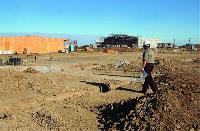
Dixon Unified School District superintendent Roberto Salinas (above) looks over the construction site of the new Dixon high school on Monday during a tour with contractors and the school board. (Brad Zweerink/The Reporter)
With just a few concrete foundations and framed-up classrooms in place, the future site of Dixon's new high school might not look like much to the casual observer.
But it's a little slice of heaven for school board members who called a special meeting this week in order to tour the site together.
Donning their hard hats and blue jeans, the trustees expressed plenty of excitement about what they saw.
"It's wonderful to see something that has been in the plans for so long is finally starting to be built," said Trustee Ernie VanSant.
Bob Fawson from VanPelt Construction Management Group led the tour, showing the group - each carrying a copy of a map - where each building will be.
New high school principal Tom Hermon also joined the group, getting a feel for what he will face in the next year.
"It's an exciting time," Hermon said. "Lots to do and look forward to."
Former Principal Bob Dolan, now in charge of the design of the new school, was more than excited about the project.
"The process has been really outstanding," Dolan said.
That's a cheerier outlook than some had earlier this year when an unusually long rainy season pushed the project behind schedule by almost three months.
Superintendent Roberto Salinas, however, said the delay has been whittled down to just a three weeks. Instead of the project being completed at the beginning of June 2007, the original completion date, the group is looking at completion in early July 2007, at the latest.
"We're catching up quickly," said Salinas, who visits the site weekly. "It's been a steady progression, but we're keeping our fingers crossed."
Having about 110 guys on the site daily has contributed a lot to catching up with the schedule, Salinas said.
The excitement of a new school has trickled down to the students who will experience the opportunities the high school will have to offer.
"I know the junior class is already talking about how they'll be the first ones to graduate from the new high school," Salinas said. "They're already looking forward to it."
On the brink of overcrowding at the current high school, the new facility will give the students a lot more options that aren't already accessible to the students.
Easy access to the May Fair grounds and a new a career center are just a few things the school will offer.
"The better amenities will provide the opportunity for the students to grow," Salinas said.
Salinas also said the new high school is actually a "three in one" deal, providing for future growth for all grade levels.
Once students move into the new high school, the old high school will accommodate the junior high students and C.A. Jacobs Middle School will become a new elementary school.
"The setup is a really good example of good planning," Salinas said.
In order to save money now, the board planned to have possibly two extra buildings at the site constructed in the future. Now, however, those two additional classroom buildings will be built with the rest of the project because of extra funds from the state and new housing developments in the city.
The land the new high school will sit on is behind Hall Park and the Dixon May Fair grounds, a total of 90 acres, including a 30 acre farm.
The entire campus, then, is almost four times the size of the current high school location.
"It's just massive," said Board Vice President Kim Poole. "Just for the community, it's amazing. Dixon doesn't have anything like this. It's actually going to become a reality."
Melissa Murphy can be reached at dixon@thereporter.com.
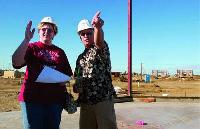
Dixon School District board member Amy Swanson (left) and school board president Alan Hodge look over the site for Dixon's new high school. (Brad Zweerink/The Reporter)
Dixon Enthused by Construction
By Melissa Murphy/Staff Writer
TheReporter.Com
Dixon Unified School District superintendent Roberto Salinas (above) looks over the construction site of the new Dixon high school on Monday during a tour with contractors and the school board. (Brad Zweerink/The Reporter)
With just a few concrete foundations and framed-up classrooms in place, the future site of Dixon's new high school might not look like much to the casual observer.
But it's a little slice of heaven for school board members who called a special meeting this week in order to tour the site together.
Donning their hard hats and blue jeans, the trustees expressed plenty of excitement about what they saw.
"It's wonderful to see something that has been in the plans for so long is finally starting to be built," said Trustee Ernie VanSant.
Bob Fawson from VanPelt Construction Management Group led the tour, showing the group - each carrying a copy of a map - where each building will be.
New high school principal Tom Hermon also joined the group, getting a feel for what he will face in the next year.
"It's an exciting time," Hermon said. "Lots to do and look forward to."
Former Principal Bob Dolan, now in charge of the design of the new school, was more than excited about the project.
"The process has been really outstanding," Dolan said.
That's a cheerier outlook than some had earlier this year when an unusually long rainy season pushed the project behind schedule by almost three months.
Superintendent Roberto Salinas, however, said the delay has been whittled down to just a three weeks. Instead of the project being completed at the beginning of June 2007, the original completion date, the group is looking at completion in early July 2007, at the latest.
"We're catching up quickly," said Salinas, who visits the site weekly. "It's been a steady progression, but we're keeping our fingers crossed."
Having about 110 guys on the site daily has contributed a lot to catching up with the schedule, Salinas said.
The excitement of a new school has trickled down to the students who will experience the opportunities the high school will have to offer.
"I know the junior class is already talking about how they'll be the first ones to graduate from the new high school," Salinas said. "They're already looking forward to it."
On the brink of overcrowding at the current high school, the new facility will give the students a lot more options that aren't already accessible to the students.
Easy access to the May Fair grounds and a new a career center are just a few things the school will offer.
"The better amenities will provide the opportunity for the students to grow," Salinas said.
Salinas also said the new high school is actually a "three in one" deal, providing for future growth for all grade levels.
Once students move into the new high school, the old high school will accommodate the junior high students and C.A. Jacobs Middle School will become a new elementary school.
"The setup is a really good example of good planning," Salinas said.
In order to save money now, the board planned to have possibly two extra buildings at the site constructed in the future. Now, however, those two additional classroom buildings will be built with the rest of the project because of extra funds from the state and new housing developments in the city.
The land the new high school will sit on is behind Hall Park and the Dixon May Fair grounds, a total of 90 acres, including a 30 acre farm.
The entire campus, then, is almost four times the size of the current high school location.
"It's just massive," said Board Vice President Kim Poole. "Just for the community, it's amazing. Dixon doesn't have anything like this. It's actually going to become a reality."
Melissa Murphy can be reached at dixon@thereporter.com.
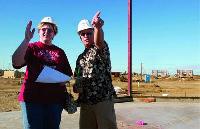
Dixon School District board member Amy Swanson (left) and school board president Alan Hodge look over the site for Dixon's new high school. (Brad Zweerink/The Reporter)
Tourism Campaign Announced
Tourism Campaign Announced
By Amanda Janis/Business Editor
Solano County's "destination marketing organizations" are doing exactly what the state's travel and tourism commission encourages: Working together to enhance economic development.
Better known as visitors bureaus and hotel associations, the organizations are set to launch a new campaign advertising festivals and events "from the Carquinez Bridge to the Yolo Causeway," Antonette Eckert, executive director of the Vacaville Conference and Visitors Bureau, announced Thursday at a tourism-related panel discussion hosted by the Solano Economic Development Corporation.
Dubbed "80 on 80," the campaign will utilize Interstate 80's electronic and static billboards to advertise the slogan and a Web site with information on 80 events along the interstate.
"We're hoping to launch on Labor Day weekend when I-80 becomes a parking lot," she told the group of business and community leaders gathered at Fairfield's Hilton Garden Inn. "People will see our message; it's catchy and easy to remember."
The campaign is a simple way for groups including the Vallejo Convention and Visitors Bureau and the Fairfield Hotel Association - both of which tout their cities as ideal hubs from which to visit regional attractions - to work together without working against one another.
In an industry that brings the state more than $88 billion annually and employs 912,000 people, partnering is key, affirmed Susan Wilcox, chief deputy director of the California Travel and Tourism Commission.
"Our strategy is likened to that of a huge bull's eye," Wilcox explained. Prospective tourists must first be attracted to travel in the U.S., then California, then the region, then Solano County.
"If they're not thinking California, they're never going to make it to the Hilton Garden Inn in Fairfield," she quipped.
Failure to promote the state's assets, she said, will result in lost market share, jobs and tax revenues, "just like any other business."
Acquiring new retail and attractions to promote is also key.
Vallejo, for example, hopes to be the future home for the Battleship Iowa. Should the U.S. Navy donate it to Vallejo, it's estimated that 300,000 tourists per year would visit the ship, said Jim Reikousky, director of communications for Vallejo's visitors bureau.
Solano County's cities, said Supervisor Mike Reagan, "already have attractions that other states would kill for, and we're not leveraging that." As a connection point between the Central Valley and Bay Area tourism districts, he said, Solano County should be able to "hijack" those region's marketing dollars, "and get people to stay here."
By Amanda Janis/Business Editor
Solano County's "destination marketing organizations" are doing exactly what the state's travel and tourism commission encourages: Working together to enhance economic development.
Better known as visitors bureaus and hotel associations, the organizations are set to launch a new campaign advertising festivals and events "from the Carquinez Bridge to the Yolo Causeway," Antonette Eckert, executive director of the Vacaville Conference and Visitors Bureau, announced Thursday at a tourism-related panel discussion hosted by the Solano Economic Development Corporation.
Dubbed "80 on 80," the campaign will utilize Interstate 80's electronic and static billboards to advertise the slogan and a Web site with information on 80 events along the interstate.
"We're hoping to launch on Labor Day weekend when I-80 becomes a parking lot," she told the group of business and community leaders gathered at Fairfield's Hilton Garden Inn. "People will see our message; it's catchy and easy to remember."
The campaign is a simple way for groups including the Vallejo Convention and Visitors Bureau and the Fairfield Hotel Association - both of which tout their cities as ideal hubs from which to visit regional attractions - to work together without working against one another.
In an industry that brings the state more than $88 billion annually and employs 912,000 people, partnering is key, affirmed Susan Wilcox, chief deputy director of the California Travel and Tourism Commission.
"Our strategy is likened to that of a huge bull's eye," Wilcox explained. Prospective tourists must first be attracted to travel in the U.S., then California, then the region, then Solano County.
"If they're not thinking California, they're never going to make it to the Hilton Garden Inn in Fairfield," she quipped.
Failure to promote the state's assets, she said, will result in lost market share, jobs and tax revenues, "just like any other business."
Acquiring new retail and attractions to promote is also key.
Vallejo, for example, hopes to be the future home for the Battleship Iowa. Should the U.S. Navy donate it to Vallejo, it's estimated that 300,000 tourists per year would visit the ship, said Jim Reikousky, director of communications for Vallejo's visitors bureau.
Solano County's cities, said Supervisor Mike Reagan, "already have attractions that other states would kill for, and we're not leveraging that." As a connection point between the Central Valley and Bay Area tourism districts, he said, Solano County should be able to "hijack" those region's marketing dollars, "and get people to stay here."
Nut Tree Stores Set to Open
Nut Tree Stores Set to Open
By Amanda Janis/Business Editor

A steam roller flattens the area of the new Nut Tree Family Park on Wednesday that will serve as bocce ball courts. The park is scheduled to open in September. (Joel Rosenbaum/The Reporter)
Work continues on much of the long-awaited Nut Tree development as one of the project's anchor tenants becomes the first to opens its doors today.
Best Buy - and the high-end electronics boutique, Magnolia, located within - is the first retail store of its kind in Vacaville, offering a dizzying array of electronics, appliances, home-office products, and entertainment software.
The big-box's public grand opening is today, following special approval by the City Council enabling it to open and operate on what is essentially still an active construction site.
"We worked hard with the city to prepare the project to allow a safe opening, while not interfering with our construction efforts," said Sean Whiskeman in an e-mail to The Reporter.
Whiskeman is a partner with Westrust, the San Francisco-based firm that has teamed with Rockwood Capital Corporation and master developer Snell & Co. on the $100 million project that will mix restaurants, shops, and office space with an amusement park, bocce ball grove, two hotels, a conference center, and 180 town houses.
"Best Buy was fortunate to be in a position to open ahead of the others," Whiskeman said. The balance of the large-format retail anchors - including Borders, PetsMart, BevMo, SportsChalet and HomeGoods - are scheduled to open throughout August, he said.
"We expect to have the remaining buildings completed in late August with additional tenant openings in the fall and early winter," he added.
Heavy spring rains are the primary reason the first phase of the mixed-use project is still under construction.
"We've been constantly playing catch up," said Ilana Minkoff, marketing director for the project's family entertainment component, the Nut Tree Family Park.
The 3.7-acre park is scheduled to install its rides by mid-August and open to the public some time after Labor Day, Minkoff confirmed.
Approximately 85 percent of the track has been laid that will be traversed by the original, restored Nut Tree train, Engine No. 5.
The skeleton of the original ice cream pavilion, to be used as a ticket booth, awaits refurbishment. As does the exterior of the Harbison House - the Nut Tree founders' original 1907 home, which will grace the center of the park and serve as a museum focused on Nut Tree and California history. Refurbishment of its interior is estimated to be finished in two to three years.
Redevelopment of the historic 80-acre site began late last year - nearly 10 years after the closure of the Nut Tree, a Vacaville icon that operated for eight decades.
Amanda Janis can be reached at business@thereporter.com.
By Amanda Janis/Business Editor

A steam roller flattens the area of the new Nut Tree Family Park on Wednesday that will serve as bocce ball courts. The park is scheduled to open in September. (Joel Rosenbaum/The Reporter)
Work continues on much of the long-awaited Nut Tree development as one of the project's anchor tenants becomes the first to opens its doors today.
Best Buy - and the high-end electronics boutique, Magnolia, located within - is the first retail store of its kind in Vacaville, offering a dizzying array of electronics, appliances, home-office products, and entertainment software.
The big-box's public grand opening is today, following special approval by the City Council enabling it to open and operate on what is essentially still an active construction site.
"We worked hard with the city to prepare the project to allow a safe opening, while not interfering with our construction efforts," said Sean Whiskeman in an e-mail to The Reporter.
Whiskeman is a partner with Westrust, the San Francisco-based firm that has teamed with Rockwood Capital Corporation and master developer Snell & Co. on the $100 million project that will mix restaurants, shops, and office space with an amusement park, bocce ball grove, two hotels, a conference center, and 180 town houses.
"Best Buy was fortunate to be in a position to open ahead of the others," Whiskeman said. The balance of the large-format retail anchors - including Borders, PetsMart, BevMo, SportsChalet and HomeGoods - are scheduled to open throughout August, he said.
"We expect to have the remaining buildings completed in late August with additional tenant openings in the fall and early winter," he added.
Heavy spring rains are the primary reason the first phase of the mixed-use project is still under construction.
"We've been constantly playing catch up," said Ilana Minkoff, marketing director for the project's family entertainment component, the Nut Tree Family Park.
The 3.7-acre park is scheduled to install its rides by mid-August and open to the public some time after Labor Day, Minkoff confirmed.
Approximately 85 percent of the track has been laid that will be traversed by the original, restored Nut Tree train, Engine No. 5.
The skeleton of the original ice cream pavilion, to be used as a ticket booth, awaits refurbishment. As does the exterior of the Harbison House - the Nut Tree founders' original 1907 home, which will grace the center of the park and serve as a museum focused on Nut Tree and California history. Refurbishment of its interior is estimated to be finished in two to three years.
Redevelopment of the historic 80-acre site began late last year - nearly 10 years after the closure of the Nut Tree, a Vacaville icon that operated for eight decades.
Amanda Janis can be reached at business@thereporter.com.
The Fair is Coming to Town!
The Fair is Coming to Town!
Daily Republic staff
VALLEJO - Ten days of corn dogs, carnival rides, farm animals and two major concerts begin today at the annual Solano County Fair.
"Hot fun in the summer time" is the theme for the fair, which runs through July 23 at the fairgrounds, located near the intersection of Interstate 80 and Highway 37.
The doors open at 11 a.m. daily and the fair closes at 11 p.m. Tickets are $8 for adults and $4 for children 6-12, service members with ID cards and seniors. Service members in uniform and children 5 and younger are free. Admission is $2 every day before 2 p.m. and parking is $6.
The fair begins with a bang tonight, hosting a demolition derby in the sports arena. That starts at 6:30 p.m. and requires a special $15 ticket, which includes admission. On Saturday night, there will be PBR bullriding and on Sunday there is a Fiesta del Charro rodeo at the sports arena. There also will be fireworks each night.
The entertainment highlights of the fair are concerts by Raven Symone and Gladys Knight on July 20 and July 21, respectively. Tickets are available on line at www.scfair.com and at the fair box office. There will also be other concerts, as well as free entertainment every day.
Horse racing began on Wednesday and continues through the end of the fair, except for Monday and Tuesday.
For more information, visit the Web site at www.scfair.com.
Daily Republic staff
VALLEJO - Ten days of corn dogs, carnival rides, farm animals and two major concerts begin today at the annual Solano County Fair.
"Hot fun in the summer time" is the theme for the fair, which runs through July 23 at the fairgrounds, located near the intersection of Interstate 80 and Highway 37.
The doors open at 11 a.m. daily and the fair closes at 11 p.m. Tickets are $8 for adults and $4 for children 6-12, service members with ID cards and seniors. Service members in uniform and children 5 and younger are free. Admission is $2 every day before 2 p.m. and parking is $6.
The fair begins with a bang tonight, hosting a demolition derby in the sports arena. That starts at 6:30 p.m. and requires a special $15 ticket, which includes admission. On Saturday night, there will be PBR bullriding and on Sunday there is a Fiesta del Charro rodeo at the sports arena. There also will be fireworks each night.
The entertainment highlights of the fair are concerts by Raven Symone and Gladys Knight on July 20 and July 21, respectively. Tickets are available on line at www.scfair.com and at the fair box office. There will also be other concerts, as well as free entertainment every day.
Horse racing began on Wednesday and continues through the end of the fair, except for Monday and Tuesday.
For more information, visit the Web site at www.scfair.com.
Solano Gets New Tourism Direction
Solano Gets New Tourism Direction
By Nathan Halverson
FAIRFIELD - Two new initiatives focused on increasing tourism in Solano County were announced Thursday at a tourism forum held in Fairfield.
In an effort to boost tourism revenue in Solano County, five organizations - including the Vallejo Convention & Visitors Bureau, the Vacaville Conference & Visitors Bureau and the Fairfield Hotel Association -Êhave joined forces to market the county as a great place for people to visit and spend their money.
"We're all friends, and we sat down and said 'How can we help each other?' " said Antonette Eckert from the Vacaville Conference & Visitors Bureau. "Our marketing dollars go further when we work together."
The collaboration, called the 80 on 80 initiative, is intended to highlight 80 tourist-friendly events that occur along Interstate 80.
The group has a very limited budget, but hopes to strengthen both their ties and its budget over time.
The collaboration will also give them more lobbying power, Eckert said.
"We now have a bigger voice," she said.
And the group is already testing that voice. It has requested the county conduct an economic impact study to determine how much tourism adds to the local economy. It also asked for a so-called destination audit, which would determine each cities' attributes that can be marketed to tourists.
"This would be an honest assessment of who comes here," Eckert said. "We need to take these steps."
In a sign the county might be receptive to spending money on conducting those studies, Supervisor Mike Reagan announced at the event the creation of the Solano County Board of Supervisors' Economic Development and Tourism Committee.
"This is an area we can grow in Solano County," Reagan said. "We have all these attractions other counties would kill for."
Both Six Flags Marine World and the Jelly Bell factory draw several hundred thousand visitors every year. The Nut Tree Family Park might also attract significant visitors.
Barbara Glover from the Fairfield Hotel Association said the city's proximity to Napa makes it ideally located to provide more affordably priced hotels for people visiting wine country.
"As many of you know, it costs an arm and a leg to stay at a hotel in Napa," she said.
Susan Wilcox, chief deputy director of the California Travel and Tourism Commission, also attended the tourism event hosted by the Solano Economic Development Corp. She recommended the tourism groups begin searching for government funding intended to boost tourism.
Wilcox reaffirmed what many in attendance already believed.
"I think Solano is perfectly situated to take advantage of (tourism)," she said.
Nathan Halverson can be reached at 427-6934 or nhalverson@dailyrepublic.net.
By Nathan Halverson
FAIRFIELD - Two new initiatives focused on increasing tourism in Solano County were announced Thursday at a tourism forum held in Fairfield.
In an effort to boost tourism revenue in Solano County, five organizations - including the Vallejo Convention & Visitors Bureau, the Vacaville Conference & Visitors Bureau and the Fairfield Hotel Association -Êhave joined forces to market the county as a great place for people to visit and spend their money.
"We're all friends, and we sat down and said 'How can we help each other?' " said Antonette Eckert from the Vacaville Conference & Visitors Bureau. "Our marketing dollars go further when we work together."
The collaboration, called the 80 on 80 initiative, is intended to highlight 80 tourist-friendly events that occur along Interstate 80.
The group has a very limited budget, but hopes to strengthen both their ties and its budget over time.
The collaboration will also give them more lobbying power, Eckert said.
"We now have a bigger voice," she said.
And the group is already testing that voice. It has requested the county conduct an economic impact study to determine how much tourism adds to the local economy. It also asked for a so-called destination audit, which would determine each cities' attributes that can be marketed to tourists.
"This would be an honest assessment of who comes here," Eckert said. "We need to take these steps."
In a sign the county might be receptive to spending money on conducting those studies, Supervisor Mike Reagan announced at the event the creation of the Solano County Board of Supervisors' Economic Development and Tourism Committee.
"This is an area we can grow in Solano County," Reagan said. "We have all these attractions other counties would kill for."
Both Six Flags Marine World and the Jelly Bell factory draw several hundred thousand visitors every year. The Nut Tree Family Park might also attract significant visitors.
Barbara Glover from the Fairfield Hotel Association said the city's proximity to Napa makes it ideally located to provide more affordably priced hotels for people visiting wine country.
"As many of you know, it costs an arm and a leg to stay at a hotel in Napa," she said.
Susan Wilcox, chief deputy director of the California Travel and Tourism Commission, also attended the tourism event hosted by the Solano Economic Development Corp. She recommended the tourism groups begin searching for government funding intended to boost tourism.
Wilcox reaffirmed what many in attendance already believed.
"I think Solano is perfectly situated to take advantage of (tourism)," she said.
Nathan Halverson can be reached at 427-6934 or nhalverson@dailyrepublic.net.
Thursday, July 13, 2006
Violent crime drops in Solano County
Violent crime drops in Solano County - Arson up, rape, robbery, assaults down
http://local.dailyrepublic.net/story_localnews.php?a=news02.txt
Violent crime dropped 28 percent in Solano County, leading an almost across-the-board drop in crimes from 2004 to 2005, according to preliminary state Department of Justice figures. Solano County far outpaced statewide crime statistics. Violent crime dropped 4 percent statewide from 2004 to 2005....
The biggest decrease in Solano County came in aggravated assaults, which dropped from 1,346 to 889, 34 percent. The only increase came in arsons, which jumped from 125 to 152, a 21.6 percent increase....
Property crimes also dropped in Solano County, decreasing from 6,830 in 2004 to 5,657 in 2005, a reduction of 17.2 percent. Burglary led the downward trend, dropping from 2,704 to 1,997, a 26.1 percent decrease. Car theft dropped 12.4 percent and theft over $400 went down 10.2 percent....
http://local.dailyrepublic.net/story_localnews.php?a=news02.txt
Violent crime dropped 28 percent in Solano County, leading an almost across-the-board drop in crimes from 2004 to 2005, according to preliminary state Department of Justice figures. Solano County far outpaced statewide crime statistics. Violent crime dropped 4 percent statewide from 2004 to 2005....
The biggest decrease in Solano County came in aggravated assaults, which dropped from 1,346 to 889, 34 percent. The only increase came in arsons, which jumped from 125 to 152, a 21.6 percent increase....
Property crimes also dropped in Solano County, decreasing from 6,830 in 2004 to 5,657 in 2005, a reduction of 17.2 percent. Burglary led the downward trend, dropping from 2,704 to 1,997, a 26.1 percent decrease. Car theft dropped 12.4 percent and theft over $400 went down 10.2 percent....
STA OK's plan for transit expenditures
Article Launched: 07/11/2006 07:55:32 AM
By Julie Kay/Staff Writer
A subcommittee of the Solano Transportation Authority approved a proposed set of guidelines Monday on how to fund transportation projects that benefit one or more specific cities as well as the region overall.
In a 4-1 vote, members of the STA's Arterials, Highways, and Freeways Committee approved guidelines the agency developed proposing that the county provide 50 percent of funding for such a project and the city or cities benefiting provide the remaining half.
The proposal also includes guidelines for what kind of projects would be eligible for such a funding split.
The guidelines are designed primarily to apply to regionally significant interchanges and "reliever routes," or routes which run parallel to major highways to decrease traffic on roads such as interstates.
One example would be improving the interchange between I-80 and state route 113, which would benefit both Dixon and the region overall. Jepson Parkway, a planned highway alternative which would run along what are currently Leisure Town and Vanden roads, also would benefit both the region and specific cities.
To qualify for joint funding, a project would have to be adopted into the STA Overall Work Plan - the STA's prioritized list of upcoming transportation projects - the proposal says.
Funding for past transportation projects benefiting both a particular city and the region overall have been negotiated on a case-by-case basis. With many regionally significant transportation projects currently planned, the STA proposed the guidelines to simplify the funding process.
"The intent is to provide implementing agencies such as STA, the seven cities, and the County a uniform policy for funding projects with regionally generated funds," reads the explanation of the proposal in the meeting agenda.
Janet Adams, the STA Director of Projects, said the 50-50 policy is meant to serve as a starting point, not a policy set in stone.
"It gives us all guidelines for the future," she said. "There absolutely may be a situation where for a very good reason all parties agree to have a deviation. But it gives the overreaching policy."
STA committees are made up of local officials, public works directors, and members of the public. Committee members on the Arterials, Highways, and Freeways Committee who voted in favor of the funding proposal Monday were Vacaville Mayor Len Augustine, Fairfield Mayor Harry Price, Solano County Supervisor John Vasquez, and Benicia Councilmember Alan Schwartzman. Rio Vista Mayor Ed Woodruff voted against the proposal. Solano County Supervisor John Silva was absent from the meeting.
The proposal was approved by the STA's Technical Advisory Committee on June 28 and will be presented to the Board of Supervisors on Wednesday at a board workshop. A final vote on the proposed guidelines is not expected until the fall.
Julie Kay can be reached at schools@thereporter.com.
By Julie Kay/Staff Writer
A subcommittee of the Solano Transportation Authority approved a proposed set of guidelines Monday on how to fund transportation projects that benefit one or more specific cities as well as the region overall.
In a 4-1 vote, members of the STA's Arterials, Highways, and Freeways Committee approved guidelines the agency developed proposing that the county provide 50 percent of funding for such a project and the city or cities benefiting provide the remaining half.
The proposal also includes guidelines for what kind of projects would be eligible for such a funding split.
The guidelines are designed primarily to apply to regionally significant interchanges and "reliever routes," or routes which run parallel to major highways to decrease traffic on roads such as interstates.
One example would be improving the interchange between I-80 and state route 113, which would benefit both Dixon and the region overall. Jepson Parkway, a planned highway alternative which would run along what are currently Leisure Town and Vanden roads, also would benefit both the region and specific cities.
To qualify for joint funding, a project would have to be adopted into the STA Overall Work Plan - the STA's prioritized list of upcoming transportation projects - the proposal says.
Funding for past transportation projects benefiting both a particular city and the region overall have been negotiated on a case-by-case basis. With many regionally significant transportation projects currently planned, the STA proposed the guidelines to simplify the funding process.
"The intent is to provide implementing agencies such as STA, the seven cities, and the County a uniform policy for funding projects with regionally generated funds," reads the explanation of the proposal in the meeting agenda.
Janet Adams, the STA Director of Projects, said the 50-50 policy is meant to serve as a starting point, not a policy set in stone.
"It gives us all guidelines for the future," she said. "There absolutely may be a situation where for a very good reason all parties agree to have a deviation. But it gives the overreaching policy."
STA committees are made up of local officials, public works directors, and members of the public. Committee members on the Arterials, Highways, and Freeways Committee who voted in favor of the funding proposal Monday were Vacaville Mayor Len Augustine, Fairfield Mayor Harry Price, Solano County Supervisor John Vasquez, and Benicia Councilmember Alan Schwartzman. Rio Vista Mayor Ed Woodruff voted against the proposal. Solano County Supervisor John Silva was absent from the meeting.
The proposal was approved by the STA's Technical Advisory Committee on June 28 and will be presented to the Board of Supervisors on Wednesday at a board workshop. A final vote on the proposed guidelines is not expected until the fall.
Julie Kay can be reached at schools@thereporter.com.
Dixon gets OK to annex Milk Farm property
July 11, 2006
Dixon gets OK to annex Milk Farm property
By Barry Eberling
FAIRFIELD - Dixon will soon add the landmark Milk Farm commercial complex along Interstate 80 to its city limits.
The county Local Agency Formation Commission on Monday approved the 60-acre annexation. The agency should issue the certificate to make the Dixon addition official in about a month.
Now sitting abandoned, the old Milk Farm restaurant is known for its sign depicting a cow jumping over the moon. Milk Farm Associates plans to renovate the property with such things as a new restaurant, hotel and research park.
County Supervisor and LAFCO Commissioner Duane Kromm cast the only "no" vote. He expressed concern that an agricultural buffer that is part of the proposed project doesn't extend to the lower western end, leaving open the possibility Dixon could someday grow onto prime farmland there.
"Ninety percent of this I agree with," Kromm said. "But I am concerned about the western edge."
LAFCO Commissioner and Dixon Mayor Mary Ann Courville tried to reassure him. The Dixon general plan calls for no other development in that area, she said.
"But your general plan can be amended three times a year by three votes on the City Council," Kromm said.
LAFCO approved several other annexations on Monday. But the board imposed conditions reflecting its growing concern that annexing land into cities takes away property tax money from rural fire districts that are facing financial difficulties.
At the urging of Commissioner and Suisun City Mayor Jim Spering, all annexations approved Monday are subject to any policy LAFCO works out within a year on the fire district money problem. Or, as an alternative, the property owner and affected rural fire district can reach an agreement on their own.
A possible policy might be having property owners annexing into cities pay the fire districts for 10 years of lost property taxes, commission officials said.
All of this lent some uncertainty to the annexations approved at the meeting.
For example, the agency approved Vacaville annexing the 100-acre Mariani property near Crocker Drive and Vaca Valley Parkway. About 57 acres has the Mariani Packing Co. food processing operation, while the rest is vacant and could be developed.
The Vacaville Fire Protection District provides fire service to the property and receives $10,000 annually in property taxes. Once the annexation if official, the city fire department will get both the responsibility and the money.
With county law prohibiting most development in rural areas, rural districts such as Vacaville get few chances to replace lost property tax money, Vacaville Fire Protection District Chief Howard Wood said.
"Ten thousand dollars? Yes, that's a lot of money for the fire district," Wood told commissioners.
Bob Miller of Mariani expressed confusion over the commission's condition making the annexation subject to a yet-unknown commission policy on rural fire districts. This seems open-ended, he said.
"It's a surprise to you, there's no doubt about that," Kromm said.
If Mariani were to pay the Vacaville Fire Protection District for 10 years of lost property taxes, the amount would total $100,000.
Also Monday, the commission approved annexing 22.5 acres near Cordelia Road and Ledgwood Creek to Fairfield and 5.74 acres near Dittmer and Auto Plaza courts to Fairfield.
Sitting on LAFCO are public member John Saunderson, Spering, Kromm, county Supervisor Barbara Kondylis and Benicia Mayor Steve Messina. Alternates are county Supervisor Mike Reagan, Courville and public member Nancy Shopay.
Reach Barry Eberling at 425-4646 Ext. 232 or at beberling@dailyrepublic.net.
Dixon gets OK to annex Milk Farm property
By Barry Eberling
FAIRFIELD - Dixon will soon add the landmark Milk Farm commercial complex along Interstate 80 to its city limits.
The county Local Agency Formation Commission on Monday approved the 60-acre annexation. The agency should issue the certificate to make the Dixon addition official in about a month.
Now sitting abandoned, the old Milk Farm restaurant is known for its sign depicting a cow jumping over the moon. Milk Farm Associates plans to renovate the property with such things as a new restaurant, hotel and research park.
County Supervisor and LAFCO Commissioner Duane Kromm cast the only "no" vote. He expressed concern that an agricultural buffer that is part of the proposed project doesn't extend to the lower western end, leaving open the possibility Dixon could someday grow onto prime farmland there.
"Ninety percent of this I agree with," Kromm said. "But I am concerned about the western edge."
LAFCO Commissioner and Dixon Mayor Mary Ann Courville tried to reassure him. The Dixon general plan calls for no other development in that area, she said.
"But your general plan can be amended three times a year by three votes on the City Council," Kromm said.
LAFCO approved several other annexations on Monday. But the board imposed conditions reflecting its growing concern that annexing land into cities takes away property tax money from rural fire districts that are facing financial difficulties.
At the urging of Commissioner and Suisun City Mayor Jim Spering, all annexations approved Monday are subject to any policy LAFCO works out within a year on the fire district money problem. Or, as an alternative, the property owner and affected rural fire district can reach an agreement on their own.
A possible policy might be having property owners annexing into cities pay the fire districts for 10 years of lost property taxes, commission officials said.
All of this lent some uncertainty to the annexations approved at the meeting.
For example, the agency approved Vacaville annexing the 100-acre Mariani property near Crocker Drive and Vaca Valley Parkway. About 57 acres has the Mariani Packing Co. food processing operation, while the rest is vacant and could be developed.
The Vacaville Fire Protection District provides fire service to the property and receives $10,000 annually in property taxes. Once the annexation if official, the city fire department will get both the responsibility and the money.
With county law prohibiting most development in rural areas, rural districts such as Vacaville get few chances to replace lost property tax money, Vacaville Fire Protection District Chief Howard Wood said.
"Ten thousand dollars? Yes, that's a lot of money for the fire district," Wood told commissioners.
Bob Miller of Mariani expressed confusion over the commission's condition making the annexation subject to a yet-unknown commission policy on rural fire districts. This seems open-ended, he said.
"It's a surprise to you, there's no doubt about that," Kromm said.
If Mariani were to pay the Vacaville Fire Protection District for 10 years of lost property taxes, the amount would total $100,000.
Also Monday, the commission approved annexing 22.5 acres near Cordelia Road and Ledgwood Creek to Fairfield and 5.74 acres near Dittmer and Auto Plaza courts to Fairfield.
Sitting on LAFCO are public member John Saunderson, Spering, Kromm, county Supervisor Barbara Kondylis and Benicia Mayor Steve Messina. Alternates are county Supervisor Mike Reagan, Courville and public member Nancy Shopay.
Reach Barry Eberling at 425-4646 Ext. 232 or at beberling@dailyrepublic.net.
Subscribe to:
Posts (Atom)
Solano's Got It!

The Best That Northern California Has To Offer.


