Wednesday, August 09, 2006

'Bully' for Jelly Belly!

'Bully' for Jelly Belly!
Fairfield Jelly Bean Maker's Sweet Rocks Line Cashes in on Animated Film
By RACHEL RASKIN-ZRIHEN, Times-Herald staff writer


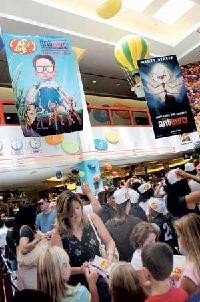
A PHOTOGRAPHER snaps a picture as children gather near a promotion for the animated movie 'The Ant Bully' at the Jelly Belly Candy Co. factory in Fairfield. The picture is made of jelly beans. Photo: J.L. Sousa/Times-Herald

Four-year-old Brianna Todero of Vallejo has no desire to try jelly beans that taste like lawn clippings or ants, although she may give the caterpillar-flavored ones a try.

Those are among the flavors Jelly Belly Candy Co. of Fairfield developed for its Sweet Rocks line, based on the newly released Warner Bros. Pictures and Legendary Pictures film, "The Ant Bully."

The film won Brianna's unqualified endorsement. "I saw it," she said during a stop at the visitors' center at the Jelly Belly factory. "My mommy took me. It was good!"

It's the first movie marketing tie-in with which Jelly Belly was directly involved, said company spokeswoman Tomi Holt.


The film's main character appears on a Sweet Rocks package. Photo: J.L. Sousa/Times-Herald

The movie, featuring the voices of Tom Hanks and Gary Goetzman ("The Polar Express"), opened July 28. It is a 3D animated feature about a 10-year-old boy who "embarks on a remarkable adventure," in which he joins an ant colony, according to a Jelly Belly statement.

Jelly Belly's new Sweet Rocks contain 20 movie-inspired flavors. They include ant hill, alka root, lawn clippings and caterpillar, Holt said.

David Sansone of Vallejo, 7, a second-grader at St. Basil's Elementary School, said he doesn't plan to try any of them. "It doesn't sound so good," he said.

However, he added, he may see the movie.

On the other hand, 13-year-old Geraldine O'Mara of Vallejo said ant hill and lawn clippings sound


POSTERS promoting 'The Ant Bully' hang above the crowd at the visitors' center at Jelly Belly Candy Co. in Fairfield. J.L. Sousa/Times-Herald

OK, but you're not going to get her to try caterpillar-flavored anything. "It's a bug," the St. Basil's eighth-grader said.

Jelly Belly's ant hill flavor has "an earthy, grainy quality," Holt said, while the lawn clippings variety tastes remarkably like grass.

While this is Jelly Belly's first direct movie tie-in, the firm has been mentioned in several films and developed some flavors for a line of Harry Potter-inspired Bertie Bott's jelly beans for Napa's Cap Candy Co. These include bacon, booger, ear wax, rotten egg, soap and vomit-flavored beans.

Sweet Rocks is not the only project keeping Jelly Belly officials busy lately, Holt said. Several new jelly bean lines and flavors have been developed in the past couple of years, she said.

Among these, the company's Smoothie Blend flavors include strawberry-banana, pineapple-pear and cherry-passion fruit. The smoothie line was rolled out in January and hit stores nationwide in spring, Holt said.

In May, the firm introduced a line of Soda Pop Shoppe jelly beans based on the Cadbury Schweppes Americas Beverages brands of sodas, like 7UP, Orange Crush, Dr. Pepper and A&W Root Beer.

Jelly Belly also recently added two flavors - Fruit Punch and Berry Blue - to its Sports Bean line, which it introduced last year, Holt said.

Scientifically formulated for sports performance, the Sports Beans are an energy product containing carbohydrates, electrolytes for hydration and vitamins to replenish nutrients lost through perspiring, Holt said. They also contain Vitamin C, thiamin, riboflavin, niacin and three B vitamins to promote metabolism of fats and carbs.

Sports Beans are packaged in 100-calorie, single-serving, 1-ounce packets and contain an informational guide with tips on how to use them, Holt said.


--------------------------------------------------------------------------------

Jelly Belly Candy Company

Owners: Gustav Goelitz family; Herman Rowland, chairman

Type: Candy manufacturer, tours and retail

First opened: 1976

Location: One Jelly Belly Lane, Fairfield

Hours: 9 a.m. to 5 p.m. daily, free tours 9 a.m. to 4 p.m. Wheelchair accessible.

Phone/web: (800) 522-3267 or 1-800-9-JELLYBEAN (1-800-953-5592), web: www.JellyBelly.com

New Projects Slated for City

New Projects Slated for City
Council Offers Guidance to North End Developers
By CHRIS G. DENINA, Times-Herald staff writer
Vallejo Times Herald

A developer Tuesday unveiled what Vallejo officials called an ambitious pitch to turn part of the city's northeast area into a new commercial center including a hotel, condominiums and offices.
The so-called Crossroads project was one of two plans presented to the Vallejo City Council on Tuesday night. The council was asked to comment on the projects, which are in the early stages of development and still need future approvals. Both are slated for key sites considered major entrances to the city.

"It's a thrilling idea," Mayor Tony Intintoli Jr. told developer Gary Mandarich about his Crossroads concept for about 128 acres northeast of Interstate 80 and Columbus Parkway in Vallejo.

Mandarich said he wants to create a statement with his newest project, which follows his work in the city's northeast area developing housing, condos and an auto mall.

"It is the most visible piece of land in the city," Mandarich said.

In the next few years, Mandarich said he hopes to develop the hotel and conference center, plus offices, high-rise condo buildings and parks.

Another project, however, may get built sooner. City staff said a Lowe's home improvement store is in the works just east of Crossroads.

The Crossroads plan is still in the early stages, Mandarich said, noting he's still working on the designs.

Meanwhile, another developer pitched its plans to develop 285 townhomes on about 13 acres between Sonoma Boulevard and Broadway south of Mini Drive in Vallejo.

"We're very excited to be entering the Vallejo market," Project Manager Dan Huertas told the council.

Before the project can move forward, however, the company would need to seek a zoning change to allow homes. The land is now zoned for such intensive uses as stores, automotive projects and even scrap operations.

The city should seek commercial uses for the land, Councilmember Gerald Davis said. To the north of Vallejo, American Canyon is seeing plenty of new stores being built along the corridor, he said.

Unlike a residential project, a commercial venture would benefit the cash-strapped city since stores generate sales tax revenues for the city, Davis said.

"In a city that is struggling financially, that has to be a factor," Davis said.

--------------------------------------------------------------------------------

Crossroads at a glance

Mandarich Developments proposes developing a new city center on about 128 acres northeast of Interstate 80 and Columbus Parkway in Vallejo. The concept includes:

- hotel including a parking structure, a conference center of as much as 30,000 square feet and as many as 350 condos averaging about 1,000 square feet on the upper floors

- office buildings with underground parking

- restaurants

- retail and office spaces

- four high-rise condo buildings

- parks that may include a soccer field, baseball diamond or dog park

- 100 acres of open space

*Source: Mandarich Developments

- E-mail Chris G. Denina at cdenina@thnewsnet.com or call 553-6835

Touchdown at Travis

Touchdown at Travis
Solano Base Scores First of its 13 C-17s
By Jason Massad/Staff Writer
TheReporter.Com


Dignitaries from the United States Air Force, local government officials, Air Force personnel and their families sit Tuesday on the flight line at Travis Air Force Base in Fairfield to welcome the first new C-17 Globemaster III to the base. (Joel Rosenbaum/The Reporter)

All eyes at Travis Air Force Base were focused Tuesday on a hulking gray plane as it slipped down through a somewhat hazy sky and touched down with a bit of white smoke swirling around its landing gear.
While it's certainly not unusual for aircraft to take off and land around the clock at Travis, this particular arrival had a very special significance.

After taxiing, Travis' first C-17, a nimble cargo hauler which is gaining quite a reputation for its versatility on the war fronts, rested proudly on the flight line.

A large appreciative crowd of military personnel, federal, state and local officials and Air Force veterans were present to welcome the C-17.

"Did anyone else have a lump in their throat like I did when (it) landed?" said U.S. Rep. Ellen Tauscher, D-Solano, who has helped the local base obtain the new aircraft.

Travis' first C-17 has been christened Spirit of Solano, a nod to the local community that has supported the base over the years. The Travis insignia, emblazoned on the plane's tail fin, seemed to make the base the C-17s home official.

The aircraft was piloted Tuesday from a Boeing production facility in Long Beach to Travis by Maj. Gen. Thomas Kane, a former wing commander at the base.

To show the base's air mobility clout, a flyover was conducted involving all three of the base's "weapons systems," now including the C-17.

A C-5, a massive cargo hauler, whined overhead and a streamlined KC-10 refueler aircraft made an appearance, followed by the "new toy," as one military leader called it.

Kane, piloting the C-17, put the airplane through its paces in the flyover, as he sharply banked the northbound aircraft as the crowd gawked.

"What you see is American spirit and industrial ingenuity," said Col. Robert Millman, acting commander of the 349th Air Mobility Wing, the reserve wing at the base that will share the incoming fleet of C-17s.

Now that the first C-17 has arrived at Travis, the base will begin accepting one of the $237 million aircraft every month, until the full squadron of 13 planes graces the base's flight line.

In the meantime, the Spirit of Solano will spend most of its time in the sky. The plane is scheduled for an overseas mission this week, according to base officials.

The C-17s, after they all have arrived, essentially will replace a squadron of C-5 haulers that have been stationed elsewhere.

With the C-17, the base has three distinct missions. The C-17 is used to send troops and equipment, such as the M1 Abrams tank, directly to the front lines in places like Kandahar, Afghanistan.

The C-5 performs "strategic airlift" and moves supplies and troops to major hubs around the world. The KC-10, meanwhile, is versatile in that it refuels fighters and cargo planes alike.

Rick Tubbs, an activated reservist with the 349th, summed up the feelings, no doubt, of many of the military personnel who gathered for the ceremony. The C-17 had instantly become his new favorite, he said.

"The plane you're flying is always your favorite plane," Tubbs said.

Jason Massad can be reached atcounty@thereporter.com.


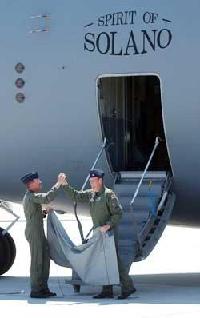
Air Force Col. Steve Arquiette (left), commander of the 60th Air Mobilty Wing at Travis, and Air Force Reserve Col. Robert Millmann, acting commander of the 349th Air Mobility Wing, high-five each other after unveiling the Spirit of Solano, a C-17 Globemaster. It's the first of 13 new high-tech military aircraft to be assigned to the base.

C-17 Casts First Big Shadow at Travis

C-17 Casts First Big Shadow at Travis
Globemaster Makes Debut at Base Amid Much Hoopla
By Ian Thompson


TRAVIS AIR FORCE BASE - More than two years of waiting ended Tuesday when the newest addition to Travis Air Force Base's aircraft arsenal arrived amid much celebration.

"All the efforts have been worth it," said C-17 Globemaster pilot Maj. Rick Tubbs of all the training, construction and organization at Travis in preparation for its newest aircraft.

Travis' first C-17 Globemaster III landed flawlessly, accompanied by the cheers and applause of a host of Air Force servicemembers and local community leaders.

"What a magnificent day! Travis is again making its mark," said Maj. Gen. Thomas Kane, who flew the C-17 past the crowds, landed it and taxied in with flags flying from above the cockpit.

The Spirit of Solano is the first of 13 C-17s slated to arrive at Travis over the next year. Travis' active-duty and Air Force Reserve C-17 flying squadrons, formed earlier, have been flying other bases' C-17s.

"Twelve more will be arriving at Travis between now and next June," Boeing Vice President Dave Bowman said.

It is the second Spirit of Solano to call the base home. The first was a B-52 Stratofortress bomber, the first of its kind at Travis in the late 1950s.

The C-17 was added to the Air Force transport fleet in 1993 and has logged more than a million flight hours carrying military cargo, transporting wounded and flying humanitarian relief missions all over the world.

Acting 349th Air Mobility Wing commander Col. Robert Millman described the C-17 as "America's spirit and industry at its best."

This arrival gives Travis a third type of aircraft in addition to the C-5 Galaxy transport and the KC-10 Extender air tanker.

"This will make Travis an all-inclusive air mobility location," 60th AMW commander Col. Steve Arquiette said, adding that Travis is now the only Air Force base with three major types of aircraft stationed there.

"It is a major countrywide accomplishment that is long in the coming," Fairfield Mayor Harry Price said. "The concerted efforts by the cities, the county and the Travis Consortium resulted in a great victory for Solano County today."

Price said local leaders have to continue to work to continue to increase the number of missions at Travis - for example, to convince Washington, D.C., to move the Coast Guard C-130 detachment to Travis from what was once McClellan Air Force Base in Sacramento.

"A lot has been done, but a lot more needs to be done," Price said.

The C-17s' arrival will make up for the shrinkage of Travis' C-5 fleet. Half of the three dozen C-5s on the base were transferred elsewhere and two of the C-5 squadrons reorganized as C-17 squadrons.

The base spent the last two years getting ready for the C-17s, undertaking 18 military construction projects worth more than $180 million to put up buildings and put in infrastructure that will support the aircraft.

Travis also formed the 860th and 945th Aircraft Maintenance Squadrons to keep the aircraft flying.

Local leaders lobbied long and hard to bring the C-17s to Travis, using that move as part of their arsenal to keep Travis out of the recent round of base closures.

Their efforts to further expand the Air Force's C-17 fleet beyond 180 aircraft proved less successful, despite support from Congress to add another 42. Boeing recently told the Air Force it will begin shutting its C-17 production line down and tell its suppliers to stop sending parts.

The C-17s destined for Travis are among the last Globemasters Boeing will make, not counting C-17 orders for Canada, Great Britain and Australia.

Ellen Tauscher (D-Walnut Creek) and other Congressmembers have been fighting to keep the Boeing production line open and recently got $300 million to build three C-17s. She continues to push past Pentagon opposition to expand the fleet to see if Boeing can build more C-17s for NATO allies.

"We know we need more C-17s. The C-17 is undeniably the best airlift platform," Tauscher said of the heavy workload being put on Air Force transports. "It is also more affordable to keep the production line open than to shut it down and then have to start it up again."

The Spirit of Solano is not being allowed to rest on its laurels.

Sometime today, the C-17 is taking off for Europe and then somewhere in Southwest Asia to support American operations in Iraq.

Reach Ian Thompson at 427-6976 or at ithompson@dailyrepublic.net.

To see an audio slideshow of Tuesday's events at Travis, visit www.dailyrepublic.com.

C-17 GloBEmaster

Arrival at Travis Air Force Base: Tuesday

Total scheduled for Travis: 13

Total in Air Force: 180

First Air Force C-17s: Began flying in 1993

Price tag of improvements at Travis to prepare: $180 million (approximately)

Tuesday, August 08, 2006

Pylon Signs to Spotlight Nut Tree Site

Pylon Signs to Spotlight Nut Tree Site
By Erin Pursell/Staff Writer
TheReporter.Com

With the official opening of the new Nut Tree rapidly approaching, developers want to get its attractions on the map.
Sitting as the Redevelopment Agency, the City Council is expected tonight to approve an agreement that will allow Nut Tree Retailers/Nut Tree Family Park to install two major signs at the new commercial center.

The two 48-foot-high, fully illuminated pylon signs will boast the tree-shaped Nut Tree logo above a listing of some of the tenants, as well as some activities that will be going on, according to staff.

"They're going to go on either side of a larger 72-foot pylon," Assistant City Manager Laura Kuhn said. "I'd expect these two smaller signs to go up by the end of the month."

The signs will be located adjacent to I-80 between the new Nut Tree overcrossing and the Nut Tree offramp to the west.

"One would be designated for Nut Tree Associates activities including the family park," Kuhn said. "The other is designated for smaller tenants in the retail area, such as restaurants."

The signage must be approved by the Redevelopment Agency since the developer has yet to purchase from the governing body the property where the signs will be located But in the meantime, Nut Tree Associates hopes to kickstart advertising for the center.

Even though the new Nut Tree won't be open yet, and not all tenants have been announced, the early marketing efforts aim to increase visits to the Nut Tree development, thus increasing sales tax revenue that will benefit the city's General Fund, according to staff.

The Vacaville City Council meets at 7 p.m. tonight in the Council Chamber, 650 Merchant St.

Erin Pursell can be reached at vacaville@thereporter.com.

Red-Carpet Welcome

Red-Carpet Welcome
First C-17 Cargo Planes, Crews Arrive at Travis

The first of 13 C-17 cargo planes arrives today at Travis Air Force Base, beefing up not only the mission of the local air base, but also the national security of the United States.

While it is cause for celebration and a salute to the men and women of Travis who have a critical role in the war on terrorism and U.S. military operations around the globe, it is also a time to recognize that more, not fewer, resources are needed.

A 200-person squadron at Travis has been created to maintain the incoming fleet of C-17 Globemaster III aircraft. The 945th Aircraft Maintenance squadron, responsible for the C-17, will be a part of the reserve 349th Air Mobility Wing based at Travis. The agile, state-of-the-art C-17 cargo haulers are the "third weapon" in the base's arsenal, along with the massive C-5 Galaxy and the KC-10 refueling aircraft.

Funding the replacement of older planes with the new C-17 has been a constant battle in Congress and the White House. And that fight continues. It is important to have a plane with an existing U.S. production line reinforcing efforts to move troops rapidly around the globe, given the American presence in the Middle East.

Solano County Supervisor Mike Reagan, whose prior career in the Air Force gives him a keen understanding of the importance of the C-17s, recently explained: "Specializing in heavy-lift operations in 'hot-zones,' the C-17 brings troops and supplies - including tanks, helicopters, and other outsized equipment - directly to and from the front lines. Its ability to take off and land from limited runways has proven invaluable."

He added, "The C-17 is the new global airlift standard - the only airlifter capable of both tactical and strategic missions - making it the airlifter of choice."

The C-17 has already fulfilled a critical role in humanitarian missions at home and around the world. It was C-17s that delivered aid to victims of Hurricane Katrina and to survivors of the earthquake in northern Pakistan.

There was a moment of concern last week when it was reported that the Boeing plant in Long Beach was having problems with the final stage of production. While the construction of planes was going smoothly, the military was concerned about last-stage preparations for planes on the flightline ready to be shipped. In the end, the company and the military said the problems were minor and would be worked out, creating no delay in getting the new planes to Travis on time.

The importance of the new squadron for the community is obvious. Downsizing has gradually shrunk the workforce of civilian and active-duty personnel at Travis. At a time when there is constant behind-the-scenes talk of more base closings and consolidations - and as the supply of older generation cargo planes, the C-5 Galaxy has been decreased - the future of Travis will be bolstered by the arrival of the C-17s.

The base's first C-17 is named "Spirit of Solano," the Air Force's acknowledgement of the community support for Travis and the men and women who serve the country there. "The surrounding communities of Solano have been terrific in their unwavering support of our base here in Northern California," said Col. Michael Shanahan, chief of the C-17 Program Integration Office. "It seems fitting that we salute that commitment by naming the first C-17A after the community."

Today's welcome ceremonies represent a genuine appreciation for the new plane, the crews that will maintain them and the civilian jobs that will be needed to keep them here. It is a time to celebrate.

County Cities Could Get Influx of Delta Water

County Cities Could Get Influx of Delta Water
By Barry Eberling

FAIRFIELD - A state court decision that has nothing to do with Solano County includes language that could make the Delta a more reliable water supply for the county's fast-growing cities.

In California, water is always a precious commodity - cities and farmers have fought over water supplies since pioneer days. Cities jockey to get legal rights for enough water to carry out their growth plans.

Solano County water officials think a state Third District Court of Appeals decision concerning a battle over Bay-Delta water rights could help local cities, such as Fairfield.

Applying the logic used in the case, cities in the Delta watershed should always get 100 percent of their state-allocated Delta water supplies, local officials reason. The state often delivers far less water than promised during dry years and even during years with normal rainfall because of shortages.

Los Angeles, Central Valley farms and other far-away Delta water importers would still be subject to cutbacks. But cities in the Delta watershed - cities such as Vacaville and Fairfield - would have priority and get all of their promised supplies.

"It's potentially a very big deal," Solano County Water Agency General Manger David Okita said.

Before anything happens, local water officials must convince the state Department of Water Resources to interpret the court decision as they do.

That's no sure thing, Okita said. It could take years, rather than months, to accomplish this, he said.

Solano County has two sources for water. One is Lake Berryessa reservoir in Napa County. The other is the Sacramento-San Joaquin Delta.

Fairfield, Vacaville, Vallejo, Benicia and Suisun City get Delta water from the state's North Bay Aqueduct. The total contracted amount is 47,000 acre feet annually.

The North Bay Aqueduct is part of the massive State Water Project, a series of reservoirs, dams, pumps and aqueducts that serves much of California. But not all of the reservoirs originally envisioned got built and the state cannot always deliver to cities their full allocated water supplies.

For example, in 2001, the state delivered 39 percent of the contracted amounts.

State Appellate Court Judge Ronald Robie wrote the decision that county officials think might change things. Robie's decision dealt with water rights for the federally owned Central Valley Project. Local water officials think the reasoning should apply to state system as well.

Fairfield, like other cities, looks ahead to whether its water supplies can serve expected growth. The city counts on getting only 32 percent of its North Bay Aqueduct water, Assistant Public Works Director Rick Wood said.

If the city could count on 100 percent of its North Bay water, that would be equivalent to another 10,000-acre feet annually. That could meet the yearly water needs of between 10,000 and 20,000 families.

Counting on 100 percent of North Bay Aqueduct water would give Fairfield almost all the remaining water supplies it needs to grow to the size envisioned in its General Plan, Wood said. The plan calls for a city of 136,000 people, compared to about 104,000 today.

Fairfield and Vacaville in 2003 concluded another watershed-of-origin claim. The resulting deal lets them take surplus Delta water during the spring runoffs.

But this latest attempt could let them get all of their allocated water supplies, whether there are surplus amounts available in the Delta or not.

Reach Barry Eberling at 425-4646 Ext. 232 or at beberling@dailyrepublic.net.

Monday, August 07, 2006

Solano benefits from economic ties with surrounding counties
Working to commercialize research; cost of living entices Bay Area companies
Sacramento Business Journal - August 4, 2006
by Melanie Turner
Staff Writer

Solano County at a glance


Population: 422,848 (19th in California)
Two largest cities: Vallejo and Fairfield, with populations of 121,099 and 105,601 respectively.
Two fastest-growing cities over the past 10 years: Rio Vista, with 98.9 percent growth; and Dixon, with 28.6 percent growth.
A county of cities: While 82 percent of Californians live in cities and 18 percent in unincorporated areas, in Solano County 95 percent of residents live within the county's seven cities. In the early 1980s, the residents passed an Urban Growth Initiative, Measure A, which limits most urban growth to incorporated areas.
Solano County's cities: Benicia, Dixon, Fairfield, Rio Vista, Suisun City, Vacaville, Vallejo.
Average wage per job: $38,899
Median household income: $60,400

More than $1 billion in capital expenditures has either been spent in recent years or is being spent now in Solano County as companies such as Anheuser-Busch have modernized and expanded, and as others including Kaiser Permanente and Genentech Inc. build bigger facilities.

Growth is occurring in food-related manufacturing and healthcare, in particular. A lower cost of living and Solano's location along Interstate 80 between San Francisco and Sacramento has provided incentive for companies such as sports drink maker Cytosport Inc. and Guittard Chocolate to relocate to Solano from the Bay Area. Cytosport is in Benicia, and Guittard Chocolate is in Fairfield.

Meanwhile, a growing population is driving healthcare expansions in Vallejo, Fairfield and Vacaville. Solano's population grew 7.2 percent since Census 2000 to 422,848 people this year, according to the California Department of Finance.

Though not all sectors are growing as fast as others, Solano County's diverse economy helps keep it stable, said Mike Ammann, president of Solano Economic Development Corp. Solano also has a strong retail and service industry, agriculture, tourism, and an emerging biotech and medical device industry. The biggest threat to the local economy in the past five years -- the possible closure of Travis Air Force Base -- disappeared last spring.

Bordered by Napa, Yolo, Sacramento and Contra Costa counties, Solano's growth is driven in part by each of its surrounding communities, Ammann said. "We're always kind of in the middle of everything, and in the middle you get kind of pulled in a lot of directions," he said.

For example, Saint-Gobain is building a 1 million-square-foot warehouse to distribute wine bottles to Napa's renowned wine industry. Yolo's University of California Davis, also has an affect. UC Davis employees live in Solano and local businesses serve the university.

"You're starting to see the industries that have to have highly skilled and educated people be pulled up the (Interstate) 80 corridor and that has to do with UC Davis," Ammann said, citing Bio-Rad Laboratories Inc., a Hercules-based company with a lab in Benicia. "We're trying to work with (UCD) to commercialize the research that's coming out of there."
A diverse economy

Fairfield, the county seat, is roughly an equidistant 45-miles northeast of San Francisco and southwest of Sacramento. Most of the county's seven cities sit along heavily traveled I-80 -- the main route for people traveling to and from Lake Tahoe. Historically that's been a boon for business. Businesses such as the Vacaville outlet stores and the Nut Tree, which closed in 1996 and is re-opening now in phases as a retail and family amusement center, count on freeway travelers.

Solano boasts tourist destinations such as Vallejo's Six Flags Marine World and Fairfield's Jelly Belly headquarters and factory. It also hosts an agriculture industry with about 70 commodities, and stable manufacturers like the 3 million gallon-a-day Anheuser-Busch brewery in Fairfield.

"We have a very diverse economy with some things that are growing a little faster than others," Ammann said.

While most businesses tend to grow at a more moderate pace here, the South San Francisco-based biotech giant Genentech, for example, is doubling its Vacaville plant to about 1,200 workers, he said.

People here learned last spring that the possible closure of Travis Air Force Base had passed, Ammann said. Instead, the military has invested more than $100 million for C-17 Globemaster III jet transports, he said. The first aircraft is due to arrive at Travis Aug. 8.

Chuck Eason, director of the Solano County Small Business Development Center, said big retail projects also are coming on line. Seattle-based Triad Communities LP has ongoing projects in Vacaville, Fairfield and Vallejo. Triad is working on a mixed-use retail and residential development in Vallejo's downtown. Retail is coming to Vallejo's waterfront and Mare Island, too.

Triad also is adding office and retail in Fairfield's Allan Witt Park, and housing and offices in Vacaville.
Food means business

Particularly in Fairfield, the food-related manufacturing business has seen growth in recent years. There are stable companies, like Jelly Belly, which moved its headquarters from Oakland to Fairfield 20 years ago. More recently, Englehart Gourmet Foods, a sausage manufacturer, moved from San Francisco to Fairfield in 2003. Companies with plans to move to this city include:

* Guittard Chocolate, with a warehouse here, has plans to move manufacturing from Burlingame to Fairfield in 2007.
* CalBee America Foods is building a manufacturing plant here, moving from Sebastopol to Fairfield, also in 2007.
* Columbus Salami, a San Francisco dried salami and deli products manufacturer since 1917, has purchased 22.5 acres in Fairfield.

Food manufacturing companies are growing in part, officials say, because of the high quality water here. The city gets its water from Lake Berryessa and the Sacramento River delta. Fairfield has water rights to serve full build-out of the community, including its growing manufacturing sector, said Curt Johnston, who manages Fairfield's economic development division. Johnston said the city is "extremely well balanced" with nearly as many jobs as homes.

Travis Air Force Base is Fairfield's biggest employer at 14,900 jobs, followed by the Fairfield-Suisun School District with 3,500 and the county with 3,000. NorthBay Healthcare employs 1,300, and the city, 780.
A healthy healthcare sector

Healthcare is another growing industry here.

With population growth, hospitals in Fairfield and Vacaville are full or nearly full most of the time, said Joanie Erickson, director of public relations for NorthBay, which has been in the community for the past 50 years. NorthBay opened a new emergency room in Fairfield in June 2002 and is building a new emergency room in Vacaville.

Because operating room and office space is limited, the independent healthcare organization finds it tough to recruit physicians, Erickson said. As a result, NorthBay also expects to break ground soon on a Vacaville surgery center. Also coming is a conference center and administration building in Fairfield.

"We anticipate building a third hospital in that area in about 10 years," she said.

Kaiser and Sacramento-based Sutter Health also are expanding. Kaiser is building a hospital in Vacaville and has purchased nine acres for a medical office in Fairfield. Sutter, purchased about 25 acres in Busch Corporate Park to build a second 80,000-square-foot medical office and hospital site south of Highway 12.

melanieturner@bizjournals.com | 916-447-7661

Genentech Maps Massive Expansion

Genentech Maps Massive Expansion
Doubled Headquarters Could Employ 16,000 People in 10 Years
San Francisco Business Times - August 4, 2006
by J.K. Dineen

Genentech plans to nearly double its South San Francisco footprint and workforce over the next decade, adding 2.5 million square feet of building space that could accommodate an astonishing 16,000 workers, according to a draft of the company's 10-year master plan.

The blueprint of Genentech's ambitious expansion plan, which will be unveiled publicly for the first time at an Aug. 17 South San Francisco Planning Commission workshop, envisions a 6-million-square-foot network of walkable campuses with as many as 16 new buildings spread across the properties.

The company, the Bay Area's largest biotech firm, employs about 8,000 in South San Francisco and owns 2.8 million square feet of space on 160 acres. It also leases 780,000 square feet from Slough Estates at the Britannia East Grand Business Park, an eight building complex under construction.

The bulk of the new development would be office and laboratory space, which would respectively account for 50 percent and 33 percent of new construction. Only 11 percent of the expanded campus would be dedicated to warehouse and manufacturing, and 6 percent to amenities.

Much of the new development would occur on a new six-building West Campus, bordered by Allerton Avenue, East Grand Avenue and Grandview Drive. The West campus would include 530,000 square feet of office space, 200,000 square feet of manufacturing, and 104,000 square feet of amenities, according to the plan. Much of the land where the new campus would be constructed was purchased in 2004 and 2005.

Genentech is South San Francisco's top property owner by a long shot, owning 36 parcels with a combined value of more than $1 billion, 12.2 percent of total property value in the city. The second biggest player, United Airlines, has properties assessed at $278 million. Genentech shelled out about $4.8 million in property taxes during fiscal year 2004-2005, according to San Mateo County Assessor's office.

Company spokeswoman Colleen Wilson said having the majority of clinical and research scientists in close proximity to marketing, manufacturing, and finance is "a unique part of our culture."

"This allows us to more easily bring the best thinking across disciplines to bear on the most challenging problems we're working through," she said.

The Genentech spokeswoman said the company would continue to place a strong emphasis on public transportation with car pools, van pools, and free commuter shuttle service from the South San Francisco BART and CalTrain. In addition to on-campus shuttles, campus bikes, known as GenenClunkers, are available.

South San Francisco Mayor Joe Fernekes said he has not had a chance to review the plan, but is thrilled the company, which started in a South San Francisco warehouse in 1976, plans to expand its campus.

"I am very thankful that Genentech wants to continue to grow within our city," said Fernekes. "They have always been very upfront that they want to do business here and I've never seen the company waver on that point."

South San Francisco Council member Karyl Matsumoto, who has raised concerns that the company might be growing too fast for the South San Francisco infrastructure, said she also has not seen the plan yet. She cautioned that the city's $70 million sewer improvements, currently under construction, may be strained by the Genentech expansion, which would increase the company's sewer flow by 45 percent.

"I love having Genentech in South San Francisco, but I have other things I need to balance," she said. "We have to look at the jobs-to-housing balance and make sure the infrastructure is there."

Matsumoto's apprehension is unusual among South San Francisco elected officials. When Matsumoto voted last year against a temporary, pre-fabricated modular building that Genentech proposed to meet unexpected growth, it was the first time a South City politician had opposed any of the company's expansion plans. The council approved the modular with a 4-1 vote. She said she opposed the request for a temporary building because it came as a surprise.

"It doesn't do us, or the biotech industry, any good if we're not prepared," she said.

Deberah Bringelson, president of Samceda, a San Mateo County business advocacy group, applauded Genentech's growth, but said the region has to be careful not to put all its economic eggs in one basket.

"In terms of the overall county, we need to continue to look at making sure we have a diverse economy and don't rely too heavily on one economic engine," she said.

The relatively small amount of manufacturing space in the new plan is not surprising. The company is developing the second phase of a 92-acre manufacturing campus in Vacaville and has 20 or 30 acres left to build on, according to Mike Palumbo, manager of the town's economic development department. The company also has a plant in Spain and recently announced plans to build a manufacturing plant in Oregon.

In the second quarter, Genentech reported product sales of $1.8 billion, a 42 percent increase over the second quarter of 2005, and operating revenue of $2.1 billion, a 44 percent increase over last year.

J.K. Dineen covers real estate for the San Francisco Business Times. Senior Editor Emily Fancher contributed to this report.

Downtown Revitalized

Downtown Revitalized -- Officials Say Government Center is Just What Fairfield Needed
By Mike Corpos


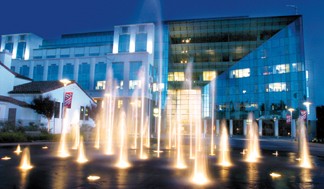
The backlit fountains outside the county government center on Texas Street in downtown Fairfield create a spectacular visual effect after sunset. (Mike McCoy/Daily Republic)

FAIRFIELD - More than a year after the last county employees moved into the new government center in downtown Fairfield, the ripple effect of the massive building's presence is beginning to be felt.

When the government center was still in the planning stages, the hope for city, county and downtown officials was that it would be a catalyst to much-needed changes and the revitalization of downtown Fairfield.

So far it has done just that, local officials said, adding that while change is happening, it's usually slow going.

"The new county building has been a tremendous asset," said Emily Low of the Fairfield Downtown Association. "A lot of the merchants here supported the project."

Once the county building became a sure thing, other projects started to materialize, Low added.

"McInnis Corner (the northwest corner of Texas and Jefferson streets) - that would not have happened without the county building," she said. That project was completed and opened about a year ago - shortly after the government center opened.

She also said the further concentration of county operations in downtown Fairfield has boosted many businesses.

"It's also just the influx of additional people - I see them walking down the street with our restaurant guide in their hands, so I know they've been (to the county building)," Low said.

"It's helped, we're seeing people down here that we didn't see before."

A large portion of the county's 3,000 employees work at the government center or in the neighboring county buildings.

With the government center so close to downtown, it's shortened the distance for people to travel for lunch, and for the weekly farmers' market, which is held on Jefferson Street.

"We've definitely noticed a shift in the demographic at our farmers' market," Low said, noting many of the customers there are county employees.

The county government center has just begun to serve its purpose in terms of bringing on a revival of the downtown area, added Curt Johnston, assistant director of economic development for the city.

"All along, we knew that government investment alone will not change the area," Johnston said. "But rather it has been a catalyst to other projects."

Johnston also pointed to McInnis corner as one example, adding more development is planned for the northeast corner of that intersection.

"Change in downtown, or in any district, is going to be incremental," he said. "We're taking small steps, but it's much different than it was 10 years ago."

Since the planning process for the county building began, a number of building renovations have also helped bring new life to downtown Fairfield, Johnston said.

"Pepper Belly's is a big one," he said. "Four or five years ago it was a struggling one-screen theater, now it's a popular comedy club."

All of downtown is looking better, Johnston added, "You drive down the street and see buildings freshly painted."

The key to getting to this point was for the city and the county to work together closely to see that both sides benefited from the project.

"The project represents the county's commitment to downtown," he said.

John Vasquez, chairman of the county Board of Supervisors, agreed.

"It's very important for the city and the county to work together."

"That was the idea when planning started in 1997 or 1998," Silva added. "The project brought another 700-plus county employees into one location."

The plaza in front of the building has served to attract people to downtown since the building opened, Vasquez added.

On a recent sweltering day, he saw a number of people gathering at the fountain on the plaza.

"There were probably 30 people in the fountain, running and playing - out there with beach towels and everything," he said. "Any time you can include a plaza like that, it allows people to gather. That's really important."

As far as the revitalization of downtown, Vasquez said it's visible on a daily basis.

"If you walk around downtown anywhere between 11 a.m. and 2 p.m., you'll see (county) people everywhere," he said. "We're already starting to see the effect migrate down (Texas Street)."

That is exactly the effect the city was hoping for, Johnston said. But more needs to be done. Specifically, the area needs more mixed-use development, combining commercial with office space.

Future hopes for the area include enhancing residential options in the downtown area, as well as finding more uses for the plaza at the county building.

"We want to create downtown as an entertainment location as well," Johnston said. "There are places like the Fairfield Center for the Creative Arts - we want to maximize the potential of those facilities."

Reach Mike Corpos at 427-6977 or mcorpos@dailyrepublic.net.

Vanden Construction Rolls Ahead

Vanden Construction Rolls Ahead
By Susan Winlow


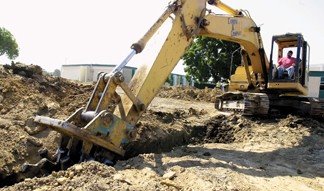
Workers with Carone and Company Construction prepare to put underground utilities where 27 new classrooms will be built at Vanden High School. (Gary Goldsmith/ Daily Republic)

FAIRFIELD - Vanden High School is tucked into a less-traveled corner of Fairfield, close to the Vacaville border.

Usually it's awash in silence - surrounded by hills and fields. Not much happens out on the corner DeRonde and Markeley Lane.

But the silence was broken recently when heavy equipment began ripping into the parking lot and knocking down school buildings. Right now much of the perimeter of the school is filled with heavy equipment, various colored pipe, building rubble and enough dirt and rock to create a small dust storm if the wind kicked up.

It's all part of a massive modernization project that began July 5, which will update classrooms and add a student parking lot, three large quad areas and an indoor eating area.

While crews hurry to finish the new student parking lot before school starts Aug. 28, the rest of the project won't be done until summer 2007.

The project, which costs $15.7 million, actually began last year when the locker rooms were remodeled and a new fire alarm system was installed.

Made possible by the passage of Proposition 47, Mello-Roos and developers funds, the remodeling continues this summer with the addition of a new lighted student parking lot.

"For Vanden that's a big thing," Principal Sheila McCabe said. "Right now there are no lights."

The newly created lot will provide an additional 40 stalls for the students, which is a boon for a school where space is tight and parking limited.

"We have a lot of kids that park on the street," said Kate Wren Gavlak, superintendent of the Travis school district. "Hopefully we will have room for all the students."

Vanden High School opened in 1965 and over the years several phases were added to accommodate the growing population. Vanden now has 1,500 students.

This is one of the largest projects since the school opened, McCabe said.

In addition to the parking lot, the school will add four buildings that will contain six classrooms each, bathrooms and office space for teachers. Right now some of the classrooms are in an area once designated a hallway between classrooms.

In addition there will be a music room and two new art studios.

"The visual art teachers are just in heaven," McCabe said.

Currently, art classes are held in the old science rooms.

"This time it will really be set up for art," said David Florez, director of maintenance, grounds and custodial facilities. "(Now) they're using old desks (from the 1960s and 1970s) and regular six-foot folding tables."

When construction ends in August 2007 the portables will be removed from the grounds, making Vanden one of the only schools without auxiliary classrooms and giving the school's exterior a new look.

"I believe in quality facilities," Wren Gavlak said. "It's always good to have permanent facilities instead of portables."

Florez agreed.

"It will make the campus look more like a campus and less like a hodgepodge," he said.

Reach Susan Winlow at 427-6955 or swinlow@dailyrepublic.net.

New Medical Offices Open

New Medical Offices Open

Solano Regional Medical Group patients now have more south-county options with this month's opening of the Sutter Regional Medical Foundation physicians' office in Vallejo.

Located on the second floor of the Sutter Solano Cancer Center at 100 Hospital Drive in Vallejo, the SRMF medical office measures more than 17,000 square feet with space for nine physicians and accompanying staff. Two primary care physicians - Maureen Mbadike and Dina Nyugen - will open the office immediately.

In addition to the two family physicians, Lorre Henderson, an ear, nose and throat specialist, and Haroon Mojaddidi, a general surgeon, will see patients at the Vallejo facility. Patients can also have labs drawn and visit the diagnostic imaging department for X-rays, digital mammograms, ultra-sound and bone density tests.

Both current and new patients living in Vallejo, Benicia, and surrounding communities like American Canyon and Napa can take advantage of local medical care from SRMG and make an appointment by calling 551-3600. The office officially opens Aug. 14.

Healthy Candy? Sweet!

Healthy Candy? Sweet!
Confectioners Cater to Health-Conscious Consumers
By Amanda Janis/Business Editor
TheReporter.Com


Developed for the Jelly Belly Cycling Team as an alternative to nutrition bars, the sport beans are now being marketed to aid workouts. (Joel Rosenbaum/The Reporter)

A kid in a candy store has a lot more options these days. And some of those options may have parents, dentists, and coaches nodding their approval, as confectioners throughout the country capitalize on one of the biggest food industry trends: Healthier products.

"As a broad marketer and a leading company, we need to be consistent with all the major consumer trends," said Lance Jensen, vice president of marketing for Fairfield-based Jelly Belly Candy Company. "It's all about keeping your brand relevant."

That's important for an industry that, according to the U.S Census Bureau, has seen a slight decline in candy consumption during the past few years. In 1997, the average American devoured more than 27 pounds of candy per year; in 2004, Americans consumed 24.7 pounds per capita.

And while the candy industry has an admittedly fun, playful air about it, it's not all Everlasting Gobstoppers and lickable wallpaper - it's big business. More than $28 billion in various types of candies were sold in the U.S. in 2005, according to the National Confectioners Association.

Jelly Belly's Jensen explained that candy companies have three basic options for creating products that fall under the "healthy halo" while maintaining fabulous flavor - highlight the healthful benefits in existing products, like the antioxidants found in dark chocolate; remove something from the products, such as refined sugar; or add something nutritional, like vitamins.

Jelly Belly does it all, with well-established product lines, including dark chocolate-covered nuts and sugar-free candies, as well as new products that fit the latter category.

Its newest "health-added" product, Jelly Belly Fruit Snacks, just hit select Costco stores last month.

"It's 33 percent fruit juice-based," Jensen said. "Sugar is in the product, but it's also made with seven fruit juices and (contains) 25 percent of Vitamin C (recommended daily allowance)."

The colorful gummy fruit snacks, which are a joint effort with Costco and its Kirkland Signature brand, could be developed for sale in traditional stores and markets, though there's no current plan to do so, Jensen said.

Incorporating fruit juice into candy - in some cases entirely replacing refined sugar - is a trend among domestic candy makers, like Atlanta, Ga.-based Innovative Candy Concepts.

Its president and chief executive realized the need for such products after watching his grandchildren eat his company's Too Tarts candy, reported Columbia News Service's Lauren Mack.

"They were basically eating pure sugar," Hammer told Mack. So he had refined sugar removed from the company's recipes, calling the revamped candies Too Tarts SmartChoice. His business grew as a result.

"It's the best thing we've ever done," he told Mack. "It's a healthier, smarter choice; it's not broccoli."

Another hot, new product that falls under the "healthy halo," Jelly Belly's Jensen said, is the Fairfield company's Sport Beans.

"This is more of an example of an energy product that takes the shape of a jelly bean," he explained. "We don't consider this a candy, we consider this an energy product."

Sport Beans - like sport drinks, bars and gels - are designed to provide a power boost before or during prolonged periods of exercise. One package of Sport Beans, which were developed with help from "key Ph.D.s" at the University of California, Davis, contains 25 grams of carbohydrates, as well as electrolytes and vitamins B1, B2, B3 and C.

"They actually got the idea to make a sport drink in a bean form from their cycling team," recalled Dr. Liv Applegate, director of sports nutrition at U.C. Davis. "They fiddled around with formulations and then gave me a call, asked me what I thought of it, and so we worked together on that about a year ago."

While the idea originated with the company's cycling team, Jensen said, "the more we developed and learned about it, we realized there are a lot of people out there (for whom) this product can fill a niche. It's a great product because it tastes great and it works."

Applegate applauds the company for taking a product already being used by athletes and making it more functional and tailored to such use.

"For years and years I've recommended that cyclists, runners and triathletes take jelly beans with them," she said, "because they can pop them in their mouth while running and it's a great source of carbohydrates."

She also praises the company for going the extra mile in product research; Jelly Belly is currently supporting a study at Davis that tests a sport drink, carb gel and Sport Beans against water. Results should be available in September or October, Applegate said, and will be presented at the American College of Sports Medicine.

Amanda Janis can be reached at business@thereporter.com.

Solano Sees No Need for Universal Care

Solano Sees No Need for Universal Care
By Andrea E. Garcia

FAIRFIELD - The need to provide health care access to the uninsured recently led San Francisco to create a universal health plan for its residents. Solano County, on the other hand, found a different way to tackle the problem years ago.

The genesis began in 1988, when California and its counties faced a major budget crisis that caused setbacks in the state's health care facilities. For Solano, a fragmented health care system hurt patients and providers.

More than 60,000 of the 370,000 residents in Solano County were uninsured while another 45,000 on Medicaid faced a decreasing number of physicians willing to treat them because of low reimbursement rates.

A collaboration of health care leaders in the county, including county administrators, CEO's of NorthBay Healthcare Group, Kaiser Permanente and Sutter Solano Medical Center, clinic administrators and Solano County Department of Health & Social Services led to the birth of Solano Coalition for Better Health, a nonprofit organization geared toward improving access to health care and the health of underserved populations.

"We've put a lot emphasis on getting anyone who is eligible enrolled in health care," said Patrick Hughes, executive director of the Coalition. "We've done it by really strengthening our clinic systems and by improving care for low income adults who don't qualify for Medi-Cal."

This idea of viewing health care collectively created a unique program among the counties in California, one that spawned a 50 percent drop in emergency room use, a 33 percent decrease in hospital inpatient days for Medicaid enrollees and a successful prenatal case management plan.

"We have the highest rate of insured people of all the counties in the state," said Dr. Rob Chapman, Solano County's deputy director of public health/public health officer. "Ninety-seven percent of all children (in the county) have insurance. And when they have access to medical care, they're healthier and don't miss school."

Currently, 8 percent of Solano County adults and 3 percent of children are uninsured, which makes Hughes believe the need of universal health care in Solano isn't really necessary.

"I would say given all the access to the health care we have and the very low percentage of uninsured, and while we could do, there really is not as great a need to do that," he said.

The county offers the Partnership Healthplan of California, which provides health care to Medi-Cal recipients; Solano Kids Insurance Program; the County Medical Services Program and Healthy Family.

"You want people to be healthy and when you delay care it's more costly," Hughes said. "It's all preventive maintenance."

Reach Andrea E. Garcia at 427-6953 or agarcia@dailyrepublic.net.

A Big Day for Travis, Solano

A Big Day for Travis, Solano
Tuesday will be a momentous day at Travis Air Force Base.

The first of 13 new Globemaster III C-17s will arrive at its permanent destination on the tarmac off Hickam Avenue. It is a proud day for Travis and for Solano County.

An incredible amount of preparation has gone into securing the C-17s for Travis, a process that began back in 2002 when the Air Mobility Command received word that it would receive the aircraft and two squadrons, one active duty and one reserve.

More than $180 million has been spent on base in construction projects to make ready for the new airplanes. In all, there are 17 construction projects, including a training simulator and squadron operations building.

At ceremonies planned on base Tuesday morning, military personnel and the community will welcome the first aircraft, aptly named "The Spirit of Solano." There's no question, Solano County has embraced Travis and helped wherever and whenever it could in the effort to expand missions at the base and keep Travis off any proposed base closure lists.

Base commanders repeatedly lauded local officials for support, including the Travis Regional Armed Forces Committee, which represents the seven Solano County cities and chambers of commerce. TRAF recently won the Air Mobility's Citizen of the Year Award for its dedication to Travis.
The C-17s will join C-5s and KC-10s giving Travis a full spectrum of missions, covering strategic, tactical and refueling tasks close to home and around the globe.

Those who will be flying and maintaining the new aircraft speak highly of its versatility and reliability. One of those is the 349th Aeromedical Evacuation Squadron. Members of that team call it a "manna from heaven" because it can be reconfigured into a flying ambulance.

Others talk about the airplanes maneuverability. One pilot describes its technology as so sophisticated that it flies "like a fighter." It has the ability to land on short runways and carry twice the cargo of the airplane it replaces, the C-141 Starlifter.

Tuesday's C-17 arrival is only a beginning. On tap will be new assault landing zone to be built to accommodate aircrew training by 2009.

Congratulations to Travis and the entire AMW for a job well done. And to a bright future.

Vacaville's Acorn Won't Fall Too Far From the Nut Tree

Vacaville's Acorn Won't Fall Too Far From the Nut Tree
Popular Site's Development has Nostalgic Twist
Robert Hollis, Special to The Chronicle


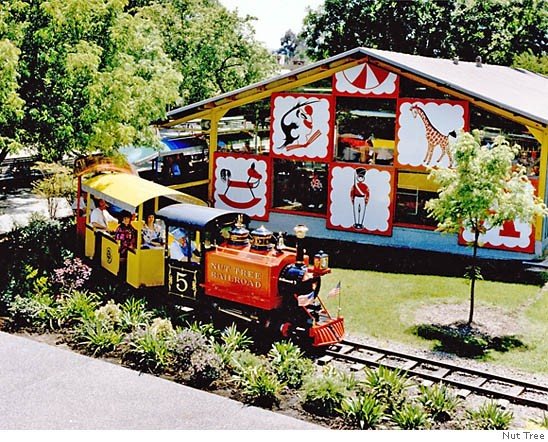
The miniature steam train was always popular at the Nut Tree in Vacaville. The new development also is expected to include one. Photo courtesy of the Nut Tree


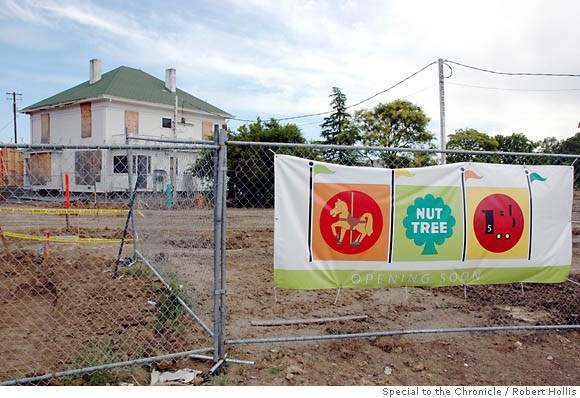
A big reconstruction of the Nut Tree land is taking place on the site along Interstate 80 in Vacaville. Photo by Robert Hollis, special to the Chronicle

Travelers of a certain age on old Highway 40 and later Interstate 80 vividly remember the Nut Tree. Generations of bored children pleaded, "Can we stop at the Nut Tree, please!"

On hot summer afternoons in the '70s and '80s, a stop at the tree-shaded roadside destination might include a ride on the miniature steam train that tooted and chugged among the orchards between the private Nut Tree airport and the station/toy store across the plaza from the famous Nut Tree restaurant.

Kids would jump from the family car and race to the big wooden rocking horses scattered about the plaza, even when summer temperatures soared past 100 degrees. Families suddenly liberated from their cramped, luggage-laden autos would queue up for ice cream, or check out the aviary as they waited to be seated in the main dining room. Others shopped for confections, the Nut Tree's trademark bread and baked goods or whimsical souvenirs at the sprawling emporium.

Begun as a rambling fruit stand just a few feet from the highway in 1921 by Helen and Bunny Power, the Nut Tree became a required stop for generations of travelers on the way to Tahoe or the coast.

When it opened for business, two-lane Highway 40 was then known as the Lincoln Highway. As the travel artery grew to its present eight lanes, the Nut Tree also grew. But by the 1990s, as travelers' habits changed, the popular spot went into decline. It closed in 1996.

Fast-forward a decade, and a new Nut Tree is rising on now-vacant land that was acquired by the city of Vacaville to keep the property intact, said Mike Palombo, Vacaville's economic development director.

With the exception of the original Nut Tree family farmhouse, the 80-acre site is being rebuilt, but with a nostalgic twist. When the first phase is finished later this year, travelers will again be able to stop and stroll among shops, restaurants, a family amusement park (with the trademark miniature steam train) and an open-air market.

When completed, the new Nut Tree will include two hotels and a conference center, 290,000 square feet of retail space, 180 condos and apartments, and 140,000 square feet of office space.

Pilot Buoyed by New Role

Pilot Buoyed by New Role
By Erin Pursell/Staff Writer


U.S. Air Force Cpt. John Flynn is a C-17 pilot stationed at Travis Air Force Base. The first of the base's 13 C-17's will be arriving on Tuesday. Flynn is standing next to a C-17 from Hickam Air Force Base in Hawaii that visited the base late last week. (Joel Rosenbaum/The Reporter)

Versatility and flexibility are traits that Air Force Capt. John Flynn shares with the aircraft he loves to fly.

Things in the sky don't always go exactly according to plan. The key, Flynn said, is rolling with it. Or in this case, flying with it.

"You have to be like a chameleon and adapt to your environment," he said.

Flynn, of the 21st Airlift Squadron, is one of 76 active duty pilots coming to Travis Air Force Base to fly a fleet of 13 of the new C-17 Globemaster III aircraft.

He joins 14 other pilots who have moved to Solano County so far, just in time for the delivery of Travis' first C-17 on Tuesday. In the meantime, the base is buzzing with anticipation.

In addition to the active duty pilots, reserve forces have been trained to fly the new aircraft as well.

"We're getting brand spanking-new aircraft," gushed Rick Tubbs, a member of the Air Force Reserve 301st Air Squadron that just spent more than a year leaning the ins and outs of the new planes.

And, he said, it's very big for the community at large.

"It just makes us a much more viable base," he said. "Something the surrounding cities can be proud of and build on as new personnel moves in."

"Once the plane gets here there's gonna be people falling all over each other to fly it," added Flynn, revealing his own excitement.

The versatile, cargo-carrying C-17 is capable of a variety of missions. That's rather like Flynn, who has been to some 41 countries, including Mongolia and New Zealand, during his six years of flying with the Air Force.

"In terms of showing up at work and having something different to do every day, the C-17 allows some flexibility," he said.

The agile hauler's ability to land in relatively short distances and on uneven terrain enables it to deliver supplies just about anywhere in the world, which makes for some interesting assignments, according to Flynn.

One of the captain's most memorable missions was flying supplies into Baghdad in 2003.

"As you were flying in, you could see the people running out from their houses and waving," he said. "It was touching to know you were going to make a difference in their lives."

The calm, fresh-faced 29-year-old moved to Benicia in late June with his wife of 15 months after spending nearly four years at McChord Air Force Base in Tacoma, Wash.

An Irvine native, he said returning to California has been a welcome homecoming.

"Everything from setting up our lease to installing Internet, everyone has been really helpful," he said. "Especially once they find out you're in the military."

Flynn was interested in the armed forces from a young age, especially after watching Army-Navy football games on TV as a kid.

"Pretty much everything that's going on around the world the military and air force has a role, in and that intrigued me," said Flynn, who ended up on the football team at the Air Force Academy before getting on the C-17 track. "And it's pretty much a guaranteed job after training."

But being a pilot isn't all Top Gun glamor.

"Some missions take up to 26 hours, including flight, stops and refueling," he said.

Then, after a short rest period of as little as 12 hours, they can re-embark on "back-to-back-to-back" flights.

"I wasn't a big coffee drinker until I started flying longer trips," he laughed.

With the C-17 being added to the base's C-5s and KC-10s, Travis is now at the forefront of air mobility.

"It's kind of the last piece of the puzzle in terms of aerial command at Travis," said Lieutenant Lindsey Hahn, a base spokeswoman.

And Flynn is happy to be a part of that puzzle.

"You have to take a step back sometimes and realize there are not many people in the military world who get the opportunity to do what you're doing."

He often considers this, he said, while soaring more than 30,000 feet above one of the world's vast oceans.

Erin Pursell can be reached at vacaville@thereporter.com.

A Special Debut

A Special Debut
Travis Awaiting 'Spirit of Solano'
By Jason Massad/Staff Writer

The pending arrival of the first C-17 cargo plane to Travis Air Force Base is more than just a move of multimillion-dollar machinery to a military hub in Northern California, base officials say.

The impressively nimble hauler, which can jet a 60-ton M1 Abrams tank or 100 troops to the front lines in Iraq, signals a shift toward modernization that could insulate Travis from future rounds of military base closures.

The base will receive the first of its 13 C-17s Tuesday. It will be christened "Spirit of Solano," a nod to the local community that has rallied around the base through tough times. The coming fleet of C-17s will complement the base's two squadrons of KC-10 refueling aircraft and one remaining squadron of the C-5 cargo haulers.

"That's what is really unique about Travis," said Col. Mike Shanahan, in charge of bringing the new C-17 aircraft to the base. "I hate to be clich , but it makes Travis America's first choice because we can do all three missions."

The upcoming "triple threat" of aircraft at Travis will make it singular among air mobility bases in the nation, military officials say. Neither McChord Air Force Base, Wash., nor those at Charleston, S.C., and McGuire, N.J., will be able to boast of Travis' pending versatility, say military officials.

To points around the globe, C-5 haulers originating from Travis will carry supplies to "strategic" locations. The base's KC-10s will circle the skies, refueling fighters and cargo aircraft alike. The C-17s, meanwhile, will be flown directly into battle-marred landing strips such as those at Bagram, Iraq and Kandahar, Afghanistan.

"Say the Army needs an M1 battle tank. We can carry that tank right into battle," Shanahan said. "We take the middle man out. We take Travis direct ... it makes for a more efficient operation."

Leaders around the Solano County community see the arrival of the C-17 fleet to Travis as decidedly positive. That enthusiasm is tempered, however, by the fact that the incoming C-17 "mission" doesn't expand the base by much.

Travis is phasing out one of its squadrons of C-5s - 19 of the aging, massive cargo haulers. With the influx of the new C-17 fleet during the next year, that C-5 squadron then essentially will have been replaced. An estimated 140 people could be added to the base's roster of active-duty personnel as a result of the change.

The local base currently employs about 15,000 military and civilian personnel, creating a $1.2 billion annual economic impact on the regional economy. Community leaders would like nothing more than to see Travis expand to a larger degree - and take the region's housing market and retail sales along for the ride.

"I see plenty of room for more aircraft," said Mike Ammann, president of the Solano Economic Development Corporation. "When I'm up there in the tower, I see a pretty big flight line that could be filled."

Make no mistake, things could be worse. Just last year, a round of federal base closures threatened to shutter or downsize military installations across the nation. With Travis spared from the dreaded closure list, the C-17 modernization effort breezed forward.

In addition to the new aircraft fleet, the Department of Defense allocated nearly $188 million in new C-17-related investment at the base. The improvements include a new flight simulator and a C-17 squadron operations center that will help accommodate the 700 personnel associated with flying, maintaining and loading of the planes in the new squadron.

In the middle of all this, Travis is in the process of upgrading its on-base housing and has opened up a new hotel that can host visiting brass. The base also has a new fuel pipeline on the flight line and relatively new radar equipment.

"Those are all good signs. They give you the opportunity for future growth," Ammann said.

Solano County Supervisor Mike Reagan, a former lieutenant colonel at Travis, said he also would like to see Travis built out.

He recalls the glory days when Travis had six active-duty aircraft squadrons, not the current four. The base's boosters will continue to push federal legislators for more missions at Travis, which could be essential to its long-term survival, Reagan said.

"We need two more squadrons here,' he said. 'Whatever it is, at the end of the day, we need a total of six squadrons to be made whole."

Jason Massad can be reached at county@thereporter.com.

Sunday, August 06, 2006

Solano County - Once-quiet corridor from Vallejo to Davis sees housing boom

Not a lonesome highway
Once-quiet corridor from Vallejo to Davis sees housing boom
- Robert Hollis, Special to The Chronicle
Sunday, August 6, 2006


Despite 15 months of slowing sales across the Bay Area, Solano County finds itself in a unique position: Although its 36.2 percent decline in June compared with a year earlier is the greatest of the nine Bay Area counties, its median price rose the most.

Solano homes and condos continue to be the most affordable in the Bay Area, drawing a steady stream of buyers even as the median home price reached $482,000 in June, up 7.3 percent from June 2005, according to DataQuick Information Systems, which tracks real estate sales statewide.

Sandy Vollmer, president of Solano Association of Realtors, says median prices continue to inch up because homes in the lowest- and highest-priced segments are still selling relatively well in today's environment of higher interest rates and fewer buyers.

Solano's housing boom has been going for about two decades. Today the growth is most pronounced along the Interstate 80 corridor as it courses through the western hills and flat eastern expanses of Solano and Yolo counties. What was once a relatively carefree ride between the Bay Area and Sacramento can now be a daily slog that is often punctuated by gridlock.

For Vallejo residents Cathy and Ray Diaz, who are buying an as-yet unbuilt 2,810-square-foot home just across the Napa County line in American Canyon for about $800,000, there is also the lure of getting more for their money.

"We decided we wanted to move into a bigger home," Cathy Diaz said of the four-bedroom, 3 1/2-bath dwelling in Standard Pacific Homes' Dolcetto at Vintage Ranch development.

"A lot of people are willing to sacrifice commuting for a bigger home," she said. "These houses are being snapped up."

Commuters from Solano County's far-flung cities have to be a special breed: Vacaville is 52 stop-and-go miles from San Francisco via I-80 while Vallejo is 30.

The lure of more-house-for-the-money has in recent years turned places like Vallejo, Fairfield, Suisun City, Vacaville and Dixon into some of the fastest-growing communities in Northern California.

In the process, urban planners and road builders have had to race to keep up. Once-sleepy communities now struggle with development controversies and sprawl. Meanwhile, homes carrying prices from about $400,000 to upward of $1 million have created a linear suburbia along I-80.

Glen Martin, East Bay division president for Standard Pacific Homes of Northern California, agrees that home sales have slowed in the last year or so, but he predicts that it's only a pause. Standard Pacific, one of the region's major builders, has developments in Fairfield, Vacaville and American Canyon.

County and regional planners also predict that the growth slowdown is only a pause. Projections by the Association of Bay Area Governments show Solano's population of about 440,000 will expand by 30 percent by 2025 to around 573,000, with much of it expected to occur in the county's major cities, Vallejo, Fairfield and Vacaville.

To tens of thousands of motorists, the clustering of development means there is no way of avoiding rush-hour crunches along I-80 that can add 30 minutes or more to travel times. Conditions are forecast to get worse before they ever get better, according to a 2004 study done for the Solano County Transportation Authority.

Smaller communities are also struggling with rapid expansion. Dixon, once a somnambulant agricultural crossroads that hugs Interstate 80 near Solano County's eastern boundary, is undergoing a dramatic transformation as subdivisions and commercial centers have consumed hundreds of acres of the checkerboard fields covering the rich Sacramento Valley floor.

In the early 1980s, Dixon's population was around 6,000. Today it is three times that.

Real estate professionals say Dixon's growth reflects its proximity to Davis, just 6 miles east across Putah Creek in Yolo County, and Sacramento's still-growing job market. Davis is home to the University of California's largest Central Valley campus and a magnet for high-tech and biotech companies offering good salaries to the well-educated local workforce.

Since the tree-shaded university town long ago enacted tough growth controls, a strong market for home developments has emerged in Dixon and Woodland, to the southwest and northwest of Davis, respectively.

Sales down, prices up

One of the most vexing realities confronting real estate shoppers in Solano and Yolo counties is that as home sales have declined sharply for 15 months, prices have continued to rise modestly.

DataQuick figures show that in most of Solano's communities median prices were up in June compared with a year ago. Exceptions included two neighborhoods in Vallejo and Fairfield, which recorded 1.2 percent and 2.3 percent drops; parts of Vacaville, which saw a 6.3 percent decline; and Benicia, with a 5.4 percent slippage.

In some cities, declines in sales have been dramatic. In parts of Vallejo, sales were off 59.7 percent in June compared with the same month a year ago. In one Vacaville ZIP code, sales were off 48.2 percent; even Dixon saw a drop of 41.3 percent in June sales compared with a year ago.

Vollmer, the Solano Association of Realtors president, said the California Association of Realtors now predicts that the statewide median home price is likely to increase by only 8 percent for the year.

The softening market has also caused sellers to offer a variety of enticements to make a sale. "Sellers may give buyers a credit for closing costs, credits for dated household equipment," she said. "They are also leaving appliances, spas, things of that nature."

Despite increasing inducements, the average days on market for existing homes before they sell has nearly tripled in the past 12 months, according to Multiple Listing Service figures. In June, the average home sold in 74 days in northern Solano County compared with 27 days in June 2005. In the southern part of the county -- Vallejo and Benicia -- it took 72 days to sell a home on average in June, compared with 30 days in June 2005.

The Diaz family, like many other Solano homeowners, bought their first home in Vallejo more than a decade ago, moving from a rental in Daly City. With one daughter leaving for college this fall and a second girl in middle school, both parents commute long distances: Ray Diaz to Concord and Cathy Diaz via ferry to downtown San Francisco.

Cathy Diaz said what attracted her and her husband to the Standard Pacific home in American Canyon was a design incorporating an interior courtyard. "It's amazing, I've always liked homes with courtyards," she said. "We were really pleasantly shocked by the layout."

Not everyone commutes

While Solano's population growth still outstrips job growth, county officials boast of an expanding biotechnology hub in Vacaville, and new health care facilities there and in Vallejo as signs that an ever-larger percentage of well-educated residents are finding good-paying professional positions locally.

Genentech, the South San Francisco biotech behemoth, has a 33-acre pharmaceutical production facility on the outskirts of Vacaville employing about 700 people, according to the company's Web site.

The company is expanding the 427,000-square-foot facility by 380,000 square feet and expects to begin operating in the facility with 595 new employees in 2009. The expansion represents a $600 million investment, the company says.

Two other major biotech companies, Chiron, which was acquired by Novartis in April, and Alza, a unit of Johnson & Johnson, employ several thousand workers. Alza occupies six buildings while Chiron owns more than 50 acres in the city, according to Michael Ammann, president of the Solano County Economic Development Corp.

Kaiser Permanente is also making major investments in Vacaville and Vallejo to keep up with regional growth. The nation's largest health maintenance organization expects to finish replacing a 248-bed hospital adjacent to its medical office complex in Vallejo in 2008. A 166-bed hospital in Vacaville, next to I-80 at Leisure Town Road, is also under construction and will be finished a year later, Kaiser says.

By far the largest employer in the county is Fairfield's Travis Air Force Base, whose 19,000 or so military and civilian personnel pump about $1 billion a year into Solano's economy, according to Karin MacMillan, the city's former mayor who ran unsuccessfully in June for county supervisor.

Fairfield voters in 2002 enacted a controversial urban growth boundary that banned housing and commercial development around the sprawling airbase. MacMillan said 60 percent of voters approved the measure to help protect "this incredible economic engine" from possible closure by the Pentagon. The growth limit explicitly allows the airbase to expand into the protected open space for military purposes, she said.

Another large employer in Vacaville is the state Department of Corrections, which operates the California Medical Facility and the Solano state prison.

Working locally can make a big economic difference, especially in an age of $3.25-a-gallon gas. Before she landed her job as the Napa-Solano field representative for the Greenbelt Alliance in her hometown of Fairfield, Nicole Arnold worked for a nonprofit in Sacramento.

"Even though I drive a fairly small car, I figure I saved $5,000 on gas and other travel costs after the first year," she said. "That's like getting a $5,000 raise." She says she feels "incredibly lucky" to now work in Solano County.

Development galloping

Traveling east from Vacaville along I-80, subdivisions and commercial development thin out and travelers can still see stretches of agricultural land that once dominated most of the route from Vallejo to Sacramento. But this, too, is changing.

Dixon is embroiled in a divisive debate over a proposed 260-acre racetrack-satellite betting-retail/entertainment complex called Dixon Downs.

Proponents, including many local officials and the city Chamber of Commerce, argue that the project planned for the northeast corner of town by Magna Entertainment of Ontario will bring much needed tax revenues, developer-paid streets and sewers, a large number of permanent jobs and a general revitalization of the local economy.

Opponents say the sprawling project will fundamentally alter the community's small-town image, significantly worsen traffic, exacerbate air pollution and, if laws change in the future, bring slot-machine-style gambling.

Nor is the racetrack complex the only development changing the city. About 600 acres of commercial development and 500 acres of residential development have been constructed, approved or proposed within the small city, according to the draft Dixon Downs environmental impact report.

Last August, opponents presented petitions signed by about 1,700 people seeking to have the Dixon Downs proposal put to a public vote. But in May, the City Council declined to put the issue on the ballot. Now the council is looking at other ways to gauge citizen sentiment.
Next week: Transportation and the environment on the Interstate 80 corridor.

Friday, August 04, 2006

This Fine Ol' House

This Fine Ol' House
It Echoes Nut Tree Nostalgia
By Erin Pursell/Staff Writer
TheReporter.Com


Shawn Lum, executive director of the Vacaville Museum, peers out the window of the master bedroom of the Harbison House. Renovations for the Harbison family home are in full swing. When completed, it will be the centerpiece of the Nut Tree Family Park. (Joel Rosenbaum/The Reporter)

The Harbison House still is boarded up. Long wires curl out of its peeling walls and bees swarm out of one of its hollow redwood columns.
But not for much longer.

"It's the only architectural structure left from the original Nut Tree," said Vacaville Museum Director Shawn Lum.

Major fundraising efforts are finally under way toward the estimated $1.5 million price tag for the makeover of the 1907 colonial style ranch house that will be the heart of the new Nut Tree Family Park development.

Since its kickoff just two weeks ago, the Harbison House Capital Campaign already has secured $142,000 in pledges toward the restoration.

With photo and artifact galleries and hands-on interpretive exhibits like butter making and fruit drying, the historic landmark will become a living and interactive museum, showcasing the rich history of both the Nut Tree and Vacaville.

"This is not just about the Nut Tree," said Mayor Len Augustine, who is also a member of the museum's board of directors. "It's a definite link to Vacaville's past and the history of Solano County."

"It's a phenomenal opportunity for people to be able to go to the new Nut Tree and find elements of the old (Nut Tree)," Lum added.

Built by renowned homebuilder George Sharpe for Luther and Hester Harbison, the structure currently is owned by the Vacaville Museum after being donated by the Power and Fairchild families, who ran the Nut Tree for more than 70 years.

Last October, the house was moved about 1,000 feet across the Nut Tree property to its current location, where a historical architect is helping plan its rebirth.

"It represents something that's really family oriented," Augustine said. "That's why it was put in the middle of the family park."

While the house won't be open to the public until sometime around September 2009, interim repairs are set to begin immediately.

Installing the repaired original stained glass windows, as well as a new door and fresh paint job at least will make its presentation more pleasant in time for the Nut Tree opening, Lum said.

After years of shuttered isolation, once the musty smell and dust of construction have lifted, the fully restored home will be accessible not only to the local community but also the estimated 3 million annual Nut Tree visitors, according to Lum.

"The legacy of Nut Tree is a prominent one," she said. "Nut tree had a draw that was statewide and in some cases even greater than that."

While the new Nut Tree may or may not have that same draw, Lum hopes that the Harbison House will help maintain some of the nostalgia about the historic site.

"I think of it as more of a visitor center than a museum," she said. "It adds to this park a sense of place that would have been missing."

Erin Pursell can be reached at vacaville@thereporter.com.


A mural that hangs in the dining room of the Harbison family home is seen Wednesday at the home's new site. (Joel Rosenbaum/The Reporter)


Landscape work continues this week adjacent to the Harbison House on the grounds of the Nut Tree Family Park. (Joel Rosenbaum/The Reporter)

Thursday, August 03, 2006

Head Start Program Among Nation's Best

Head Start Program Among Nation's Best
By Susan Winlow

FAIRFIELD - The Solano and Napa County Head Start program recently earned the National Head Start Association's highest award.

Child Start Inc., which operates the Head Start program in both counties, earned the Quality Initiative Program of Achievement. In a field of 2,700 Head Start programs in the United States, Child Start and two other U.S. programs were singled out for their outstanding quality of preschool education services offered to young children and families, and the positive impact the program has on the community.

"We've been working so hard and we're proud of ourselves," said Lisa Wiggins, a teacher at the Mariposa 2 site in Vacaville. "It takes a village, right? We have a big village."

The local Head Start program not only promotes kindergarten readiness for the child, it helps entire families prepare for a child's entry into the school system.

"We deal with moms, dads and siblings," said Debra George, a teacher at the Woolner Avenue site in Fairfield. "We try to help the whole family and not just the child who is registered with our program."

The Program of Achievement is given after a Head Start program is reviewed and certified to be in full compliance with Head Start performance standards. The program also undergoes a review of 77 achievement indicators in several areas such as organizational development, parental involvement and program enrichments.

Earning awards is not new to Child Start. It received several other honors from the National Head Start Association, which include being named a 40th Anniversary Head Start Grantee. Child Start executive director Jackie Dollar Harrison received the Lifetime Achievement Award.

Head Start, a federally funded program designed to help low-income families, began nationwide in 1965 and Napa County provided one of the first Head Start sites that year.

Child Start was created in 2000 to operate the Head Start programs - and other early childhood development services - in both Solano and Napa Counties.

In Solano County, Fairfield, Suisun City and Travis Air Force Base are the county's three biggest draws for Head Start, said Erin Busby, the regional program director. Out of 1,000 children, 380 are from those three areas.

Reach Susan Winlow at 427-6955 or swinlow@dailyrepublic.net.

Wednesday, August 02, 2006

Firm licenses UCD diagnostics for autism

Article Created: 7/28/2006 09:56 AM

Firm licenses UCD diagnostics for autism

Daily Democrat

SACRAMENTO - Pediatric Bioscience Thursday announced the hiring of Dr. Thomas R. Anderson as the founding CEO and the licensing of three technologies from UC Davis.

Pediatric Bioscience was formed by a group of researchers, parents and experienced business leaders with the goal of bringing to market diagnostics and therapeutics to diagnose and eventually treat children with autism.

"Great advances in medicine are brought to market by a combination of public research and private enterprise," said Dr. Anderson. "By building on the work done by the research team at the UCD M.I.N.D. Institute, we can have a direct positive impact on children with autism and their families by bringing to market reliable diagnostic tests for autism."

Pediatric Bioscience has licensed three promising discoveries of the UCD M.I.N.D. Institute, a multidisciplinary research center striving to find causes, improved treatments and ultimately cures for neurodevelopmental disorders.

The licensed technologies include: A prenatal assessment of increased risk of delivering a child with autism by detecting certain auto-antibodies in the blood of the prospective mothers, and a method for detecting autism biochemically, rather than by observed behavior, allowing for much earlier identification of children with autism.

"The M.I.N.D. Institute was founded on the promise to parents to take the quickest path possible to finding answers to autism," said Dr. Robert Hendren, executive director of the UCD M.I.N.D. Institute. "We are coming closer every day to fulfilling that promise with new discoveries on the biological markers of autism. We're thrilled that our research outcomes will be developed further and will eventually be available to the broader community of scientists and clinicians."

Dr. Thomas R. Anderson is an experienced executive with successful tenures at several early stage bio-pharmaceutical companies.

He founded Berkeley Antibody Company and was instrumental in the growth of the company through its successful sale to Covance. He most recently served as the CEO of Lipomics Technologies of West Sacramento, a leading metabolomics company with capabilities in quantifying lipid metabolites and interpreting their biological significance.

Pediatric Bioscience LLC was formed in 2006 by a group of researchers, parents and experienced business leaders with the goal of bringing to market diagnostics and therapeutics to diagnose and eventually treat children with autism. The company is based in Sacramento.

Crucial Report on Dixon Downs

Crucial Report on Dixon Downs
Racetrack Analysis Completed
By Melissa Murphy/Staff Writer

A proposed horse racetrack and entertainment center in Dixon would have unavoidable impacts on the city, but concerns about traffic, air pollution, water and other issues are matters to be dealt with by the City Council as it moves closer to a final decision on the proposal.

Those are some of the findings of a final environmental impact report on the proposed Dixon Downs development. The report now is available for public review.

But city leaders say they have no intention of jumping the gun on Dixon Downs, a thoroughbred racehorse and training facility, retail, hotel and conference center development proposed by Magna Entertainment Corp. for 260 acres in northeast Dixon. The final EIR, they note, is but the next step in review for the proposed track.

City leaders, project proponents, opponents and local citizens are digging into the 4-inch thick document, saying they believe it is thorough, but that they need more time to review its findings.

The final EIR consists of a draft report released last year as well as written comments received from agencies and individuals, and responses to those comments.

Among the agencies to submit comments were the California Regional Water Quality Control Board, Assemblywoman Lois Wolk, the Army Corps of Engineers, Public Utilities Commission, California Integrated Waste

Management Board, California Highway Patrol, California Department of Transportation, Yolo-Solano Air Quality Management District and a host of others.

In the area of transportation, concerns about traffic impacts in the city were expressed by state highway officials, in particular the CHP, which noted the Dixon Downs development and proposed Milk Farm development would require additional officers and vehicles to be brought on board. The EIR response says the Dixon City Council will consider that issue as it decides on Dixon Downs.

In addition, the final report acknowledges that impacts on certain intersections would have to be dealt with before the project could be built.

In the area of impacts on air, the EIR notes that during construction air quality standards of the Yolo-Solano Air Quality Management District would be exceeded. It says those issues will have to be forwarded to the Council for consideration.

As for water issues, the EIR notes some concerns about increased use and also notes that the Council will have to weigh those issues in deciding on the Dixon Downs complex.

"The final EIR is just a response to the comments made by the public," explained John O'Farrell, local project manager for the proposed facility. "We plan to show that the project is environmentally superior."

With more than a month until the first meetings on the EIR in September, city leaders say they are using various strategies to tackle the lengthy document.

Planning Commissioner Yvonne McCluskey said she has spent the last few weeks gathering notes and letters that she has received personally to make sure she has all the information before the public review process gets under way.

Councilman Michael Smith said taking the time out of a busy schedule to read hundreds of pages is not an easy thing to do.

"It took me 16 hours to read the draft," Smith said. "I'm guessing it's going to take an entire weekend to read through the final EIR for the first time."

Some points of interest for Smith are the response to the traffic concerns as well as drainage.

O'Farrell believes that as they delve into the document, city leaders and others will find that Dixon Downs "is a good project that will give Dixon lasting benefits."

One thing for sure is that the Planning Commission and City Council will continue to listen to constituents, according to Vice Mayor Gil Vega.

"We get contacted more than people think," he said. "It's time to make an informed decision. The developer has waited a long time and we owe them an answer."

Melissa Murphy can be reached at dixon@thereporter.com.

Tuesday, August 01, 2006

Sutter opens Vallejo primary care center

Sutter opens Vallejo primary care center

East Bay Business Times - 2:26 PM PDT Tuesday
by Kathy Robertson

Sutter Regional Medical Foundation will open a new medical office building in Vallejo on August 14 to serve new and current patients living in Vallejo, Benicia and surrounding communities like America Canyon and Napa.

The 17,000-square-foot office is located on the second floor of the Sutter Solano Cancer Center at 100 Hospital Drive in Vallejo.

Sacramento-based Sutter Health is spending $42.5 million to recruit more doctors and build more medical offices in Solano County. Ambulatory care has become the fastest-growing segment of Sutter, as the health system adds services in areas where there is demand.

Two primary-care physicians will open the Vallejo office, but there is room for nine doctors and accompanying staff. An ear, nose and throat specialist and general surgeon will see patients at the new office, and additional specialties, including obstetrics and gynecology, will be added soon.

Patients can get laboratory work done on site, as well as X-rays, mammograms, ultrasound and bone-density tests.

Sutter stepped up its involvement in Solano in mid-2003, when the largest multispecialty doctors' group in the county sold its assets to the health system. The group is now called Sutter Regional Medical Foundation.

"We are extending our reach to South Solano County, giving residents and families greater choices in medical care in a new, state-of-the-art facility," said Dr. Samuel Santoro, president of the medical group.

Solano EDC Hosts Golf Tourney

Solano EDC Hosts Golf Tourney

GREEN VALLEY - Solano EDC will host its 17th annual Golf Classic Aug. 14 at Green Valley Country Club.

The event includes a barbecue lunch, free use of the driving range, green fees, golf cart, putting contest, tee prizes, a closest-to-the-hole contest, a long-drive contest, two mulligans and dinner.

The cost is $175 per golfer.

Registration and free driving range starts at 10 a.m. The putting contest is 10-11:30 a.m., with the barbecue at 11 a.m. The shotgun start begins at noon.
To reserve a foursome call Pat at 864-1855 or e-mail pat@solanoedc.org with player names, company, address, phone and estimated handicap. Singles are welcome also. Advance payment is required.

Solano's Got It!

Solano's Got It!
The Best That Northern California Has To Offer.