Article Published: Tuesday, February 22, 2005
Solano at front of pack
County is in position for boom, study finds
By RACHEL RASKIN-ZRIHEN, Times-Herald staff writer
Solano County is better positioned to take off economically than most of the region, according to the second independent study in two weeks to make the claim.
The new study shows Solano County suffered less and recovered faster from the nation's recession earlier this decade than much of the rest of the area. The report, released by Sonoma State University's Center for Regional Economic Analysis, mirrors the findings of an Association of Bay Area Government economic forecast last week.
Solano County is on an upward economic trend, the new study shows.
A variety of current and predicted economic trends "show Solano County on the upswing, that the economy is moving toward a boom," center director Robert Eyler said.
Like ABAG's analysts, Eyler said Solano County's diverse economic base and its less expensive real estate likely explain how it escaped the worst of 2001's economic downturn. The recession hit hardest areas like Silicon Valley that rely heavily on high-tech industries.
But even Solano County's economy has slowed in the past five months, Eyler said.
"Employment grew faster in the beginning of 2004 than at the end of it. It's still positive, but slowing," Eyler said. "Solano County is still moving a little faster than other counties, and the forecast for Solano County is probably the best of all the counties I study."
Eyler has studied Solano, Marin, Napa, Mendocino and Lake counties' economies for the past three years, though this is the first time he's published the results, he said.
Eyler analyzes economic indicators including notices of default and bankruptcies, residential building permits, help-wanted ads, initial unemployment insurance claims, an agricultural price index and the U.S. Leading Economic Indicator. He also compiles local data on non-farm employment levels, county taxable sales and county personal income levels.
Solano County can become the standout North Bay county, if it plays its cards right, Eyler said.
"I think people don't recognize the potential of Solano County, which is starting to show its face. Solano and Sonoma counties have the most balanced economic bases in the area, though the others are catching up. It's a survival issue," Eyler said. "You have to look at these counties like countries. They don't want to export their incomes into other counties.
"Marin, for instance, gets a lot of its employees from Solano because of its cost of living, which means it's exporting a lot of its income dollars to Solano County, which benefits retail-wise, and they pay property taxes in Solano."
County economies not only compete, they also depend on each other in what Eyler calls "an interesting symbiotic relationship."
"Solano County is growing steadily and didn't experience a huge downturn during the recession," Eyler said. "Compared to other counties I study, it's seen continued growth, while others were hit a little harder in 2001 and 2002.
"In general, Solano County is one of the more dynamic local economies, for sure," he said. "People mistake Solano County for places like Lake and Mendocino counties - places you drive through to someplace else - but it's bordered by many other dynamic local economies and is poised to be a hub if it grows the right way. The seeds are there."
Eyler said if Solano County can attract a major player in some high-tech industry like communications or bio-technology, it can "develop around it."
"The challenge," Eyler said, "is to develop an economic profile of what the county is and what it wants to be, develop a plan, and act on that."
- E-mail Rachel Raskin-Zrihen at RachelZ@thnewsnet.com or call 553-6824.
Tuesday, February 22, 2005
Wednesday, February 16, 2005
North Bay Bancorp profits climb 16%
By Reporter Staff
North Bay Bancorp, parent of The Vintage Bank in Napa County and Solano Bank in Solano County, reported Monday that profits grew by 16 percent in 2004.
Strong loan demand, excellent deposit growth and a stable interest margin were among the reasons for the higher profitability, according to a press release.
In 2004, loans grew 23 percent to $374 million, deposits grew 19 percent to $484 million, the net interest margin was virtually unchanged, return on equity increased 64 basis points, and the efficiency ratio improved by 217 points from a year ago.
Net income increased to $5.1 million in 2004 compared to $4.4 million in 2003. Fourth-quarter profits increased 21 percent to $1.6 million, compared to $1.3 million in the fourth quarter 2003.
Other highlights include earnings per diluted share increased 13 percent to $1.29 million, and revenues increased 20 percent to $27 million.
Solano Bank, now a division of The Vintage Bank, has offices in Vacaville, Fairfield, Vallejo and Benicia.
North Bay Bancorp, parent of The Vintage Bank in Napa County and Solano Bank in Solano County, reported Monday that profits grew by 16 percent in 2004.
Strong loan demand, excellent deposit growth and a stable interest margin were among the reasons for the higher profitability, according to a press release.
In 2004, loans grew 23 percent to $374 million, deposits grew 19 percent to $484 million, the net interest margin was virtually unchanged, return on equity increased 64 basis points, and the efficiency ratio improved by 217 points from a year ago.
Net income increased to $5.1 million in 2004 compared to $4.4 million in 2003. Fourth-quarter profits increased 21 percent to $1.6 million, compared to $1.3 million in the fourth quarter 2003.
Other highlights include earnings per diluted share increased 13 percent to $1.29 million, and revenues increased 20 percent to $27 million.
Solano Bank, now a division of The Vintage Bank, has offices in Vacaville, Fairfield, Vallejo and Benicia.


From war to wine
Storage facility is part of the changing face of Mare Island
By RACHEL RASKIN-ZRIHEN, Times-Herald staff writer
Grapes aren't the only thing growing in the Napa area. There is also a need for wine storage warehouses growing in the region - a need Jack Krystal aims to help fill with his new Wines Central, LLC facility on Mare Island.
Krystal, a San Rafael real estate developer and entrepreneur, was advised that wine-storage is a growing industry, and that the rapidly changing Mare Island is the perfect place to operate such a business. The building Krystal chose, 710 L St., Building 627 on Mare Island's northwest end, once had a very different purpose.
"I fell in love with the building, and I was informed it used to be used to store torpedoes and ordnance. And I thought this would be a much better use for it. It's construction and layout is perfect for this," Krystal said.
Wines Central's warehouse manager Glenn Coats, 47, said rumors among some Mare Island old-timers has the building storing either the Hiroshima or Nagasaki atomic bombs briefly during the war. The building's layout - huge, movable cranes, thick concrete walls, floors and ceilings and heavy steel doors that open to allow rail cars inside - seems to lend some credence to the possibility.
"Several people told me that, and I saw something about it on a documentary once," said Coats, who spent much of his childhood in Vallejo. "It's quite a facility."
Krystal said he's known Mare Island for many years, having developed several projects in Vallejo, including the Fairgrounds Holiday Inn and a number of homes in South Vallejo.
"Vallejo has been dear to my heart for the past 30 years," said Krystal, a 60-something father and grandfather originally from Argentina. "I go back to the days when Vallejo had 50,000 people; to the days when the mayor was Florence."
Krystal said his love of wines was born in his Argentinean childhood.
"I've been drinking wine since I was a child," he said. "In Argentina, it's like Italy and France. You drink wine with lunch, with every meal. It's like Coca Cola out here."
Krystal leaves the day-to-day operation of Wines Central to Debbie Polverino of St. Helena, its general manager who has been with the 3-year-old firm for just over a year. Krystal explained his business plans to Polverino and offered her the job. And it was a perfect fit, she said.
"He liked the building and he knew it would be great for storing wine. It's near the Napa Valley. Wine storage and distribution is a big business in this area," Polverino said. She said there are several area warehouses devoted to the industry, though Wines Central is the only one in Vallejo. The city's access to all forms of shipping options from truck to rail to sea, makes the Mare Island location especially desirable, she said.
Polverino, 42, said she was practically born into the wine business.
"I've been in the wine business for 25 years," Polverino said. "I've been the general manager of warehouses and wineries. I'm from the Napa Valley, so my history in the wine industry goes all the way back to my grandfather growing grapes. My whole family grew up in the wine industry. It's our life. We've never done anything else."
Polverino said her grandparents immigrated to the United States from Spain in the early 1900s. Wine has proverbially been running through her veins for three generations on her father's side, and even longer than that through her husband's, she said.
"It has to do with history - the evolution, the change in the community, the passion. I remember as a child playing in the vineyards," she added. "It's all there was. I love the vineyards, they're the most beautiful in the world. That's why you live here - because you love the wine and it's a passion. I love everything about it. Everything I've ever done has to do with the wine industry. I love that I'm involved in it. It's not hard to love this."
As familiar as she is with the various aspects of the wine business, Polverino said she immediately recognized the potential in Krystal's idea to store wine in a Mare Island building.
"Land in the Napa Valley is very expensive, so most of it is used to grow grapes. There are very few storage or distribution facilities there," she said.
Her vast knowledge of the various aspects of the wine industry permits Krystal to leave Wines Central's operation in Polverino's capable hands, she said. While whipping the place into shape after being hired, she engaged her marketing skills and contacts to let people know that the perfect wine storage facility was open, she said.
"I talked to people I knew about this great, safe building, the great prices. The police department and fire department are nearby. It's a great location for shipping," Polverino said.
Polverino said Wines Central now has about 80 winery clients and some 40 private collectors storing their precious bottles and barrels in its facility's various sized locked cages.
"Our clients include small collectors, marketing companies, overflow warehousing and wineries' library collections, which are the history of the winery by vintage examples," Polverino said. The Francis Ford Coppola brand of pastas and sauces, C&H Sugar, specialty olive oils and a variety of other merchandise is stored in the always chilly climate-controlled environment.
Wines Central employs eight local people and expansion is planned, Polverino said.
Besides storage of wines, bottled water, specialty food items and other materials on a lane address system, Wines Central processes orders, arranges shipping and distribution for clients and provides them space to do special projects like holiday labeling.
Everything is organized on a computerized software system designed specifically for the wine storage industry, Polverino said.
Polverino and Krystal said they especially like being involved in changing Mare Island's military image into a more peaceful one.
"I like that they're taking the old military buildings and converting them to civilian use like this," Polverino said.
Krystal said he hopes his new enterprise will add to Mare Island's renaissance.
"I hope it becomes an indispensable service business for small to medium sized wine makers, right at the front door to Napa and Sonoma, and helps make Mare Island an oasis of productivity and jobs for Vallejo," he said.
For information, visit www.winescentral.com , or call 551-7000.
By RACHEL RASKIN-ZRIHEN, Times-Herald staff writer
Grapes aren't the only thing growing in the Napa area. There is also a need for wine storage warehouses growing in the region - a need Jack Krystal aims to help fill with his new Wines Central, LLC facility on Mare Island.
Krystal, a San Rafael real estate developer and entrepreneur, was advised that wine-storage is a growing industry, and that the rapidly changing Mare Island is the perfect place to operate such a business. The building Krystal chose, 710 L St., Building 627 on Mare Island's northwest end, once had a very different purpose.
"I fell in love with the building, and I was informed it used to be used to store torpedoes and ordnance. And I thought this would be a much better use for it. It's construction and layout is perfect for this," Krystal said.
Wines Central's warehouse manager Glenn Coats, 47, said rumors among some Mare Island old-timers has the building storing either the Hiroshima or Nagasaki atomic bombs briefly during the war. The building's layout - huge, movable cranes, thick concrete walls, floors and ceilings and heavy steel doors that open to allow rail cars inside - seems to lend some credence to the possibility.
"Several people told me that, and I saw something about it on a documentary once," said Coats, who spent much of his childhood in Vallejo. "It's quite a facility."
Krystal said he's known Mare Island for many years, having developed several projects in Vallejo, including the Fairgrounds Holiday Inn and a number of homes in South Vallejo.
"Vallejo has been dear to my heart for the past 30 years," said Krystal, a 60-something father and grandfather originally from Argentina. "I go back to the days when Vallejo had 50,000 people; to the days when the mayor was Florence."
Krystal said his love of wines was born in his Argentinean childhood.
"I've been drinking wine since I was a child," he said. "In Argentina, it's like Italy and France. You drink wine with lunch, with every meal. It's like Coca Cola out here."
Krystal leaves the day-to-day operation of Wines Central to Debbie Polverino of St. Helena, its general manager who has been with the 3-year-old firm for just over a year. Krystal explained his business plans to Polverino and offered her the job. And it was a perfect fit, she said.
"He liked the building and he knew it would be great for storing wine. It's near the Napa Valley. Wine storage and distribution is a big business in this area," Polverino said. She said there are several area warehouses devoted to the industry, though Wines Central is the only one in Vallejo. The city's access to all forms of shipping options from truck to rail to sea, makes the Mare Island location especially desirable, she said.
Polverino, 42, said she was practically born into the wine business.
"I've been in the wine business for 25 years," Polverino said. "I've been the general manager of warehouses and wineries. I'm from the Napa Valley, so my history in the wine industry goes all the way back to my grandfather growing grapes. My whole family grew up in the wine industry. It's our life. We've never done anything else."
Polverino said her grandparents immigrated to the United States from Spain in the early 1900s. Wine has proverbially been running through her veins for three generations on her father's side, and even longer than that through her husband's, she said.
"It has to do with history - the evolution, the change in the community, the passion. I remember as a child playing in the vineyards," she added. "It's all there was. I love the vineyards, they're the most beautiful in the world. That's why you live here - because you love the wine and it's a passion. I love everything about it. Everything I've ever done has to do with the wine industry. I love that I'm involved in it. It's not hard to love this."
As familiar as she is with the various aspects of the wine business, Polverino said she immediately recognized the potential in Krystal's idea to store wine in a Mare Island building.
"Land in the Napa Valley is very expensive, so most of it is used to grow grapes. There are very few storage or distribution facilities there," she said.
Her vast knowledge of the various aspects of the wine industry permits Krystal to leave Wines Central's operation in Polverino's capable hands, she said. While whipping the place into shape after being hired, she engaged her marketing skills and contacts to let people know that the perfect wine storage facility was open, she said.
"I talked to people I knew about this great, safe building, the great prices. The police department and fire department are nearby. It's a great location for shipping," Polverino said.
Polverino said Wines Central now has about 80 winery clients and some 40 private collectors storing their precious bottles and barrels in its facility's various sized locked cages.
"Our clients include small collectors, marketing companies, overflow warehousing and wineries' library collections, which are the history of the winery by vintage examples," Polverino said. The Francis Ford Coppola brand of pastas and sauces, C&H Sugar, specialty olive oils and a variety of other merchandise is stored in the always chilly climate-controlled environment.
Wines Central employs eight local people and expansion is planned, Polverino said.
Besides storage of wines, bottled water, specialty food items and other materials on a lane address system, Wines Central processes orders, arranges shipping and distribution for clients and provides them space to do special projects like holiday labeling.
Everything is organized on a computerized software system designed specifically for the wine storage industry, Polverino said.
Polverino and Krystal said they especially like being involved in changing Mare Island's military image into a more peaceful one.
"I like that they're taking the old military buildings and converting them to civilian use like this," Polverino said.
Krystal said he hopes his new enterprise will add to Mare Island's renaissance.
"I hope it becomes an indispensable service business for small to medium sized wine makers, right at the front door to Napa and Sonoma, and helps make Mare Island an oasis of productivity and jobs for Vallejo," he said.
For information, visit www.winescentral.com , or call 551-7000.
Tuesday, February 15, 2005
City's growing economyJob-producing firms result from long-term plans
The Reporter
That rumbling sound is not too far in the distance. In fact, the sound of economic revival is upon the community.
While the national and state economies continue to idle or simmer, it is apparent that Vacaville is on the verge of some very important progression - in the public and private sector equally.
This makes it a bit of a madhouse at times within City Hall as planners, engineers and inspectors hustle to keep pace with the building activity that nearly overwhelms them. On Sunday, our City Hall reporter, Tom Hall, outlined in fastidious detail what will be a $2 billion investment explosion in Vacaville in the next two years.
And at the rate new projects are being proposed, that figure could increase significantly and quickly.
The city's redevelopment agency is finishing up two big projects critical to the downtown
district - the Town Square and the new Police Department headquarters. With Caltrans, the city is in mid-project for an essential traffic improvement enterprise - a new and larger Leisure Town overpass to Interstate 80.
Genentech is expanding to become the world's largest biotech manufacturing plant to create the company's flagship in Vacaville. Alza is another biotech giant that is growing, becoming the city's largest private-sector employer. And Kaiser Permanence is going ahead with a new hospital.
A new auto dealership, a half dozen new large restaurants, a new supermarket and a host of other new businesses are coming or already have their doors open.
The impressive note on the city's progress report is the fact that the new investment is job-producing businesses. The city no longer is simply building houses. There are a trio of projects on the horizon - North Village, South Town and Lagoon Valley. Still, the most impressive facet of development is tax-producing, job-growing businesses.
This did not come overnight. It reflects a city management that a decade ago had the foresight to plan and put in place a foundation to let the city grow smart and efficiently. As much as the state wants to rob the city of revenue, the city has fortified its fiscal stability.
That rumbling sound is not too far in the distance. In fact, the sound of economic revival is upon the community.
While the national and state economies continue to idle or simmer, it is apparent that Vacaville is on the verge of some very important progression - in the public and private sector equally.
This makes it a bit of a madhouse at times within City Hall as planners, engineers and inspectors hustle to keep pace with the building activity that nearly overwhelms them. On Sunday, our City Hall reporter, Tom Hall, outlined in fastidious detail what will be a $2 billion investment explosion in Vacaville in the next two years.
And at the rate new projects are being proposed, that figure could increase significantly and quickly.
The city's redevelopment agency is finishing up two big projects critical to the downtown
district - the Town Square and the new Police Department headquarters. With Caltrans, the city is in mid-project for an essential traffic improvement enterprise - a new and larger Leisure Town overpass to Interstate 80.
Genentech is expanding to become the world's largest biotech manufacturing plant to create the company's flagship in Vacaville. Alza is another biotech giant that is growing, becoming the city's largest private-sector employer. And Kaiser Permanence is going ahead with a new hospital.
A new auto dealership, a half dozen new large restaurants, a new supermarket and a host of other new businesses are coming or already have their doors open.
The impressive note on the city's progress report is the fact that the new investment is job-producing businesses. The city no longer is simply building houses. There are a trio of projects on the horizon - North Village, South Town and Lagoon Valley. Still, the most impressive facet of development is tax-producing, job-growing businesses.
This did not come overnight. It reflects a city management that a decade ago had the foresight to plan and put in place a foundation to let the city grow smart and efficiently. As much as the state wants to rob the city of revenue, the city has fortified its fiscal stability.
Sunday, February 13, 2005
Finding sweet deals for Solano County--Agency touts benefits of moving businesses to the area
By Matthew Bunk
FAIRFIELD - When Mike Ammann goes to business conventions, he loads his briefcase with candy wrapped in packaging that exclaims "Solano's Got It!" It's a way to hold the attention of people he meets while hobnobbing with the movers and shakers of industry - and candy is much more effective than a brochure or postcard, he said." I always offer them a sweet deal," Ammann, president of Solano Economic Development Corporation, said during an interview in his Green Valley office.
For Ammann, whose job is to bring startup or relocating businesses to Solano County, it's all about leaving an impression. So, as he walks the convention floors with company site selectors and corporate decision-makers, he lets them test some of Solano's homegrown products. Specifically, he gives them Jelly Belly beans and chocolate bars made in Fairfield candy factories.
But Ammann's job is much more than handing out sugar treats. The candy is just a way to break the ice before pitching the county as a great place to do business. Every year, Ammann teams up with other economic developers in the county's seven cities to visit cities across the country and the Bay Area. The idea is promotion, and the result, Ammann hopes, is a healthier local economy. "My job is to pull people together," he said. " And to make things happen that wouldn't have otherwise happened."
So Ammann does a lot of traveling. He also makes a lot of phone calls. And all of his efforts are geared toward convincing business leaders that they're missing out if they're not operating in Solano County. His first step is to find "leads," or people vaguely interested in the area, and then to cultivate those leads into "prospects," who are more serious about opening here. At any one conference, Ammann can line up hundreds of leads. If he's lucky, three or four of them will become prospects. "It's like panning for gold," he said. "You have to make sure you're standing in the right stream." You also have to know what to look for. And Ammann has specific goals, such as attracting biotech companies, light manufacturing, all types of office users and producers of specialty foods.
With a yearly budget of about $400,000 - about 60 percent comes from membership dues and 40 percent is paid by local government agencies - and a staff of three, Ammann makes Solano County an option for business leaders. Persistence and ingenuity are key, he said. "We're competing against organizations with much larger budgets," he said. "So we have to do more with less and choose what works best for us. "We believe in relationship marketing and using the Internet. We build those relationships and work the relationships, so when they have a decision to make we're right there."
Last year, Ammann helped reorganize the 20-year-old Solano EDC, which had been called SEDCORP. He built up the Web site, initiated an Internet-based property locator that provides easy access to information about every parcel in the county and formed a consortium of economic developers to promote the region at large conventions. That's the foundation. Now that it's been laid, Ammann has moved on to the next phase - taking the show on the road.
For the past six months, Solano EDC concentrated on national marketing. Now, the attention is turning to the Bay Area, which Ammann sees as Solano County's primary economic driver. Because Solano EDC can do the most for the county's businesses when on the road, some people in Solano County still regard the organization as an enigma. Other than an understanding that it promotes business, some folks simply don't know what people like Ammann do all day.
Robert Simpson, a Jelly Belly executive and member of the Solano EDC Board of Directors, offered his assurance that Ammann is worth his salary and then some. "Under the former administration, there was no clear direction. It kind of floundered," Simpson said. "But this area has a lot to offer, and Mike recognizes that. "I would say the influence of his community marketing is huge."
Another board member, Sue Vaccaro, of Solano Garbage Co., agrees. "It's an exciting time," she said. "Right now we're really charged up. "The most essential element, Vaccaro said, is cooperation with groups with similar economic interests. Instead of several disjointed efforts to market the area, it's all under one roof with Solano EDC. "If we get everyone to the table we have continuity," she said. "Then we can be smart about growth."
The board doesn't hesitate, from time to time, to let Ammann know where he should be focusing his energies. "I always tell people to tap me on the shoulder if I'm going the wrong direction," Ammann said. "Or tap me if they see an opportunity. "I expect a tap every now and then."
Reach Matthew Bunk at 425-4646 Ext. 267 or mbunk@dailyrepublic.net.
FAIRFIELD - When Mike Ammann goes to business conventions, he loads his briefcase with candy wrapped in packaging that exclaims "Solano's Got It!" It's a way to hold the attention of people he meets while hobnobbing with the movers and shakers of industry - and candy is much more effective than a brochure or postcard, he said." I always offer them a sweet deal," Ammann, president of Solano Economic Development Corporation, said during an interview in his Green Valley office.
For Ammann, whose job is to bring startup or relocating businesses to Solano County, it's all about leaving an impression. So, as he walks the convention floors with company site selectors and corporate decision-makers, he lets them test some of Solano's homegrown products. Specifically, he gives them Jelly Belly beans and chocolate bars made in Fairfield candy factories.
But Ammann's job is much more than handing out sugar treats. The candy is just a way to break the ice before pitching the county as a great place to do business. Every year, Ammann teams up with other economic developers in the county's seven cities to visit cities across the country and the Bay Area. The idea is promotion, and the result, Ammann hopes, is a healthier local economy. "My job is to pull people together," he said. " And to make things happen that wouldn't have otherwise happened."
So Ammann does a lot of traveling. He also makes a lot of phone calls. And all of his efforts are geared toward convincing business leaders that they're missing out if they're not operating in Solano County. His first step is to find "leads," or people vaguely interested in the area, and then to cultivate those leads into "prospects," who are more serious about opening here. At any one conference, Ammann can line up hundreds of leads. If he's lucky, three or four of them will become prospects. "It's like panning for gold," he said. "You have to make sure you're standing in the right stream." You also have to know what to look for. And Ammann has specific goals, such as attracting biotech companies, light manufacturing, all types of office users and producers of specialty foods.
With a yearly budget of about $400,000 - about 60 percent comes from membership dues and 40 percent is paid by local government agencies - and a staff of three, Ammann makes Solano County an option for business leaders. Persistence and ingenuity are key, he said. "We're competing against organizations with much larger budgets," he said. "So we have to do more with less and choose what works best for us. "We believe in relationship marketing and using the Internet. We build those relationships and work the relationships, so when they have a decision to make we're right there."
Last year, Ammann helped reorganize the 20-year-old Solano EDC, which had been called SEDCORP. He built up the Web site, initiated an Internet-based property locator that provides easy access to information about every parcel in the county and formed a consortium of economic developers to promote the region at large conventions. That's the foundation. Now that it's been laid, Ammann has moved on to the next phase - taking the show on the road.
For the past six months, Solano EDC concentrated on national marketing. Now, the attention is turning to the Bay Area, which Ammann sees as Solano County's primary economic driver. Because Solano EDC can do the most for the county's businesses when on the road, some people in Solano County still regard the organization as an enigma. Other than an understanding that it promotes business, some folks simply don't know what people like Ammann do all day.
Robert Simpson, a Jelly Belly executive and member of the Solano EDC Board of Directors, offered his assurance that Ammann is worth his salary and then some. "Under the former administration, there was no clear direction. It kind of floundered," Simpson said. "But this area has a lot to offer, and Mike recognizes that. "I would say the influence of his community marketing is huge."
Another board member, Sue Vaccaro, of Solano Garbage Co., agrees. "It's an exciting time," she said. "Right now we're really charged up. "The most essential element, Vaccaro said, is cooperation with groups with similar economic interests. Instead of several disjointed efforts to market the area, it's all under one roof with Solano EDC. "If we get everyone to the table we have continuity," she said. "Then we can be smart about growth."
The board doesn't hesitate, from time to time, to let Ammann know where he should be focusing his energies. "I always tell people to tap me on the shoulder if I'm going the wrong direction," Ammann said. "Or tap me if they see an opportunity. "I expect a tap every now and then."
Reach Matthew Bunk at 425-4646 Ext. 267 or mbunk@dailyrepublic.net.
Saturday, February 12, 2005
Blueprint for growth
City prepares for predicted housing boom
By Barbara Smith/Business Writer, The Reporter
Creativity may turn the key to affordable homeownership in Vacaville as the city braces for a predicted population boom.
Vacaville's 2005 Affordable Housing Study explores nearly a dozen options city leaders will consider in planning for housing development in a region with a relatively stable apartment vacancy rate, but a sales market that may lock out lower income buyers.
Maureen Carson, senior planner, said a look at affordable housing is part of the city's strategic plan adopted in 2003. The current study primarily deals with affordable housing.
"The council's intent really was to look at what the city can do to encourage construction of affordable ownership housing," Carson said. "That was kind of the narrow focus of this report."
The study includes a report from the Association of Bay Area Governments - "Projections 2005" - which predicts that the nine- county Bay Area will be home to about 7.75 million by the year 2015. That's an increase of some 657,000 new residents and 235,630 new households.
City staff has concluded the lack of affordable housing in the greater Bay Area is why employees and their families are moving to cities like Vacaville.
According to ABAG's report, Solano County's seven cities will bear the brunt of the population swell, with an additional 80,700 people during the next decade - mostly moving to Vacaville, Fairfield and Vallejo.
And, Solano is also projected to be the Bay Area leader with the highest job growth between 2000 and 2015 due to the availability of land designated for commercial and industrial development. The county is projected to add more than 39,160 jobs between 2000 and 2015, a percentage increase of 29 percent.
In Vacaville's next decade, 16,000 people could be added in 5,290 new households - an average annual growth rate of slightly more than 529 households per year. The number of local jobs in Vacaville is projected to increase by 11 percent by 2010, from 28,880 to 31,920 jobs.
Those figures can't be ignored by city officials. State law requires each city and county prepare and adopt a housing element for its general plan every five years. The state determines what is expected in statewide growth, then tells ABAG what the growth will be in the nine-county Bay Area. ABAG then allocates housing target numbers to each city.
Vacaville's 2001-06 housing element was certified easily and reviewed recently, Carson said.
"We pretty much breezed through the state review process, and they were satisfied that we met the laws," Carson said. "If you look at Vacaville compared to other similar cities, we're doing at least as well or better than other cities our size."
ABAG assigned Vacaville for the 2001-06 window 5,365 units for a mix of housing at income levels ranging from "very low" - below $36,950 annual - to "above moderate" - $88,700 annual - income. Vacaville's remaining need is 2,137 units.
The median household income in Solano County is projected to increase by 13 percent during the next 10 years, from $73,900 to $82,700 - $18,500 below the projected Bay Area average of $101,200.
A citywide apartment rental vacancy and rental rate survey conducted in October found the overall vacancy rate is 6.4 percent - the highest vacancy rate since 1986 following the 1980s apartment construction boom. While rental rates have increased since 2000, the actual increases have been fairly low.
Carson said staff has come up with some 11 options for the City Council to consider to encourage the development of affordable homeownership.
"Some of these options are simply tweaking or amending existing programs or policies that we have, and some ideas are new for them to consider," she said.
New options include promoting infill development by partnering with developers to construct new affordable housing.
"The city's actually got a pretty good track record of partnering with developers to do multifamily rental housing, but we're looking at maybe taking that to the next step to do ownership housing," Carson said.
Another idea is to include duets in new subdivisions. Gramercy Park, a subdivision built in south Vacaville in the 1970s, has a duet on every corner, Carson said. That's something that the city may want to incorporate in its larger projects, she said.
Also, the City Council is being asked to look at secondary living units, commonly referred to as "granny flats."
"The owner not only has the home they are buying, but they have a secondary living unit for a family member, or for a rental," Carson said.
But first, the council may amend current constraints in place for granny flats including impact fees.
"Our fees for the secondary living units are fairly high, so we're asking the council to look at our fee structure. That might by itself encourage construction of secondary units, and be more feasible for residential builder," she said.
Another option is to require smaller lot sizes and smaller floor plans in new subdivisions.
"Generally, over the past few years, we've seen home sizes - the floor area - increase substantially, even in small lot subdivisions. What would normally be entry level housing, the homes are fairly large.
"What we'd like to suggest is we may want to have a requirement that there be a floor plan or two that would be on the smaller size, so it would make it more relatively affordable."
Carson said the housing element law does not require the city to construct the units, but requires cities to make sure there is enough land zoned to accommodate its fair share, while requiring cities to look at existing policies to encourage development.
"It also requires us to look at what constraints there are that we have control over that we may be able to change," she said. "Some examples are are our fees excessively high? Are there any other factors that the city has control over that we can change?"
Without a certified housing element, a city could be subject to lawsuits from developers or housing advocates. Being out of compliance also could jeopardize the city's eligibility for certain state grants.
The City Council is likely to begin a new strategic planning process later this month, Carson said.
Barbara Smith can be reached at business@thereporter.com.
By Barbara Smith/Business Writer, The Reporter
Creativity may turn the key to affordable homeownership in Vacaville as the city braces for a predicted population boom.
Vacaville's 2005 Affordable Housing Study explores nearly a dozen options city leaders will consider in planning for housing development in a region with a relatively stable apartment vacancy rate, but a sales market that may lock out lower income buyers.
Maureen Carson, senior planner, said a look at affordable housing is part of the city's strategic plan adopted in 2003. The current study primarily deals with affordable housing.
"The council's intent really was to look at what the city can do to encourage construction of affordable ownership housing," Carson said. "That was kind of the narrow focus of this report."
The study includes a report from the Association of Bay Area Governments - "Projections 2005" - which predicts that the nine- county Bay Area will be home to about 7.75 million by the year 2015. That's an increase of some 657,000 new residents and 235,630 new households.
City staff has concluded the lack of affordable housing in the greater Bay Area is why employees and their families are moving to cities like Vacaville.
According to ABAG's report, Solano County's seven cities will bear the brunt of the population swell, with an additional 80,700 people during the next decade - mostly moving to Vacaville, Fairfield and Vallejo.
And, Solano is also projected to be the Bay Area leader with the highest job growth between 2000 and 2015 due to the availability of land designated for commercial and industrial development. The county is projected to add more than 39,160 jobs between 2000 and 2015, a percentage increase of 29 percent.
In Vacaville's next decade, 16,000 people could be added in 5,290 new households - an average annual growth rate of slightly more than 529 households per year. The number of local jobs in Vacaville is projected to increase by 11 percent by 2010, from 28,880 to 31,920 jobs.
Those figures can't be ignored by city officials. State law requires each city and county prepare and adopt a housing element for its general plan every five years. The state determines what is expected in statewide growth, then tells ABAG what the growth will be in the nine-county Bay Area. ABAG then allocates housing target numbers to each city.
Vacaville's 2001-06 housing element was certified easily and reviewed recently, Carson said.
"We pretty much breezed through the state review process, and they were satisfied that we met the laws," Carson said. "If you look at Vacaville compared to other similar cities, we're doing at least as well or better than other cities our size."
ABAG assigned Vacaville for the 2001-06 window 5,365 units for a mix of housing at income levels ranging from "very low" - below $36,950 annual - to "above moderate" - $88,700 annual - income. Vacaville's remaining need is 2,137 units.
The median household income in Solano County is projected to increase by 13 percent during the next 10 years, from $73,900 to $82,700 - $18,500 below the projected Bay Area average of $101,200.
A citywide apartment rental vacancy and rental rate survey conducted in October found the overall vacancy rate is 6.4 percent - the highest vacancy rate since 1986 following the 1980s apartment construction boom. While rental rates have increased since 2000, the actual increases have been fairly low.
Carson said staff has come up with some 11 options for the City Council to consider to encourage the development of affordable homeownership.
"Some of these options are simply tweaking or amending existing programs or policies that we have, and some ideas are new for them to consider," she said.
New options include promoting infill development by partnering with developers to construct new affordable housing.
"The city's actually got a pretty good track record of partnering with developers to do multifamily rental housing, but we're looking at maybe taking that to the next step to do ownership housing," Carson said.
Another idea is to include duets in new subdivisions. Gramercy Park, a subdivision built in south Vacaville in the 1970s, has a duet on every corner, Carson said. That's something that the city may want to incorporate in its larger projects, she said.
Also, the City Council is being asked to look at secondary living units, commonly referred to as "granny flats."
"The owner not only has the home they are buying, but they have a secondary living unit for a family member, or for a rental," Carson said.
But first, the council may amend current constraints in place for granny flats including impact fees.
"Our fees for the secondary living units are fairly high, so we're asking the council to look at our fee structure. That might by itself encourage construction of secondary units, and be more feasible for residential builder," she said.
Another option is to require smaller lot sizes and smaller floor plans in new subdivisions.
"Generally, over the past few years, we've seen home sizes - the floor area - increase substantially, even in small lot subdivisions. What would normally be entry level housing, the homes are fairly large.
"What we'd like to suggest is we may want to have a requirement that there be a floor plan or two that would be on the smaller size, so it would make it more relatively affordable."
Carson said the housing element law does not require the city to construct the units, but requires cities to make sure there is enough land zoned to accommodate its fair share, while requiring cities to look at existing policies to encourage development.
"It also requires us to look at what constraints there are that we have control over that we may be able to change," she said. "Some examples are are our fees excessively high? Are there any other factors that the city has control over that we can change?"
Without a certified housing element, a city could be subject to lawsuits from developers or housing advocates. Being out of compliance also could jeopardize the city's eligibility for certain state grants.
The City Council is likely to begin a new strategic planning process later this month, Carson said.
Barbara Smith can be reached at business@thereporter.com.
Friday, February 11, 2005
Copart to expand online technology beyond junk cars
By Matthew Bunk
FAIRFIELD - Internet auctions helped Copart Inc. to its most profitable year in 2004, and now the auto salvage company wants to take its online auction technology to other industries.
For more than a year, Fairfield-based Copart watched sales and profits jump after converting from a live auction format solely to Internet sales. Using that method to sell junked cars kept operating costs down and opened the sales to buyers worldwide, instead of just those who showed up in person at one of Copart's 107 auto lots across North America.
Copart now sells salvage vehicles to repair shop owners as far away as Europe and the Middle East. In its most recent financial report, Copart said 20 percent of the cars sold during the quarter were shipped to buyers outside the U.S.
The company, which for the first time topped $400 million in sales last year, said its recent success was due to its proprietary online auction technology, Virtual Bidding Second Generation, or VB2.Now Copart executives are trying to show VB2 can grow sales in industries outside the salvaged auto genre.
Last month, the company facilitated an online auction that included items such as electronics, contemporary art and sporting goods. It was a way to showcase VB2, Willis Johnson, CEO and chairman of Copart, said in a statement.
"Just as we have revolutionized the salvage vehicle auction industry with VB2, we will continue to explore opportunities to apply VB2 to other businesses," Johnson said. "We believe VB2 is ideally suited to industries with a large number of goods for sale, with no fixed price.
"While selling jewelry and DVD players can seem a stretch for a company whose expertise is clearly in the auto industry, Copart executives are taking small steps to push VB2 beyond junked cars. One of those first steps is to sell used cars, damaged or not, to dealers and other bulk buyers, which the company started to do almost two months ago.
Copart hopes to become a bigger player in the wholesale used car market, which is about four times larger than the salvage vehicle market. Right now, it's a small player up against giants such as Atlanta-based Manheim and Carmel, Ind.-based ADESA.
Also, Copart is working with 44 wholesale vehicle auctions to provide its technology for their use. And the company is integrating VB2 with other vehicle auction software to widen its base of users and potential buyers.
There's no doubt VB2 led to higher profits for Copart's salvaged vehicle business, but leaders in the used car industry wonder if people will clamor to buy used cars without first inspecting them up close.
Kicking the tires and getting a whiff of the interior's essence have long been a key part of choosing a new car, critics argue, and buyers might shy away from cars they can't touch and smell first.
Though Copart still allows people to inspect vehicles parked at its lots prior to making a bid, it might be impractical for someone, say in Florida, to go to a Copart lot in Montana to look over a batch of cars. Pre-visiting a far-away car lot, in any case, would detract from the convenience intended with the implementation of VB2.
Trusting the Internet, with its digital pictures and brief disclosure statements, might be easier with a grading system being developed by the National Auto Auction Association.
While a grading system might not mean much to individual consumers, Copart hopes it will be enough to convince wholesale buyers that they can profit from turn-around sales of Copart vehicles.
Reach Matthew Bunk at 425-4646 Ext. 267 or mbunk@dailyrepublic.net.
FAIRFIELD - Internet auctions helped Copart Inc. to its most profitable year in 2004, and now the auto salvage company wants to take its online auction technology to other industries.
For more than a year, Fairfield-based Copart watched sales and profits jump after converting from a live auction format solely to Internet sales. Using that method to sell junked cars kept operating costs down and opened the sales to buyers worldwide, instead of just those who showed up in person at one of Copart's 107 auto lots across North America.
Copart now sells salvage vehicles to repair shop owners as far away as Europe and the Middle East. In its most recent financial report, Copart said 20 percent of the cars sold during the quarter were shipped to buyers outside the U.S.
The company, which for the first time topped $400 million in sales last year, said its recent success was due to its proprietary online auction technology, Virtual Bidding Second Generation, or VB2.Now Copart executives are trying to show VB2 can grow sales in industries outside the salvaged auto genre.
Last month, the company facilitated an online auction that included items such as electronics, contemporary art and sporting goods. It was a way to showcase VB2, Willis Johnson, CEO and chairman of Copart, said in a statement.
"Just as we have revolutionized the salvage vehicle auction industry with VB2, we will continue to explore opportunities to apply VB2 to other businesses," Johnson said. "We believe VB2 is ideally suited to industries with a large number of goods for sale, with no fixed price.
"While selling jewelry and DVD players can seem a stretch for a company whose expertise is clearly in the auto industry, Copart executives are taking small steps to push VB2 beyond junked cars. One of those first steps is to sell used cars, damaged or not, to dealers and other bulk buyers, which the company started to do almost two months ago.
Copart hopes to become a bigger player in the wholesale used car market, which is about four times larger than the salvage vehicle market. Right now, it's a small player up against giants such as Atlanta-based Manheim and Carmel, Ind.-based ADESA.
Also, Copart is working with 44 wholesale vehicle auctions to provide its technology for their use. And the company is integrating VB2 with other vehicle auction software to widen its base of users and potential buyers.
There's no doubt VB2 led to higher profits for Copart's salvaged vehicle business, but leaders in the used car industry wonder if people will clamor to buy used cars without first inspecting them up close.
Kicking the tires and getting a whiff of the interior's essence have long been a key part of choosing a new car, critics argue, and buyers might shy away from cars they can't touch and smell first.
Though Copart still allows people to inspect vehicles parked at its lots prior to making a bid, it might be impractical for someone, say in Florida, to go to a Copart lot in Montana to look over a batch of cars. Pre-visiting a far-away car lot, in any case, would detract from the convenience intended with the implementation of VB2.
Trusting the Internet, with its digital pictures and brief disclosure statements, might be easier with a grading system being developed by the National Auto Auction Association.
While a grading system might not mean much to individual consumers, Copart hopes it will be enough to convince wholesale buyers that they can profit from turn-around sales of Copart vehicles.
Reach Matthew Bunk at 425-4646 Ext. 267 or mbunk@dailyrepublic.net.
Rosy outlook for Solano in new report
By Matthew Bunk
FAIRFIELD - Solano County will lead the nine-county Bay Area in taxable sales growth for the next two years, according to a forecast by the Association of Bay Area Governments.As the Bay Area's economic outlook improves, it's expected that business investment will rise. And Solano County is expected to lead the way.Taxable sales, a measure of economic growth, rose at an average 5.6 percent in the Bay Area in 2004 and will grow about 5 percent in 2005 and 2006, according to ABAG analysts. Solano County is expected to exceed that with 6.5 percent growth in 2005 and 6.2 percent growth in 2006.Napa County will follow with a 6 percent increase both years. Most other counties will see that figure grow by less than 5 percent.The Bay Area's recovery is "still slow, but improving," according to an ABAG report. Projections show the region will add about 40,000 jobs in 2005 and another 61,000 in 2006.
Have a newsworthy business item or event? Call the Business desk at 427-6934 or e-mail mpugh@dailyrepublic.net
FAIRFIELD - Solano County will lead the nine-county Bay Area in taxable sales growth for the next two years, according to a forecast by the Association of Bay Area Governments.As the Bay Area's economic outlook improves, it's expected that business investment will rise. And Solano County is expected to lead the way.Taxable sales, a measure of economic growth, rose at an average 5.6 percent in the Bay Area in 2004 and will grow about 5 percent in 2005 and 2006, according to ABAG analysts. Solano County is expected to exceed that with 6.5 percent growth in 2005 and 6.2 percent growth in 2006.Napa County will follow with a 6 percent increase both years. Most other counties will see that figure grow by less than 5 percent.The Bay Area's recovery is "still slow, but improving," according to an ABAG report. Projections show the region will add about 40,000 jobs in 2005 and another 61,000 in 2006.
Have a newsworthy business item or event? Call the Business desk at 427-6934 or e-mail mpugh@dailyrepublic.net
Saturday, February 05, 2005
Counties like their growth numbers
By RACHEL RASKIN-ZRIHEN, Times-Herald staff writer
Solano County business people are more hopeful about the economy than elsewhere in the Bay Area - where economic confidence is also rising, a new survey shows.
The Bay Area Council's quarterly survey, which polls more than 500 top executives, found overall confidence continuing on an upward trend that began nearly a year ago, council spokesman John Grubb said. Even so, it will be a while before the region can make up for jobs lost in the past few years, he said.
For about three years, confidence was steadily declining, Grubb said. The Bay Area experienced a net loss of 415,000 jobs between 2001 and last month, he said.
"That's how many (jobs) we need to make up to draw even. It's a deep hole, but we're digging out," Grubb said.
The reason survey respondents most often cited for the overall confidence rebound is an improved Bay Area economy, Grubb said. This is particularly true in the East Bay, which, for the council's purposes, includes Solano County.
Vallejo Chamber of Commerce chief Rick Wells and its new business recruitment director Karin Moss said the results echo reports they've heard.
"It's good news, but not surprising. We've seen increasing confidence in our members over the past year," Wells said.
"I attended the Bay Area Economic Summit in Oakland recently," Moss added, "and Solano County is off the charts in growth."
The survey showed 59 percent of Solano and Contra Costa county top executives think the local economy is better than it was six months ago. Regionally, that number is 52 percent. The study shows a moderate increase in confidence over last year at this time.
About 30 percent of regional and local executives plan to hire more people in the next six months. Locally, only 4 percent plan to let people go, compared to 7 percent regionally. Sixty-five percent of survey respondents plan no workforce changes, the study shows.
"So, in the Solano County-Contra Costa County area, they are a little more optimistic," Grubb said. "This may be because we've seen the greatest job growth in the Bay Area in the past year in the East Bay, including Solano County."
Grubb said this may be partially due to the region's diverse economic base.
"The companies in the East Bay are more diverse and less tech-dependent than other counties like Santa Clara, the most tech-dependent county, which lost jobs in the past year," Grubb said.
Santa Clara lost nearly 10,000 jobs in 2004, compared to a net gain of 14,000 jobs in the East Bay, Grubb said.
-- E-mail Rachel Raskin-Zrihen at RachelZ@thnewsnet.com or call 553-6824.
Solano County business people are more hopeful about the economy than elsewhere in the Bay Area - where economic confidence is also rising, a new survey shows.
The Bay Area Council's quarterly survey, which polls more than 500 top executives, found overall confidence continuing on an upward trend that began nearly a year ago, council spokesman John Grubb said. Even so, it will be a while before the region can make up for jobs lost in the past few years, he said.
For about three years, confidence was steadily declining, Grubb said. The Bay Area experienced a net loss of 415,000 jobs between 2001 and last month, he said.
"That's how many (jobs) we need to make up to draw even. It's a deep hole, but we're digging out," Grubb said.
The reason survey respondents most often cited for the overall confidence rebound is an improved Bay Area economy, Grubb said. This is particularly true in the East Bay, which, for the council's purposes, includes Solano County.
Vallejo Chamber of Commerce chief Rick Wells and its new business recruitment director Karin Moss said the results echo reports they've heard.
"It's good news, but not surprising. We've seen increasing confidence in our members over the past year," Wells said.
"I attended the Bay Area Economic Summit in Oakland recently," Moss added, "and Solano County is off the charts in growth."
The survey showed 59 percent of Solano and Contra Costa county top executives think the local economy is better than it was six months ago. Regionally, that number is 52 percent. The study shows a moderate increase in confidence over last year at this time.
About 30 percent of regional and local executives plan to hire more people in the next six months. Locally, only 4 percent plan to let people go, compared to 7 percent regionally. Sixty-five percent of survey respondents plan no workforce changes, the study shows.
"So, in the Solano County-Contra Costa County area, they are a little more optimistic," Grubb said. "This may be because we've seen the greatest job growth in the Bay Area in the past year in the East Bay, including Solano County."
Grubb said this may be partially due to the region's diverse economic base.
"The companies in the East Bay are more diverse and less tech-dependent than other counties like Santa Clara, the most tech-dependent county, which lost jobs in the past year," Grubb said.
Santa Clara lost nearly 10,000 jobs in 2004, compared to a net gain of 14,000 jobs in the East Bay, Grubb said.
-- E-mail Rachel Raskin-Zrihen at RachelZ@thnewsnet.com or call 553-6824.
Wednesday, February 02, 2005
Mare Island firm produces clean fuel
By RACHEL RASKIN-ZRIHEN, Times-Herald staff writer
Revolutionizing the world's fossil fuel-driven economy may be a somewhat ambitious goal, but Vallejo's Bio-Energy Systems founder/owners say they're doing just that.
Jacques Sinoncelli and Michael Brown, partners in the Mare Island firm, say the idea is radical yet simple: Convert vegetable oil into diesel fuel and almost everybody wins.
"We take (nearly any type of) vegetable oil and process it for use in any diesel engine," Sinoncelli said. "The diesel engine was originally designed to run on vegetable oil, and was later adapted to run on diesel fuel, which was at the time a by-product of gasoline. So what we do is modify the vegetable oil so it mimics the density of diesel fuel to run in today's diesel engines." The firm uses mostly oils rejected for human consumption by the USDA, he said.
Sinoncelli said his firm could easily produce enough clean-burning, non-carcinogenic energy that is "less toxic than table salt," in its Mare Island facility to power the entire city of Vallejo. The plant now produces 7,000 gallons of bio-diesel daily, he said.
Sinoncelli, a 51-year-old San Anselmo resident, said he invented a hybrid production system based on a European model, using a microchip "brain" that monitors vegetable oil's viscosity and adjusts it "on the fly," producing a fuel of just the right consistency to power diesel engines.
"The idea is to do a process to remove the glycerine in vegetable oil and replace it with an alcohol. It's too thick otherwise," said Sinoncelli, a Paris native who moved with his family to San Francisco as a child.
The advantages are legion, Sinoncelli said.
"Diesel engines are more efficient than gas engines, the cost of fossil fuel production, from pump to pump, is much higher compared to vegetable oil's cost from planting to pump," Sinoncelli said. "You get three times more energy produced per unit of energy used. And with recycled oil, you get even more - seven times more than (regular) diesel."
Other advantages include that vegetable oil, unlike fossil fuel, is a renewable resource and often is a biodegradable by-product of food production.
"We hope biodiesel will start diminishing our dependence on foreign oil," Sinoncelli said. "It's grown here in the U.S. And it's a very green' fuel, producing 93 percent less particulate matter than diesel."
One byproduct of the bio-diesel process is methane, which can be used to run gas-powered engines, he added.
Though he could be mistaken for one in conversation, Sinoncelli is not a rocket scientist or even a biochemist. But, he said, he's a man with a deep interest in transportation and the environment.
A married father of one, Sinoncelli is a commercial pilot and has been a commercial bus driver and a marine captain, he said. He also worked on system designs for amphibious transportation projects, he said.
"I love to travel and I love getting into the energy aspect of it," he said. It's a long-time interest.
"My father died when I was very young. My mother was a professor of languages and loved traveling, and we traveled around the world as children," Sinoncelli said. "I played with (transportation) toys as a child. The fascinating thing was to take them apart and see what made them tick. I noticed that all these transportation methods were tied to fossil fuel, and I could see how this was starting to impact the environment and the political and economic landscape."
Sinoncelli said that in his travels, he's seen dependence on fossil fuel seems to keep some third-world countries impoverished. He said he thinks that bio-energy would permit these nations to grow and produce enough of their own energy to improve their population's living standard.
"This is great for farmers, independent producers could spring up, distributors," he said. "Independent power generating companies could develop and take some of the load off the power grid.
"A city like Vallejo could collect used vegetable oil from restaurants and run its own bio-diesel plant and fuel all its vehicles and maybe run the whole city on the fuel it produces itself," he added.
Sinoncelli said his interest developed as he investigated alternative fuels and transportation methods.
"When I was looking at electric cars a few years ago, I liked the idea, but the battery technology was lacking. There wasn't enough range in what was available to make it practical in the Bay Area. So I got interested in what technology is available right now, and biodiesel came to the forefront," Sinoncelli said.
Sinoncelli said he found an extensive program under way in Europe, and began looking into ways of launching a similar program here. He based his apparatus' design on what he learned in Europe, creating a patented dry, hybrid process. After five or six years of intense research, he was ready to give it a shot.
He contacted Brown, another commercial pilot and friend, and the two decided to team up on the project. They chose Mare Island because the facilities possessed the right attributes, such as size, access to rail, land and water shipping, and reasonable prices, Sinoncelli said. They moved to their new headquarters in November 2003 and began building a production facility. It's been operational for several months.
Brown, a 54-year-old married father of two living in San Francisco, said his "fierce environmentalism" is what fueled his interest in Sinoncelli's plan.
"I didn't know it, but this is a lifelong passion," Brown said. "I didn't know this stuff existed, really, until a couple of years ago."
Once he heard about it and comprehended its far-reaching implications, Brown wanted in on the action, he said.
"I was very excited about it from the get-go. I had always told myself that when I'm 50, I'd do something else. All I knew is that whatever it was, it was going to be quality. It took me a day or two to realize this was it," Brown said.
Both men said they hope the idea will catch on, and they plan eventually to open a chain of fueling stations when it does.
"When we started, we were only the 12th operator licensed by the EPA, and the only one in Northern California," Sinoncelli said. "We are now one of only three in California."
The fuel the firm produces is sold to Northern California wholesalers and the firm also designs and builds production systems for clients wishing to produce their own fuel.
"We sold one to a firm in Seattle, and one in Mississippi, and a small, compact unit is going to a Michigan soy bean farm co-op, which will make them completely self-sufficient, and provide them a way to contribute to the power grid," Sinoncelli said.
Bio-Energy Systems employs seven local people, and there are plans to expand. "We feel like we're on the edge of a new frontier," Sinoncelli said.
- For information on Bio-Energy Systems, call (707) 649-9100.
Revolutionizing the world's fossil fuel-driven economy may be a somewhat ambitious goal, but Vallejo's Bio-Energy Systems founder/owners say they're doing just that.
Jacques Sinoncelli and Michael Brown, partners in the Mare Island firm, say the idea is radical yet simple: Convert vegetable oil into diesel fuel and almost everybody wins.
"We take (nearly any type of) vegetable oil and process it for use in any diesel engine," Sinoncelli said. "The diesel engine was originally designed to run on vegetable oil, and was later adapted to run on diesel fuel, which was at the time a by-product of gasoline. So what we do is modify the vegetable oil so it mimics the density of diesel fuel to run in today's diesel engines." The firm uses mostly oils rejected for human consumption by the USDA, he said.
Sinoncelli said his firm could easily produce enough clean-burning, non-carcinogenic energy that is "less toxic than table salt," in its Mare Island facility to power the entire city of Vallejo. The plant now produces 7,000 gallons of bio-diesel daily, he said.
Sinoncelli, a 51-year-old San Anselmo resident, said he invented a hybrid production system based on a European model, using a microchip "brain" that monitors vegetable oil's viscosity and adjusts it "on the fly," producing a fuel of just the right consistency to power diesel engines.
"The idea is to do a process to remove the glycerine in vegetable oil and replace it with an alcohol. It's too thick otherwise," said Sinoncelli, a Paris native who moved with his family to San Francisco as a child.
The advantages are legion, Sinoncelli said.
"Diesel engines are more efficient than gas engines, the cost of fossil fuel production, from pump to pump, is much higher compared to vegetable oil's cost from planting to pump," Sinoncelli said. "You get three times more energy produced per unit of energy used. And with recycled oil, you get even more - seven times more than (regular) diesel."
Other advantages include that vegetable oil, unlike fossil fuel, is a renewable resource and often is a biodegradable by-product of food production.
"We hope biodiesel will start diminishing our dependence on foreign oil," Sinoncelli said. "It's grown here in the U.S. And it's a very green' fuel, producing 93 percent less particulate matter than diesel."
One byproduct of the bio-diesel process is methane, which can be used to run gas-powered engines, he added.
Though he could be mistaken for one in conversation, Sinoncelli is not a rocket scientist or even a biochemist. But, he said, he's a man with a deep interest in transportation and the environment.
A married father of one, Sinoncelli is a commercial pilot and has been a commercial bus driver and a marine captain, he said. He also worked on system designs for amphibious transportation projects, he said.
"I love to travel and I love getting into the energy aspect of it," he said. It's a long-time interest.
"My father died when I was very young. My mother was a professor of languages and loved traveling, and we traveled around the world as children," Sinoncelli said. "I played with (transportation) toys as a child. The fascinating thing was to take them apart and see what made them tick. I noticed that all these transportation methods were tied to fossil fuel, and I could see how this was starting to impact the environment and the political and economic landscape."
Sinoncelli said that in his travels, he's seen dependence on fossil fuel seems to keep some third-world countries impoverished. He said he thinks that bio-energy would permit these nations to grow and produce enough of their own energy to improve their population's living standard.
"This is great for farmers, independent producers could spring up, distributors," he said. "Independent power generating companies could develop and take some of the load off the power grid.
"A city like Vallejo could collect used vegetable oil from restaurants and run its own bio-diesel plant and fuel all its vehicles and maybe run the whole city on the fuel it produces itself," he added.
Sinoncelli said his interest developed as he investigated alternative fuels and transportation methods.
"When I was looking at electric cars a few years ago, I liked the idea, but the battery technology was lacking. There wasn't enough range in what was available to make it practical in the Bay Area. So I got interested in what technology is available right now, and biodiesel came to the forefront," Sinoncelli said.
Sinoncelli said he found an extensive program under way in Europe, and began looking into ways of launching a similar program here. He based his apparatus' design on what he learned in Europe, creating a patented dry, hybrid process. After five or six years of intense research, he was ready to give it a shot.
He contacted Brown, another commercial pilot and friend, and the two decided to team up on the project. They chose Mare Island because the facilities possessed the right attributes, such as size, access to rail, land and water shipping, and reasonable prices, Sinoncelli said. They moved to their new headquarters in November 2003 and began building a production facility. It's been operational for several months.
Brown, a 54-year-old married father of two living in San Francisco, said his "fierce environmentalism" is what fueled his interest in Sinoncelli's plan.
"I didn't know it, but this is a lifelong passion," Brown said. "I didn't know this stuff existed, really, until a couple of years ago."
Once he heard about it and comprehended its far-reaching implications, Brown wanted in on the action, he said.
"I was very excited about it from the get-go. I had always told myself that when I'm 50, I'd do something else. All I knew is that whatever it was, it was going to be quality. It took me a day or two to realize this was it," Brown said.
Both men said they hope the idea will catch on, and they plan eventually to open a chain of fueling stations when it does.
"When we started, we were only the 12th operator licensed by the EPA, and the only one in Northern California," Sinoncelli said. "We are now one of only three in California."
The fuel the firm produces is sold to Northern California wholesalers and the firm also designs and builds production systems for clients wishing to produce their own fuel.
"We sold one to a firm in Seattle, and one in Mississippi, and a small, compact unit is going to a Michigan soy bean farm co-op, which will make them completely self-sufficient, and provide them a way to contribute to the power grid," Sinoncelli said.
Bio-Energy Systems employs seven local people, and there are plans to expand. "We feel like we're on the edge of a new frontier," Sinoncelli said.
- For information on Bio-Energy Systems, call (707) 649-9100.
First Northern Bancorp reports record profits
By Matthew Bunk
DAILY REPUBLIC
FAIRFIELD - Rising interest rates helped First Northern Community Bancorp record profits in the fourth quarter of 2004, company officials said in a statement. First Northern Community Bancorp, a Dixon-based holding company for First Northern Bank, also reported growth in deposits, assets and overall market share in the fourth quarter." We are quite pleased with the company's performance in the past year," said Owen "John" Onsum, president and chief executive officer of FNCB. "The rise in interest rates this past quarter has had a positive effect on our margins and they are beginning to move back to more normalized levels." Besides the improvement in our interest margins, we continue to experience steady growth in market share and healthy gains in assets, deposits and loans."
Net income for the fourth quarter was $1.97 million, up 43.8 percent from $1.37 million earned in the fourth quarter of 2003. The company opened a bank branch in Roseville recently as part of an effort to expand the franchise. That investment led to growth in assets of $70 million to a total of $628.7 million for 2004. Higher profits and earnings-based investments helped soften the impact of expansion costs and "monumental" expenses associated with compliance with federal Security and Exchange Commission laws, Onsum said. On Jan. 27, the company's board of directors declared a 6 percent stock dividend, the 40th consecutive year the company has paid a stock dividend. It will be payable March 31 to stockholders of record as of Feb. 28. The company's stock, tagged FNRN and traded on the Over the Counter market, was unchanged Tuesday at $32 a share. First Northern Community Bancorp is an independent community bank headquartered in Solano County since 1920. It has 11 branches in Solano, Yolo, Sacramento, Placer and El Dorado counties.
Reach Matthew Bunk at 425-4646 Ext. 267 or mbunk@dailyrepublic.net.
Company spreadsheet:
Other highlights from First Northern's 2004 fourth-quarter financial report:
DAILY REPUBLIC
FAIRFIELD - Rising interest rates helped First Northern Community Bancorp record profits in the fourth quarter of 2004, company officials said in a statement. First Northern Community Bancorp, a Dixon-based holding company for First Northern Bank, also reported growth in deposits, assets and overall market share in the fourth quarter." We are quite pleased with the company's performance in the past year," said Owen "John" Onsum, president and chief executive officer of FNCB. "The rise in interest rates this past quarter has had a positive effect on our margins and they are beginning to move back to more normalized levels." Besides the improvement in our interest margins, we continue to experience steady growth in market share and healthy gains in assets, deposits and loans."
Net income for the fourth quarter was $1.97 million, up 43.8 percent from $1.37 million earned in the fourth quarter of 2003. The company opened a bank branch in Roseville recently as part of an effort to expand the franchise. That investment led to growth in assets of $70 million to a total of $628.7 million for 2004. Higher profits and earnings-based investments helped soften the impact of expansion costs and "monumental" expenses associated with compliance with federal Security and Exchange Commission laws, Onsum said. On Jan. 27, the company's board of directors declared a 6 percent stock dividend, the 40th consecutive year the company has paid a stock dividend. It will be payable March 31 to stockholders of record as of Feb. 28. The company's stock, tagged FNRN and traded on the Over the Counter market, was unchanged Tuesday at $32 a share. First Northern Community Bancorp is an independent community bank headquartered in Solano County since 1920. It has 11 branches in Solano, Yolo, Sacramento, Placer and El Dorado counties.
Reach Matthew Bunk at 425-4646 Ext. 267 or mbunk@dailyrepublic.net.
Company spreadsheet:
Other highlights from First Northern's 2004 fourth-quarter financial report:
- Year-to-date net income of $6.71 million on Dec. 31 was up 9.8 percent from $6.11 million a year ago.
- Annualized return on average assets was 1.14 percent, down slightly from 1.18 percent a year ago. Annualized return on core equity of 14.8 percent was down compared to 15.25 percent a year ago.
- Loans in 2004 increased 52.9 million, or 14 percent, to $432 million.
- Deposits for the year were up 11.7 percent to $557.2 million.
- Diluted earnings per share were up 42.8 percent to 50 cents.
Saturday, January 29, 2005
Strong Closing
End of the year statistics show Solano still most affordable
By Barbara Smith/Business Writer, The Reporter
Home sales in Solano County and the Bay Area finished out 2004 with the second strongest December on record, a real estate information service reported.
Among the nine Bay Area counties, Solano County boasted the highest median price increase - 25.1 percentage - followed closely by Napa County at 23 percent. A recorded 1,053 homes closed escrow, and the median sales price jumped from $323,000 in December 2003 to $404,000 in December 2004.
Yet compared with the other eight Bay Area counties, Solano County remains the most affordable for home buyers.
Dixon real estate broker Gary Archer of Archer & Ficklin described the real estate market of 2004 as "dramatic."
"It is a strong indicator of supply and demand, and prospective buyers quickly default into a geographic location that they can afford," Archer said. "And in relative terms, Solano County is still affordable."
Archer, who has a 25-year background primarily in the land business, said it's all relative. A
couple working in the city and county of San Francisco cannot find affordable housing. Next, they try Contra Costa and Walnut Creek area, but that doesn't make the grade, Archer said. The next step is Solano County.
"Even though its pricey, it's become affordable," he said. "And for the folks who can't make it in Solano County, to some extent they're going up to Yuba County."
In the Dixon market, Archer said there is land in Dixon that is in the hands of good home builders.
"We are hoping to sell some southwest Dixon home construction this year, and have sales take place either late in '05 or in the spring of '06, and they're going to reflect the current market," he said.
In the nine-county Bay Area region, a total of 11,068 new and resale houses and condos were sold. That was up 1.6 percent from 10,897 in November, and down 2.5 percent from 11,354 for December last year, according to DataQuick Information Systems.
The year-ago December sales count was the strongest for any December in DataQuick's statistics, which go back to 1988.
The interest rate for a 30-year fixed-rate mortgage was 5.34 percent in mid December 2003, it was 5.23 percent a year later, according to market tracker National Financial News Services.
The median price paid for a Bay Area home was $533,000 last month, matching the record set in November. That was up 16.4 percent from $458,000 for December a year ago. Year-over-year price increases have been in the 15-18 percent range since April.
DataQuick, a subsidiary of Vancouver-based MacDonald Dettwiler and Associates, monitors real estate activity nationwide and provides information to consumers, educational institutions, public agencies, lending institutions, title companies and industry analysts.
The typical monthly mortgage payment that Bay Area buyers committed themselves to paying was $2,350 in December, unchanged from November. A year ago it was $2,045. It peaked at $2,450 in June when mortgage interest rates were somewhat higher. In today's dollars the payment reached $2,406 in April 1990.
And what about the 2005 market?
"I think it's going to be steady, I think that there will be a percentage increase, but I don't think it's going to be as dramatic in 2004," Archer said.
Barbara Smith can be reached at business@thereporter.com
By Barbara Smith/Business Writer, The Reporter
Home sales in Solano County and the Bay Area finished out 2004 with the second strongest December on record, a real estate information service reported.
Among the nine Bay Area counties, Solano County boasted the highest median price increase - 25.1 percentage - followed closely by Napa County at 23 percent. A recorded 1,053 homes closed escrow, and the median sales price jumped from $323,000 in December 2003 to $404,000 in December 2004.
Yet compared with the other eight Bay Area counties, Solano County remains the most affordable for home buyers.
Dixon real estate broker Gary Archer of Archer & Ficklin described the real estate market of 2004 as "dramatic."
"It is a strong indicator of supply and demand, and prospective buyers quickly default into a geographic location that they can afford," Archer said. "And in relative terms, Solano County is still affordable."
Archer, who has a 25-year background primarily in the land business, said it's all relative. A
couple working in the city and county of San Francisco cannot find affordable housing. Next, they try Contra Costa and Walnut Creek area, but that doesn't make the grade, Archer said. The next step is Solano County.
"Even though its pricey, it's become affordable," he said. "And for the folks who can't make it in Solano County, to some extent they're going up to Yuba County."
In the Dixon market, Archer said there is land in Dixon that is in the hands of good home builders.
"We are hoping to sell some southwest Dixon home construction this year, and have sales take place either late in '05 or in the spring of '06, and they're going to reflect the current market," he said.
In the nine-county Bay Area region, a total of 11,068 new and resale houses and condos were sold. That was up 1.6 percent from 10,897 in November, and down 2.5 percent from 11,354 for December last year, according to DataQuick Information Systems.
The year-ago December sales count was the strongest for any December in DataQuick's statistics, which go back to 1988.
The interest rate for a 30-year fixed-rate mortgage was 5.34 percent in mid December 2003, it was 5.23 percent a year later, according to market tracker National Financial News Services.
The median price paid for a Bay Area home was $533,000 last month, matching the record set in November. That was up 16.4 percent from $458,000 for December a year ago. Year-over-year price increases have been in the 15-18 percent range since April.
DataQuick, a subsidiary of Vancouver-based MacDonald Dettwiler and Associates, monitors real estate activity nationwide and provides information to consumers, educational institutions, public agencies, lending institutions, title companies and industry analysts.
The typical monthly mortgage payment that Bay Area buyers committed themselves to paying was $2,350 in December, unchanged from November. A year ago it was $2,045. It peaked at $2,450 in June when mortgage interest rates were somewhat higher. In today's dollars the payment reached $2,406 in April 1990.
And what about the 2005 market?
"I think it's going to be steady, I think that there will be a percentage increase, but I don't think it's going to be as dramatic in 2004," Archer said.
Barbara Smith can be reached at business@thereporter.com
Thursday, January 27, 2005
State Farm officially opens new office site
By RACHEL RASKIN-ZRIHEN, Times-Herald staff writer
Architectural controversy aside, most people at Wednesday's official dedication of State Farm's new Vallejo facility agreed the good of it being there far outweighs any bad.
Several hundred State Farm Insurance Company employees and local business and civic leaders attended the dedication of the company's new Vallejo Operations Center along Mare Island Way on Wednesday afternoon. Most of the event took place inside two large white tents, erected behind the building as insurance against inclement weather which never materialized.
The building's design and placement along the waterfront has generated some controversy since the decision was announced about two years ago that the firm was interested in moving part of its operations to Vallejo. Some locals objected to the office's location on the waterfront and others didn't appreciate the look of the building itself.
Whatever remained of the controversy was barely evident at Wednesday's event. Even City Councilmember Joanne Schivley, who publicly opposed the building's location, said she was pleased the company is in Vallejo. She also said the controversy should be an object lesson to help the city avoid similar problems in the future.
"The addition of State Farm to the Vallejo business community is very positive, but I still would have preferred the building be further from the street," Schivley said. "And Vallejo needs design guidelines. You can't hold people to a standard if you don't have an established standard in place."
Continentals of Omega Boys & Girls Club founder Philmore Graham, who also attended, said he never had a problem with the building's location or form.
Besides, he said, "It's great for the community. And on a national level, State Farm supports the Boys and Girls Club."
Speaking to the crowd, Vallejo Mayor Tony Intintoli Jr. said he is "one of those who thinks the building is beautiful.
"This is a great day for us in Vallejo," Intintoli said. "We've anxiously awaited its arrival. And we know your employees will buy and shop downtown."
Intintoli expressed hope that Vallejo would "move forward with the downtown development, and bring more companies like (State Farm) who find Vallejo a good place to locate."
State Farm's Mercedes Ortiz explained how the firm's operations center wound up in Vallejo following a July 2002 corporate decision to close half the company's four regional offices. That decision included moving the firm's claims department from Rohnert Park to "someplace in the East Bay," she said.
Research and employee input led to the decision to build in Vallejo, she said. And, said State Farm vice president Warren Spikes, Vallejo seems to have been the right choice.
"We're very excited about this endeavor," Spikes said. "It's a long time coming, but well worth the wait."
Construction on the building began about a year ago and was completed in October. Company personnel moved into the building in November, said company spokesman Lonny Haskins. There are some 200 employees working in the Vallejo office, many who commute from outside the city. The firm plans to hire more people in the coming years, Haskins said.
Spikes said he knows Vallejo to be "an active waterfront community that throughout its history has attracted innovative, hardworking people."
Among other things, he said, this makes Vallejo "a good fit for State Farm today and for where it's going in the future."
- E-mail Rachel Raskin-Zrihen at RachelZ@thnewsnet.com or call 553-6824.
Architectural controversy aside, most people at Wednesday's official dedication of State Farm's new Vallejo facility agreed the good of it being there far outweighs any bad.
Several hundred State Farm Insurance Company employees and local business and civic leaders attended the dedication of the company's new Vallejo Operations Center along Mare Island Way on Wednesday afternoon. Most of the event took place inside two large white tents, erected behind the building as insurance against inclement weather which never materialized.
The building's design and placement along the waterfront has generated some controversy since the decision was announced about two years ago that the firm was interested in moving part of its operations to Vallejo. Some locals objected to the office's location on the waterfront and others didn't appreciate the look of the building itself.
Whatever remained of the controversy was barely evident at Wednesday's event. Even City Councilmember Joanne Schivley, who publicly opposed the building's location, said she was pleased the company is in Vallejo. She also said the controversy should be an object lesson to help the city avoid similar problems in the future.
"The addition of State Farm to the Vallejo business community is very positive, but I still would have preferred the building be further from the street," Schivley said. "And Vallejo needs design guidelines. You can't hold people to a standard if you don't have an established standard in place."
Continentals of Omega Boys & Girls Club founder Philmore Graham, who also attended, said he never had a problem with the building's location or form.
Besides, he said, "It's great for the community. And on a national level, State Farm supports the Boys and Girls Club."
Speaking to the crowd, Vallejo Mayor Tony Intintoli Jr. said he is "one of those who thinks the building is beautiful.
"This is a great day for us in Vallejo," Intintoli said. "We've anxiously awaited its arrival. And we know your employees will buy and shop downtown."
Intintoli expressed hope that Vallejo would "move forward with the downtown development, and bring more companies like (State Farm) who find Vallejo a good place to locate."
State Farm's Mercedes Ortiz explained how the firm's operations center wound up in Vallejo following a July 2002 corporate decision to close half the company's four regional offices. That decision included moving the firm's claims department from Rohnert Park to "someplace in the East Bay," she said.
Research and employee input led to the decision to build in Vallejo, she said. And, said State Farm vice president Warren Spikes, Vallejo seems to have been the right choice.
"We're very excited about this endeavor," Spikes said. "It's a long time coming, but well worth the wait."
Construction on the building began about a year ago and was completed in October. Company personnel moved into the building in November, said company spokesman Lonny Haskins. There are some 200 employees working in the Vallejo office, many who commute from outside the city. The firm plans to hire more people in the coming years, Haskins said.
Spikes said he knows Vallejo to be "an active waterfront community that throughout its history has attracted innovative, hardworking people."
Among other things, he said, this makes Vallejo "a good fit for State Farm today and for where it's going in the future."
- E-mail Rachel Raskin-Zrihen at RachelZ@thnewsnet.com or call 553-6824.
Marketing the State
Governor's adviser says business can be attracted
By Barbara Smith/Business Writer, The Reporter
Local officials can better market California if they emphasize its desirous climate and lifestyle, and its quality workforce, among other attributes, the governor's chief business promoter told the 22nd annual meeting of Solano Economic Development Corp. on Wednesday.
David Crane, Gov. Arnold Schwarzenegger's top aide for jobs and economic growth, spoke to 225 business leaders and elected officials at a luncheon held at the Hilton Garden Inn in Fairfield. Solano EDC is a public-private partnership that attracts new employers and industry to Solano County.
A charismatic Crane alternately informed and entertained the festive crowd, but primarily underscored the governor's philosophy that a good economy and local promoters create jobs and attract new business, not state government. By selling the unique assets of the state - not by offering tax breaks, incentives and free land - California will win in the long run, he said.
The job of the state is to lower unnecessary costs imposed on job creators, Crane said. "Government doesn't create jobs, and if they're not careful, they can kill jobs."
He added, "Government should treat job creators and workers as customers, rather than subjects."
When he took on his post, Crane said, he perceived a negative attitude from some businesses and organizations that plead for financial support from the government while seeming to ignore California's enormous, natural advantages.
The Golden State has the highest quality workforce, unbeatable lifestyle, an entrepreneurial culture, and clustering of key industries, he said. A new attitude is needed to go along with the governor's policies.
"California is simply a dream location for many kinds of enterprises," he said.
Crane pointed out that in the past 12 months, more than 150,000 jobs have been added, unemployment has dropped, and more than 17,000 public sector jobs have been eliminated.
Schwarzenegger and his wife, Maria Shriver, recently returned from Japan where they promoted tourism. In the spring, they will travel to China to sell California's products.
"If the governor had his druthers, he'd go everywhere in Asia."
Fairfield businessman Dick Banks asked how Crane felt about the Schwarzenegger changing the structure of government.
"I think that the reforms that the governor proposed were brilliant," Crane said. "The only people who don't like them are the vested interest groups ... those people have very deep pockets and they're going to fight like the dickens."
Solano County Supervisor Duane Kromm pointed out that present governor and former governor Gray Davis had not addressed what he called a $68 billion "structural deficit."
"Arnold hasn't done it, Gray didn't do it," Kromm said.
Crane responded that a $68 billion structural deficit cannot be eliminated in one year. "You cannot close the structural deficit without reforming the process," he said. And that is what the governor's new budget intends to accomplish.
Barbara Smith can be reached at business@thereporter.com.
By Barbara Smith/Business Writer, The Reporter
Local officials can better market California if they emphasize its desirous climate and lifestyle, and its quality workforce, among other attributes, the governor's chief business promoter told the 22nd annual meeting of Solano Economic Development Corp. on Wednesday.
David Crane, Gov. Arnold Schwarzenegger's top aide for jobs and economic growth, spoke to 225 business leaders and elected officials at a luncheon held at the Hilton Garden Inn in Fairfield. Solano EDC is a public-private partnership that attracts new employers and industry to Solano County.
A charismatic Crane alternately informed and entertained the festive crowd, but primarily underscored the governor's philosophy that a good economy and local promoters create jobs and attract new business, not state government. By selling the unique assets of the state - not by offering tax breaks, incentives and free land - California will win in the long run, he said.
The job of the state is to lower unnecessary costs imposed on job creators, Crane said. "Government doesn't create jobs, and if they're not careful, they can kill jobs."
He added, "Government should treat job creators and workers as customers, rather than subjects."
When he took on his post, Crane said, he perceived a negative attitude from some businesses and organizations that plead for financial support from the government while seeming to ignore California's enormous, natural advantages.
The Golden State has the highest quality workforce, unbeatable lifestyle, an entrepreneurial culture, and clustering of key industries, he said. A new attitude is needed to go along with the governor's policies.
"California is simply a dream location for many kinds of enterprises," he said.
Crane pointed out that in the past 12 months, more than 150,000 jobs have been added, unemployment has dropped, and more than 17,000 public sector jobs have been eliminated.
Schwarzenegger and his wife, Maria Shriver, recently returned from Japan where they promoted tourism. In the spring, they will travel to China to sell California's products.
"If the governor had his druthers, he'd go everywhere in Asia."
Fairfield businessman Dick Banks asked how Crane felt about the Schwarzenegger changing the structure of government.
"I think that the reforms that the governor proposed were brilliant," Crane said. "The only people who don't like them are the vested interest groups ... those people have very deep pockets and they're going to fight like the dickens."
Solano County Supervisor Duane Kromm pointed out that present governor and former governor Gray Davis had not addressed what he called a $68 billion "structural deficit."
"Arnold hasn't done it, Gray didn't do it," Kromm said.
Crane responded that a $68 billion structural deficit cannot be eliminated in one year. "You cannot close the structural deficit without reforming the process," he said. And that is what the governor's new budget intends to accomplish.
Barbara Smith can be reached at business@thereporter.com.
Monday, January 24, 2005
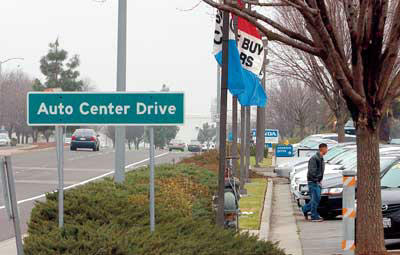
Sunday, January 23, 2005
Wheeling and Dealing
Vacaville's auto row continues to thrive
By Barbara Smith/Business Writer
Development of Vacaville's auto mall has raced forward since the first plans to expand it emerged five years ago.
Today, Orange Drive's auto row boasts 10 dealerships. Whether shoppers are looking for a Harley-Davidson motorcycle or a family friendly sport utility vehicle, it is arguably becoming the place to shop.
Construction of new dealerships moved quickly after Lithia Motors announced its decision to purchase a former amusement park property on Orange Drive at the beginning of the decade. Deals with the Barber Dealership Group and Saturn soon followed.
The momentum continues now that Saturn has plans for one of the last parcels available in the busy sector.
Under review with city planners, Saturn plans to build an 18,000-square-foot, two-level dealership at the corner of Orange Drive and Orange Tree Circle, next to the Volkswagen dealership and across from the Department of Motor Vehicles. The site plan allows for 116 parking spaces and driveways on both sides of the corner.
"We're pretty psyched about the facility," said Todd Barnes, president of North Bay Saturn Group. "It's going to be gorgeous. I think that the whole Vacaville auto row is just the right place to be, and we're very fortunate to have the opportunity."
The new dealership will replace the existing Saturn of Vacaville, presently located east of the site. That dealership has served as a satellite sales only location for 10 years, Barnes said. Currently, Saturn customers have to go to the Fairfield store for service.
Now, the new dealership will offer service in addition to sales. Saturn decided that the market has grown to the point where it needed a full service facility for sales and service.
Barnes said he's very optimistic about the Vacaville market.
"It's a little more youth oriented, the city is growth oriented and that will bode well for us in the future," he said. "We really feel like the timing is right now. As Saturn owner families grow, we'll have vehicles that will meet their transportation needs."
The timing is also right because Saturn is adding to its product portfolio with larger cars, like a seven-passenger crossover van named the Relay. Next year, a two-seater roadster called the Sky will debut and immediately following a new, extremely stylish four-door called the Aura, Barnes said.
"General Motors is really focusing on Saturn at this point to revitalize the GM brand, very similar to the renaissance that Cadillac went through a few years ago," Barnes said. "Saturn is moving upscale, and will end up being a brand within the General Motors family that will fall between Pontiac and Cadillac."
The new facility will cost up to $2.5 million to build, and will add about 25 to 30 jobs, Barnes said. He expects city approval by the end of the month, and hopes construction will commence by the end of March.
Peyman Behvan, associate planner with the city, said staff is excited about the new Saturn dealership.
"We're pretty excited that they're moving to a more prominent location and obviously expanding. We're happy about that, and we'll do what we can to facilitate that," he said.
Behvan said auto dealerships are important to the city.
"It's good for the city in a tax dollars sense, but it's good for business generally," he said. "And we have a pretty good working relationship with the dealerships."
There are still a few parcels of land along Orange Drive, but there's no telling if more dealerships will move in, Behvan said.
Barbara Smith can be reached at business@thereporter.com.
By Barbara Smith/Business Writer
Development of Vacaville's auto mall has raced forward since the first plans to expand it emerged five years ago.
Today, Orange Drive's auto row boasts 10 dealerships. Whether shoppers are looking for a Harley-Davidson motorcycle or a family friendly sport utility vehicle, it is arguably becoming the place to shop.
Construction of new dealerships moved quickly after Lithia Motors announced its decision to purchase a former amusement park property on Orange Drive at the beginning of the decade. Deals with the Barber Dealership Group and Saturn soon followed.
The momentum continues now that Saturn has plans for one of the last parcels available in the busy sector.
Under review with city planners, Saturn plans to build an 18,000-square-foot, two-level dealership at the corner of Orange Drive and Orange Tree Circle, next to the Volkswagen dealership and across from the Department of Motor Vehicles. The site plan allows for 116 parking spaces and driveways on both sides of the corner.
"We're pretty psyched about the facility," said Todd Barnes, president of North Bay Saturn Group. "It's going to be gorgeous. I think that the whole Vacaville auto row is just the right place to be, and we're very fortunate to have the opportunity."
The new dealership will replace the existing Saturn of Vacaville, presently located east of the site. That dealership has served as a satellite sales only location for 10 years, Barnes said. Currently, Saturn customers have to go to the Fairfield store for service.
Now, the new dealership will offer service in addition to sales. Saturn decided that the market has grown to the point where it needed a full service facility for sales and service.
Barnes said he's very optimistic about the Vacaville market.
"It's a little more youth oriented, the city is growth oriented and that will bode well for us in the future," he said. "We really feel like the timing is right now. As Saturn owner families grow, we'll have vehicles that will meet their transportation needs."
The timing is also right because Saturn is adding to its product portfolio with larger cars, like a seven-passenger crossover van named the Relay. Next year, a two-seater roadster called the Sky will debut and immediately following a new, extremely stylish four-door called the Aura, Barnes said.
"General Motors is really focusing on Saturn at this point to revitalize the GM brand, very similar to the renaissance that Cadillac went through a few years ago," Barnes said. "Saturn is moving upscale, and will end up being a brand within the General Motors family that will fall between Pontiac and Cadillac."
The new facility will cost up to $2.5 million to build, and will add about 25 to 30 jobs, Barnes said. He expects city approval by the end of the month, and hopes construction will commence by the end of March.
Peyman Behvan, associate planner with the city, said staff is excited about the new Saturn dealership.
"We're pretty excited that they're moving to a more prominent location and obviously expanding. We're happy about that, and we'll do what we can to facilitate that," he said.
Behvan said auto dealerships are important to the city.
"It's good for the city in a tax dollars sense, but it's good for business generally," he said. "And we have a pretty good working relationship with the dealerships."
There are still a few parcels of land along Orange Drive, but there's no telling if more dealerships will move in, Behvan said.
Barbara Smith can be reached at business@thereporter.com.
Wednesday, January 19, 2005
Copart picks up salvage lot in Ohio
By Matthew Bunk
FAIRFIELD - Auto salvager Copart Inc. acquired its 108th salvage lot, a 16-acre facility in Strongsville, Ohio, the company announced Tuesday. Fairfield-based Copart has picked up dozens of lots in the past several years while the company's profits have surged to all-time highs. But the Strongsville facility, which will give the company a greater presence in the Cleveland area, is the first auto salvage lot acquisition of 2005. Last year, the company topped $400 million in sales with the help of online auto auction technology that eliminated the inconvenience of live auctions and juiced competition in bidding.
Copart is now pursuing ways to extend its second-generation Internet technology to industries other than used car sales. Rather than sit back on pre-tax profit growth ranging from 35 percent to 32 percent annually, the 23-year-old company continues to branch out. And national media has taken note. Forbes' columnist Richard Pathon called Copart the Sotheby's of Scrap in a Jan. 11 magazine article, noting that Copart has adapted the Internet to "the clunky business of auctioning wrecked cars, with results even crusty old Henry Ford would applaud."
Instead of going to live auctions, buyers can bid online in real time at all of the company's auto lots. And, as an effective middleman, Copart makes money from buyers who pay handling fees and from sellers - mostly insurance companies - in the form of a flat fee or commission.
Reach Matthew Bunk at 425-4646 Ext. 267 or mbunk@dailyrepublic.net.
FAIRFIELD - Auto salvager Copart Inc. acquired its 108th salvage lot, a 16-acre facility in Strongsville, Ohio, the company announced Tuesday. Fairfield-based Copart has picked up dozens of lots in the past several years while the company's profits have surged to all-time highs. But the Strongsville facility, which will give the company a greater presence in the Cleveland area, is the first auto salvage lot acquisition of 2005. Last year, the company topped $400 million in sales with the help of online auto auction technology that eliminated the inconvenience of live auctions and juiced competition in bidding.
Copart is now pursuing ways to extend its second-generation Internet technology to industries other than used car sales. Rather than sit back on pre-tax profit growth ranging from 35 percent to 32 percent annually, the 23-year-old company continues to branch out. And national media has taken note. Forbes' columnist Richard Pathon called Copart the Sotheby's of Scrap in a Jan. 11 magazine article, noting that Copart has adapted the Internet to "the clunky business of auctioning wrecked cars, with results even crusty old Henry Ford would applaud."
Instead of going to live auctions, buyers can bid online in real time at all of the company's auto lots. And, as an effective middleman, Copart makes money from buyers who pay handling fees and from sellers - mostly insurance companies - in the form of a flat fee or commission.
Reach Matthew Bunk at 425-4646 Ext. 267 or mbunk@dailyrepublic.net.
Thursday, January 13, 2005

Lennar spruces up Building 117, fills it with offices, light industry
By RACHEL RASKIN-ZRIHEN, Times-Herald staff writer
After several months of renovation and marketing, Mare Island's Building 117 is now fully occupied, according to a Lennar Mare Island spokesman.
Located along the waterfront at Nimitz and Seventh Street, the 41,000-square-foot, 20-year-old former shop building now provides office and light industrial space ranging in size from 1,300 square feet to 10,000 square feet, said Lennar spokesman Jason Keadjian.
The renovation cost about $400,000, he said.
Construction included work on the building's roof, interior renovations and repairs to such systems as plumbing, he said.
Keadjian said about half the building's tenants are new to Vallejo; the rest are either transplants from elsewhere in the city or expansions. All told, the building's tenants bring about 40 new jobs to the island, he said.
Hal Pierce Electric, a longtime Vallejo contractor, said he was the first business to set up shop in the newly renovated building. The timing couldn't have been better for him, he said.
"I was the first one in the building," Pierce said. "We've been here since March. Before that, we were at 520 Broadway since 1947. My grandparents built the building in 1947, and the family sold it. That's why I moved."
Pierce said relocating has worked out well, and that watching the building and Mare Island in general beginning to thrive has made him excited about the future.
"It's wonderful," Pierce said. "I'm elated to be here. Lennar's been great to work with. And it seems like in just the past couple of months, the building has really filled up. The residential aspect of the island is getting off the ground.
"I think it's a sign the economy's finally improving. I feel more confident than I did even two weeks ago."
That's the kind of thing Lennar likes to hear, and hopes to hear more of in months to come, Keadjian said. "Lennar continues to evaluate, and where appropriate, invest money in capital improvements to Mare Island buildings," he said.
- E-mail Rachel Raskin-Zrihen at RachelZ@thnewsnet.com or call 553-6824.
After several months of renovation and marketing, Mare Island's Building 117 is now fully occupied, according to a Lennar Mare Island spokesman.
Located along the waterfront at Nimitz and Seventh Street, the 41,000-square-foot, 20-year-old former shop building now provides office and light industrial space ranging in size from 1,300 square feet to 10,000 square feet, said Lennar spokesman Jason Keadjian.
The renovation cost about $400,000, he said.
Construction included work on the building's roof, interior renovations and repairs to such systems as plumbing, he said.
Keadjian said about half the building's tenants are new to Vallejo; the rest are either transplants from elsewhere in the city or expansions. All told, the building's tenants bring about 40 new jobs to the island, he said.
Hal Pierce Electric, a longtime Vallejo contractor, said he was the first business to set up shop in the newly renovated building. The timing couldn't have been better for him, he said.
"I was the first one in the building," Pierce said. "We've been here since March. Before that, we were at 520 Broadway since 1947. My grandparents built the building in 1947, and the family sold it. That's why I moved."
Pierce said relocating has worked out well, and that watching the building and Mare Island in general beginning to thrive has made him excited about the future.
"It's wonderful," Pierce said. "I'm elated to be here. Lennar's been great to work with. And it seems like in just the past couple of months, the building has really filled up. The residential aspect of the island is getting off the ground.
"I think it's a sign the economy's finally improving. I feel more confident than I did even two weeks ago."
That's the kind of thing Lennar likes to hear, and hopes to hear more of in months to come, Keadjian said. "Lennar continues to evaluate, and where appropriate, invest money in capital improvements to Mare Island buildings," he said.
- E-mail Rachel Raskin-Zrihen at RachelZ@thnewsnet.com or call 553-6824.
Wednesday, January 12, 2005

Celebrating Solano
Local magazine spotlights where to go, what to see
By RACHEL RASKIN-ZRIHEN, Times-Herald staff writer
If Sacramento and San Francisco can have their own magazines, Michelle Branton of Fairfield figured the Solano County area could, too.
So, in November 2003, she and her accountant husband, Michael Koks, launched Solano magazine, which, they said, has taken off faster and come further in the past year than they even could have hoped.
With Branton and Koks as publishers, Julia Smith of Fairfield as sales director, and some 30 full- and part-time staff working on each bi-monthly issue, Solano features stories and information of interest to people living and working in the Napa, Solano and Yolo county region.
"We found a hole in the market for this type of media locally," Branton said. "There's no major magazine covering this area and most newspapers cover only their very immediate area. We cover the counties in a broader way," Branton said. "If I wanted to find out what was going on in the cities next door to me, I'd have to get seven or eight newspapers, and that's not practical."
The public's reaction to Solano's first issue was an indication of how bright its future might be, Branton said.
"It was very exciting. We sold more than 500 copies in the first few weeks at Fairfield's Barnes & Noble, alone," Branton said. "They kept calling and asking for more copies."
A former marketing person originally from Hawaii, Branton, 32, said she has lived in Fairfield since high school. She spent most of her childhood criss-crossing the globe as her father followed the construction work with which he made his living.
"My father built railroads and airports and that sort of thing in the Middle East and South America and all over," Branton said. "We moved here in the mid-1980s."
Smith, on the other hand, is a Bay Area native originally from San Mateo. She moved to Fairfield about four years ago.
The two women, who met two summers ago when Branton sold Smith an ad, share a background in publishing and advertising and a vision for Solano magazine that together they seem to be bringing to fruition.
"I've worked with other magazines, and we did a little test marking to see if there was a readership and advertising market for this, and there was a significant and positive response, so we decided to take the plunge," Branton said.
Smith, a 38-year-old mother of two, said she thinks one reason for Solano's unusually rapid success - it took in just shy of $1 million in revenues in 2004 - is the area's unique location.
"Our reader base wants to find out what there is to see and do outside the local area as well as inside," Smith said. "We have a different type of reader than metro area readers. We don't have as many high-end places, and we'll go outside the area to shop to San Francisco and to Sacramento."
This, Branton adds, translates to "regional opportunities for both readership and advertising."
Smith said that as a shy child she hadn't hoped to grow up to be in advertising sales necessarily, she did always envision herself a businesswoman.
"I always wanted to be like (the Cybill Shepherd character in the television show) Moonlighting,' " Smith said. "Even as a youngster, I always wanted to be independent and successful."
A glossy, full-color, coffee-table-type publication, Solano focuses on "lifestyle where to go, what there is to do, where to shop and eat. Who's doing what, health care, education, real estate," Branton said. "A huge part of what we do is letting people know all the wonderful things there are to do around here."
Solano also contains insert publications, including its latest, "Celebrating the Arts" publication focusing on the arts in what Smith calls the "underserved counties of Napa, Solano and Yolo."
"It's an arts magazine we launched in November. It covers regional arts, and we have it as an additional insert and also as additional distribution to arts venues. Our goal is to elevate the recognition of the arts, regionally," Branton said.
Branton said she did not wake up one day and decide to publish a magazine. On the contrary, the idea's been percolating for a decade as she awaited the right opportunity.
"I love all aspects of this, especially the regional ones. I get to give back to the community. I get to hear great stories and promote great community enterprises, and I don't think there's anything better," Branton said.
Branton said one of Solano's most important focuses is on children's issues.
"We have a book review for kids and another for adults," Branton said. "We have youth accomplishments, a kids' calendar of events, a family feature called "Out and About," which suggests family-oriented places to go and things to do, like there's a dude ranch just outside of Winters that most people don't know about."
Though it takes most new publications five years just to break even, assuming they last that long, Branton said Solano did so its first year. Branton and Smith said they expect the business to grow in 2005.
Branton said she is especially enjoying the opportunity the magazine affords her to express her creative side and have a positive impact on the community in which she lives.
"I'm a creative person, always have been, and I handle that part of the magazine. And I really love people," Branton said. "The best part of this is learning about the local resources available here, and the amazing people famous and not-so-famous who live and accomplish amazing and inspiring things.
"I love this magazine for what its able to help me give back to the community," Branton added. "It's extremely satisfying. It's always been one of my life's goals. It's my way of doing Rotary, I guess."
Smith said she feels the same way.
"I'd rather do something for my community than work for a big corporation that may not have a direct impact on my community," she said.
But the main goal, the women said, is to produce the best magazine possible.
"We set a really high bar for quality and content, and it's maturing, the look and the feel, the editorial content, our response to our readers," Branton said.
By RACHEL RASKIN-ZRIHEN, Times-Herald staff writer
If Sacramento and San Francisco can have their own magazines, Michelle Branton of Fairfield figured the Solano County area could, too.
So, in November 2003, she and her accountant husband, Michael Koks, launched Solano magazine, which, they said, has taken off faster and come further in the past year than they even could have hoped.
With Branton and Koks as publishers, Julia Smith of Fairfield as sales director, and some 30 full- and part-time staff working on each bi-monthly issue, Solano features stories and information of interest to people living and working in the Napa, Solano and Yolo county region.
"We found a hole in the market for this type of media locally," Branton said. "There's no major magazine covering this area and most newspapers cover only their very immediate area. We cover the counties in a broader way," Branton said. "If I wanted to find out what was going on in the cities next door to me, I'd have to get seven or eight newspapers, and that's not practical."
The public's reaction to Solano's first issue was an indication of how bright its future might be, Branton said.
"It was very exciting. We sold more than 500 copies in the first few weeks at Fairfield's Barnes & Noble, alone," Branton said. "They kept calling and asking for more copies."
A former marketing person originally from Hawaii, Branton, 32, said she has lived in Fairfield since high school. She spent most of her childhood criss-crossing the globe as her father followed the construction work with which he made his living.
"My father built railroads and airports and that sort of thing in the Middle East and South America and all over," Branton said. "We moved here in the mid-1980s."
Smith, on the other hand, is a Bay Area native originally from San Mateo. She moved to Fairfield about four years ago.
The two women, who met two summers ago when Branton sold Smith an ad, share a background in publishing and advertising and a vision for Solano magazine that together they seem to be bringing to fruition.
"I've worked with other magazines, and we did a little test marking to see if there was a readership and advertising market for this, and there was a significant and positive response, so we decided to take the plunge," Branton said.
Smith, a 38-year-old mother of two, said she thinks one reason for Solano's unusually rapid success - it took in just shy of $1 million in revenues in 2004 - is the area's unique location.
"Our reader base wants to find out what there is to see and do outside the local area as well as inside," Smith said. "We have a different type of reader than metro area readers. We don't have as many high-end places, and we'll go outside the area to shop to San Francisco and to Sacramento."
This, Branton adds, translates to "regional opportunities for both readership and advertising."
Smith said that as a shy child she hadn't hoped to grow up to be in advertising sales necessarily, she did always envision herself a businesswoman.
"I always wanted to be like (the Cybill Shepherd character in the television show) Moonlighting,' " Smith said. "Even as a youngster, I always wanted to be independent and successful."
A glossy, full-color, coffee-table-type publication, Solano focuses on "lifestyle where to go, what there is to do, where to shop and eat. Who's doing what, health care, education, real estate," Branton said. "A huge part of what we do is letting people know all the wonderful things there are to do around here."
Solano also contains insert publications, including its latest, "Celebrating the Arts" publication focusing on the arts in what Smith calls the "underserved counties of Napa, Solano and Yolo."
"It's an arts magazine we launched in November. It covers regional arts, and we have it as an additional insert and also as additional distribution to arts venues. Our goal is to elevate the recognition of the arts, regionally," Branton said.
Branton said she did not wake up one day and decide to publish a magazine. On the contrary, the idea's been percolating for a decade as she awaited the right opportunity.
"I love all aspects of this, especially the regional ones. I get to give back to the community. I get to hear great stories and promote great community enterprises, and I don't think there's anything better," Branton said.
Branton said one of Solano's most important focuses is on children's issues.
"We have a book review for kids and another for adults," Branton said. "We have youth accomplishments, a kids' calendar of events, a family feature called "Out and About," which suggests family-oriented places to go and things to do, like there's a dude ranch just outside of Winters that most people don't know about."
Though it takes most new publications five years just to break even, assuming they last that long, Branton said Solano did so its first year. Branton and Smith said they expect the business to grow in 2005.
Branton said she is especially enjoying the opportunity the magazine affords her to express her creative side and have a positive impact on the community in which she lives.
"I'm a creative person, always have been, and I handle that part of the magazine. And I really love people," Branton said. "The best part of this is learning about the local resources available here, and the amazing people famous and not-so-famous who live and accomplish amazing and inspiring things.
"I love this magazine for what its able to help me give back to the community," Branton added. "It's extremely satisfying. It's always been one of my life's goals. It's my way of doing Rotary, I guess."
Smith said she feels the same way.
"I'd rather do something for my community than work for a big corporation that may not have a direct impact on my community," she said.
But the main goal, the women said, is to produce the best magazine possible.
"We set a really high bar for quality and content, and it's maturing, the look and the feel, the editorial content, our response to our readers," Branton said.
Monday, January 10, 2005
Transit company grows
FAIRFIELD - MV Transportation expanded its transit services to two more areas, according to press releases that show the Fairfield-based company increased its employee base to more than 8,000.
The company recently began providing limited transit services in Warren County, Ohio, its eighth contract in that state.
It also has partnered with Elk Grove to provide transit services using remanufactured hybrid buses that run on gasoline and electric power. In the press release, MV Transportation called it an "environmentally friendly" bus service.
The company recently began providing limited transit services in Warren County, Ohio, its eighth contract in that state.
It also has partnered with Elk Grove to provide transit services using remanufactured hybrid buses that run on gasoline and electric power. In the press release, MV Transportation called it an "environmentally friendly" bus service.
Genentech has happy employees
By Matthew Bunk
VACAVILLE - Not only is Genentech Inc. revered in the biotech industry as a leading drug-maker, it's also brewed some affection among its employees.
Based in South San Francisco, Genentech earned the No. 4 spot on Fortune Magazine's list of "100 Best Companies to Work For" in 2005.
It was the seventh consecutive year that Genentech made the list. This year it trailed only three companies - family owned Wegman's Food Markets; W.L. Gore, the maker of GORE-TEX; and Republic Bancorp, a Michigan-based holding company for Republic Bank.
Companies were judged on "policies and culture" and the opinions of the company's own employees. Employees were asked to rate attitudes toward management, camaraderie and job satisfaction.
Genentech's manufacturing plant in Vacaville employs more than 500 people and is expected to grow to become the largest biotech manufacturing facility in the world by 2009. The expanded facility will employ more than 1,100, according to the company.
VACAVILLE - Not only is Genentech Inc. revered in the biotech industry as a leading drug-maker, it's also brewed some affection among its employees.
Based in South San Francisco, Genentech earned the No. 4 spot on Fortune Magazine's list of "100 Best Companies to Work For" in 2005.
It was the seventh consecutive year that Genentech made the list. This year it trailed only three companies - family owned Wegman's Food Markets; W.L. Gore, the maker of GORE-TEX; and Republic Bancorp, a Michigan-based holding company for Republic Bank.
Companies were judged on "policies and culture" and the opinions of the company's own employees. Employees were asked to rate attitudes toward management, camaraderie and job satisfaction.
Genentech's manufacturing plant in Vacaville employs more than 500 people and is expected to grow to become the largest biotech manufacturing facility in the world by 2009. The expanded facility will employ more than 1,100, according to the company.
Sunday, January 09, 2005

Vallejo Hopes to Regain Identity
By Matthew Bunk
VALLEJO - When Richard Lemke's ship was decommissioned at Mare Island after World War II, it was easy to fall in love with Vallejo.
Sailors and businessmen stopped along downtown streets to discuss politics and sports. Women wearing fine dresses and white gloves shopped at various department stores, which at the time included a JC Penney Co. at its fashion peak and the very stylish City of Paris boutique.
It was a thriving waterfront city with so much potential Lemke and many of his shipmates decided to stay.
Almost 60 years later, Lemke is still here. But he's seen Vallejo change from a fashionable berg and Navy outpost to a city on the mend and trying to rediscover an identity many longtime residents believe got lost along the way.
Only recently, he said, has the excitement of Old Vallejo returned. He believes the city of crossroads is about to emerge from what future generations will look back on as a dark age.
"In five years you won't recognize this part of Vallejo," Lemke said during an interview at Mr. Ric Men's Clothing, a staple on Marin Street in downtown Vallejo. "I was here when downtown was thriving, and I've watched its demise. But things have starting to turn around."
More than 10,000 jobs left Vallejo when Mare Island closed in 1996. But that loss cut deeper than just jobs, as many residents believe the city's soul - steeped in Navy tradition - became a casualty as well.
Efforts to rejuvenate the city's shopping districts, to bring industrial jobs back and to create a sense of community have had limited impact in the past several years. Large employers such as K-Mart, General Mills and others continued to cut back and close.
Now, though, it's become easier to find replacements for businesses lost. And several large commercial projects promise to bring life back to one of California's oldest cities.
Investors, too, believe again in Vallejo.
Lennar Communities has spent roughly $45 million to ready Mare Island for homes and business parks; Seattle-based developer Triad has laid the groundwork for residential and retail complexes downtown; and Callahan-De Silva is trying to unite the community behind its vision for the waterfront, a critical piece of property that has awaited major development for more than 25 years.
Beyond the city's core is the county fairgrounds, where mall builder Mills Corp. hopes to put a lifestyle center full of retail shops, restaurants and other entertainment.
City leaders have authorized spending tens of millions of dollars on redevelopment projects throughout the city, an effort business leaders expect to pay off in the next decade. Some progress is evident already, said Michael Wilson of the architecture firm Arc Inc. and incoming chairman of the Vallejo Chamber of Commerce.
"Business has been booming in the last couple of years," Wilson said. "But there's so much more potential."
Wilson wants to return Vallejo to its history. Or, rather, bring the history back to Vallejo.
"People in San Francisco used to come to Vallejo to shop," he said. "That's the kind of revitalization we're hoping to see in Vallejo's future."
Lemke and other downtown merchants want desperately to believe that will happen. They've been waiting on promises of urban renewal since the city tore down much of the waterfront district in the 1950s and 1960s to make room for development that never happened.
Disconnecting downtown from its waterfront led to the demise Lemke and others still talk about. But recent efforts to expand main roadways - the Georgia Street thoroughfare was extended last year to reconnect the two districts - may bring the commercial neighborhoods back together.
The next step will be to recreate Mare Island as an economic engine and to take advantage of the waterway between the island and the mainland, Wilson said. Instead of letting the strait separate the two areas, it could provide an aesthetic advantage that improves the flow of commerce, he said.
"Vallejo is seeing a renewal as a community to live, work and play," he said. "Something that goes with all of those is the water, which wasn't as interesting with the Navy base across the way."
The water has always been a part of what Vallejo is - once as a conduit for the Navy, and now as a visual and economic enhancement for a city trying to find itself. The city, it seems, will find its future by tweaking what it used to be.
"Vallejo is moving forward," Wilson said. "Even though, if you want to see the tangible progress, some of these things are still a few years out."
No matter how much tradition has to move out of the way to make room for what Vallejo will become, the old timers will still hold memories of the 5 p.m. rush hour of sailors and shipbuilders disembarking from Mare Island.
"In the late afternoons when Mare Island let out, you couldn't even get across the street," Lemke said with a far-away look in his eyes. "That was when everyone would stop and talk and when window shopping was a big thing.
"Now you drive around and everybody is remodeling and fixing, and it's mostly new people that I don't know - and I used to know everybody."
Reach Matthew Bunk at 425-4646 Ext. 265 or mbunk@dailyrepublic.net.
VALLEJO - When Richard Lemke's ship was decommissioned at Mare Island after World War II, it was easy to fall in love with Vallejo.
Sailors and businessmen stopped along downtown streets to discuss politics and sports. Women wearing fine dresses and white gloves shopped at various department stores, which at the time included a JC Penney Co. at its fashion peak and the very stylish City of Paris boutique.
It was a thriving waterfront city with so much potential Lemke and many of his shipmates decided to stay.
Almost 60 years later, Lemke is still here. But he's seen Vallejo change from a fashionable berg and Navy outpost to a city on the mend and trying to rediscover an identity many longtime residents believe got lost along the way.
Only recently, he said, has the excitement of Old Vallejo returned. He believes the city of crossroads is about to emerge from what future generations will look back on as a dark age.
"In five years you won't recognize this part of Vallejo," Lemke said during an interview at Mr. Ric Men's Clothing, a staple on Marin Street in downtown Vallejo. "I was here when downtown was thriving, and I've watched its demise. But things have starting to turn around."
More than 10,000 jobs left Vallejo when Mare Island closed in 1996. But that loss cut deeper than just jobs, as many residents believe the city's soul - steeped in Navy tradition - became a casualty as well.
Efforts to rejuvenate the city's shopping districts, to bring industrial jobs back and to create a sense of community have had limited impact in the past several years. Large employers such as K-Mart, General Mills and others continued to cut back and close.
Now, though, it's become easier to find replacements for businesses lost. And several large commercial projects promise to bring life back to one of California's oldest cities.
Investors, too, believe again in Vallejo.
Lennar Communities has spent roughly $45 million to ready Mare Island for homes and business parks; Seattle-based developer Triad has laid the groundwork for residential and retail complexes downtown; and Callahan-De Silva is trying to unite the community behind its vision for the waterfront, a critical piece of property that has awaited major development for more than 25 years.
Beyond the city's core is the county fairgrounds, where mall builder Mills Corp. hopes to put a lifestyle center full of retail shops, restaurants and other entertainment.
City leaders have authorized spending tens of millions of dollars on redevelopment projects throughout the city, an effort business leaders expect to pay off in the next decade. Some progress is evident already, said Michael Wilson of the architecture firm Arc Inc. and incoming chairman of the Vallejo Chamber of Commerce.
"Business has been booming in the last couple of years," Wilson said. "But there's so much more potential."
Wilson wants to return Vallejo to its history. Or, rather, bring the history back to Vallejo.
"People in San Francisco used to come to Vallejo to shop," he said. "That's the kind of revitalization we're hoping to see in Vallejo's future."
Lemke and other downtown merchants want desperately to believe that will happen. They've been waiting on promises of urban renewal since the city tore down much of the waterfront district in the 1950s and 1960s to make room for development that never happened.
Disconnecting downtown from its waterfront led to the demise Lemke and others still talk about. But recent efforts to expand main roadways - the Georgia Street thoroughfare was extended last year to reconnect the two districts - may bring the commercial neighborhoods back together.
The next step will be to recreate Mare Island as an economic engine and to take advantage of the waterway between the island and the mainland, Wilson said. Instead of letting the strait separate the two areas, it could provide an aesthetic advantage that improves the flow of commerce, he said.
"Vallejo is seeing a renewal as a community to live, work and play," he said. "Something that goes with all of those is the water, which wasn't as interesting with the Navy base across the way."
The water has always been a part of what Vallejo is - once as a conduit for the Navy, and now as a visual and economic enhancement for a city trying to find itself. The city, it seems, will find its future by tweaking what it used to be.
"Vallejo is moving forward," Wilson said. "Even though, if you want to see the tangible progress, some of these things are still a few years out."
No matter how much tradition has to move out of the way to make room for what Vallejo will become, the old timers will still hold memories of the 5 p.m. rush hour of sailors and shipbuilders disembarking from Mare Island.
"In the late afternoons when Mare Island let out, you couldn't even get across the street," Lemke said with a far-away look in his eyes. "That was when everyone would stop and talk and when window shopping was a big thing.
"Now you drive around and everybody is remodeling and fixing, and it's mostly new people that I don't know - and I used to know everybody."
Reach Matthew Bunk at 425-4646 Ext. 265 or mbunk@dailyrepublic.net.
Friday, January 07, 2005
Fairfield hires a tourism director
By Matthew Bunk
FAIRFIELD - It's going to be a challenge, but hotel owners and other merchants who could benefit from tourism have started to unveil plans they hope will make Fairfield a visitor's destination.
Fairfield and Suisun City already have the attractions - world-famous candy companies, vineyards and wineries, as well as an inland harbor and a brewery, according to those who want to bring more tourists to the area.
The challenge, they say, will be to advertise those resources in a way that makes people want to spend time and money in the cities between Sacramento and San Francisco.
Vacaville recently began its own tourism-based organization, and Vallejo also has one.
To do so in Fairfield, the fledgling tourism bureau needed money and a leader - two things that recently fell into place.
Earlier this week, the Fairfield City Council approved a transfer of roughly $158,000 to the group in charge of the tourism effort. And to head up the organization, a tourism committee chose Solano County resident Candy Pierce as the top tourism executive.
Both decisions, as well as the formation of a marketing plan, should lead to more exposure for Fairfield and Suisun, said Kevin Johnson, general manager of Fairfield's Hilton Garden Inn and a leader of the tourism movement.
Johnson said there will be more announcements next month, including a site for the long-planned Fairfield Welcome Center.
"We're ready to give birth to this thing," he said in a phone interview. "Everything is coming together, but there's still a lot that hasn't been finalized. For example, we're still negotiating on the land (for the Welcome Center)."
As part of the marketing plan, the tourism group will design a Web site to promote the area and put up a 60-foot sign next to the freeway to draw attention to the future Welcome Center. The sign will go up near the Fairfield Auto Mall just off Interstate 80.
The money to do those things came from a 2 percent hotel assessment tacked on to the price of an overnight stay at all Fairfield hotels. The added fee, which the city began collecting last spring, comes to about $1 for every $50 spent on rooms.
The yearly budget for the tourism group will be about $260,000. It will be less in 2005 because the fee wasn't collected for the entire 12 months of 2004.
Business leaders expect to get much more in return for the money spent to promote tourism. Because visitors spend money and then leave, tourism as an industry is even more attractive, said David Sommer, executive director for the Fairfield-Suisun Chamber of Commerce.
"It's a desirable industry that uses very few city services," Sommer said. "And it increases the city's tax base."
Reach Matthew Bunk at 425-4646 Ext. 267 or mbunk@dailyrepublic.net.
FAIRFIELD - It's going to be a challenge, but hotel owners and other merchants who could benefit from tourism have started to unveil plans they hope will make Fairfield a visitor's destination.
Fairfield and Suisun City already have the attractions - world-famous candy companies, vineyards and wineries, as well as an inland harbor and a brewery, according to those who want to bring more tourists to the area.
The challenge, they say, will be to advertise those resources in a way that makes people want to spend time and money in the cities between Sacramento and San Francisco.
Vacaville recently began its own tourism-based organization, and Vallejo also has one.
To do so in Fairfield, the fledgling tourism bureau needed money and a leader - two things that recently fell into place.
Earlier this week, the Fairfield City Council approved a transfer of roughly $158,000 to the group in charge of the tourism effort. And to head up the organization, a tourism committee chose Solano County resident Candy Pierce as the top tourism executive.
Both decisions, as well as the formation of a marketing plan, should lead to more exposure for Fairfield and Suisun, said Kevin Johnson, general manager of Fairfield's Hilton Garden Inn and a leader of the tourism movement.
Johnson said there will be more announcements next month, including a site for the long-planned Fairfield Welcome Center.
"We're ready to give birth to this thing," he said in a phone interview. "Everything is coming together, but there's still a lot that hasn't been finalized. For example, we're still negotiating on the land (for the Welcome Center)."
As part of the marketing plan, the tourism group will design a Web site to promote the area and put up a 60-foot sign next to the freeway to draw attention to the future Welcome Center. The sign will go up near the Fairfield Auto Mall just off Interstate 80.
The money to do those things came from a 2 percent hotel assessment tacked on to the price of an overnight stay at all Fairfield hotels. The added fee, which the city began collecting last spring, comes to about $1 for every $50 spent on rooms.
The yearly budget for the tourism group will be about $260,000. It will be less in 2005 because the fee wasn't collected for the entire 12 months of 2004.
Business leaders expect to get much more in return for the money spent to promote tourism. Because visitors spend money and then leave, tourism as an industry is even more attractive, said David Sommer, executive director for the Fairfield-Suisun Chamber of Commerce.
"It's a desirable industry that uses very few city services," Sommer said. "And it increases the city's tax base."
Reach Matthew Bunk at 425-4646 Ext. 267 or mbunk@dailyrepublic.net.

The pride of Dixon: May Fair is more than a festival to Solano town
By Sarah Arnquist
DIXON - The Dixon May Fair's arms of influence stretch around more than a century of life in this quiet northern Solano County town.
The May Fair and the town are barely distinguishable as separate entities. No one alive today can remember a time when the May Fair didn't interrupt everyday life with three event-filled days in the spring.
When the fair began in 1876, Dixon had only 1,200 residents, compared to its more than 16,000 residents today. As the town changed through the decades the fair changed, but residents such Carlene Blaylock - who has lived in Dixon all her life - cannot imagine life without the May celebration.
The May Fair is central to life in Dixon, said Blaylock, 67, who at each stage of her life has been involved in the fair.
As a child, Blaylock looked forward to the excitement of the fair.
"When you're a kid, it's magic," she said.
As a teenager, the fair was tons of fun. The May Queen election and the rodeo were grand events, and she spent countless hours creating floats for the annual parade.
As an adult, Blaylock volunteered many times and brings her grandchildren to experience the same magic she did as a child.
"The whole town loves it," she said.
The Dixon May Fair operates as the 36th Agricultural District of California and is overseen by the Division of Fairs and Expositions within the California Department of Food and Agriculture.
A nine-member Fair Board appointed by the governor directs the fair's operations. Fair Manager Mike Green and two additional employees work full-time throughout the year to plan the fair.
In 2002, the fair had an economic impact of about $4.6 million in Solano County. It created 56 jobs and generated $40,412 in local taxes, according to the CDFA.
The CDFA also reported that in 2002 more than 4,000 exhibits sprawled across the fair grounds. Children and adults from around the county bring their livestock, plants and creative arts to display at the fair. The fair also attracts local community and nonprofit groups such as 4-H, which organize and participate in the fair.
The fair's success depends on committed and creative volunteers, Green said.
One of the fair's greatest assets is the nonprofit sponsor organization Friends of the Dixon May Fair, Green said. Chairman Donnie Huffman said the $274,000 the group has raised from alcohol sales over the years all goes back into improving the fairgrounds. The volunteer group donates its time so the fair remains vibrant and full of the traditional small-town feel, Huffman said.
"We try to keep it as close to the old style as we always had it," Huffman said.
Fairs of the past
In spring 1876 Dixon residents wanted an excuse to throw a celebration. The town decided to celebrate the country's 100th birthday, but didn't wait until the traditional July 4. It threw the party on May 1.
The party must have been a good one, because the May Day celebration became an annual event, growing each year with games, activities and picnics, according to the fair's unofficial historian, Ardeth Riedel.
"Any good excuse to gather was a wonderful thing," said 70-year-old Riedel, a lifelong Dixon resident and former fair board member.
By 1886, a few local gentlemen, itching for a place to show off their racehorses, purchased 20 acres at 655 S. First St. to build the Dixon Driving Park. Dixon has celebrated May Day on those same 20 acres since, thus giving Dixon the bragging rights of the having the oldest continuous agricultural fair in the state of California.
Solano County adopted the May Day celebration for its county fair site in 1916. Recognizing the growing popularity of horse racing and a potential source of revenue, California legalized horse-race betting in 1933. Dixon racing flourished and the sport generated tax money which in turn funded fairs all across the state as it still does.
The Dixon Racetrack was one of the few tracks in the state that remained open through World War II. Following the war, county political powerhouses emerged in Vallejo and joined forces to "steal" the fair in the late 1940s, Dixon residents say.
Unwilling to give up their May Day celebration, Dixon formally adopted the name the Dixon May Fair in the early 1950s and continued hosting a full-blown fair. Through the decades the fair has had good and bad years. There have been bleak periods when the future of the fair was uncertain - such as the mid-1960s, when the town rallied together for a letter-writing campaign asking the governor to help save the fair.
Dixon has grown, and new people have moved in, but the fair has largely remained the same, Green said. Dixon shines with small-town charm for the four days in May when the town swells with fairgoers.
Riedel has spent hours recording the fair's history so the traditions and rural aspect of the fair endure for future generations.
"The May Fair has been a part of my life and I think a lot of people here in town want the new people in town to know what it's about," Riedel said.
Future of the fair
The fair always has been a place for children to learn about agriculture, but more recently the fair has assumed the additional role of educating Dixon newcomers, Huffman said.
Dixon has grown by more than 6,000 people since 1990. Many of these new residents come from the city without an agricultural background so, to them, the fair is a place learn where their milk and eggs come from, Huffman said.
"The fairgrounds are another arm of education," he said.
The challenge for the future will be to involve these new residents in the fair while maintaining the fair's rural feeling, Huffman said.
The May Fair's greatest change in recent years came in 1996 when the fair first brought nationally known entertainers to Dixon. Following two rained-out years, the fair emerged from dire financial problems after selling out concerts by Eddie Money and Credence Clearwater Revisited.
"It changed the way we do business, and it was music that allowed us to do that," Green said. "Maybe it could have been something else, but I don't think so."
Strong presales to the 2005 Lynyrd Skynyrd concert saved the fair again this year.
The fair may encounter another great change soon. As part of the Gov. Arnold Schwarzeneger's campaign to downsize and increase efficiency of state government, all fairs may be released from state control and be allowed to operate as private businesses. That would eliminate much of the bureaucratic background work and could prove to be a positive move for the Dixon May Fair, Green said.
"The May Fair could flourish independently," Green said.
Whether the Dixon May Fair will endure for another 130 years is unknown. As Dixon grows and changes, some aspects of the May Fair will certainly change, too. New management may soon take over as Green and his assistant, Dolores Garton, near retirement. Technology will play an increasingly large role in exhibits. Newcomers will come in with new ideas, and events will be added, deleted and renovated.
But the general consensus seems to be that the spark of pride that has compelled Dixon residents to put on the May Fair for more than 100 years will not die out anytime soon.
Reach Sarah Arnquist at 427-6953 or sarnquist@dailyrepublic.net.
Fast Facts:
What: Dixon May Fair, California's oldest continuous agricultural fair in California
When: The first weekend in May
Why: For 130 years the Dixon has hosted the agricultural fair and now brings in big-name entertainment like this year's headliner Lynyrd Skynyrd.
More info: www.dixonmayfair.com
Timeline:
1876: The First May Day Celebration in Dixon.
1886: Dixon Fairgrounds purchased and racetrack built.
1916: Becomes official site of Solano County Fair.
1933: California legalizes racehorse betting and Dixon racetrack flourishes.
1936: Dixon May Day becomes the 36th District Fair Association in California.
1942: Dixon horse racing is one of few to remain open during World War II and attracts people from all of the state.
1950: Political powerhouses from Vallejo arrange for the county fair to change locations.
1950s: Officially called Dixon May Fair.
1960s: Dixon rallies to save the May Fair.
1996: May Fair enters the music entertainment business.
2005: May Fair brings back the demolition derby.
Who: Dixon May Fair Manager Mike Green
A self-described "jack of all trades," Green oversees the year-round planning of the Dixon May Fair. In his 11 years at the helm of the May Fair, Green's largest move has been to shape the fair into an event that draws nationally known musical talents such as Faith Hill and Lynyrd Skynyrd.
Green, 64, saw his first May Fair as a child growing up in Fairfield in the 1940s. Then in high school, the fair really grabbed his attention.
"It was the place to go to meet pretty girls," Green said.
Green came to the May Fair knowing little about livestock and agriculture in 1993, but his 10 years as a designer at the Nut Tree in Vacaville trained him to plan and market big events, he said.
Along with his business assistant, Dolores Gorton, and grounds manager, Bob Botana, Green oversees the fairgrounds and organizes the four-day event that has a yearly operating budget of almost $1 million.
The fair today "has pretty much become an extravaganza," Green said.
DIXON - The Dixon May Fair's arms of influence stretch around more than a century of life in this quiet northern Solano County town.
The May Fair and the town are barely distinguishable as separate entities. No one alive today can remember a time when the May Fair didn't interrupt everyday life with three event-filled days in the spring.
When the fair began in 1876, Dixon had only 1,200 residents, compared to its more than 16,000 residents today. As the town changed through the decades the fair changed, but residents such Carlene Blaylock - who has lived in Dixon all her life - cannot imagine life without the May celebration.
The May Fair is central to life in Dixon, said Blaylock, 67, who at each stage of her life has been involved in the fair.
As a child, Blaylock looked forward to the excitement of the fair.
"When you're a kid, it's magic," she said.
As a teenager, the fair was tons of fun. The May Queen election and the rodeo were grand events, and she spent countless hours creating floats for the annual parade.
As an adult, Blaylock volunteered many times and brings her grandchildren to experience the same magic she did as a child.
"The whole town loves it," she said.
The Dixon May Fair operates as the 36th Agricultural District of California and is overseen by the Division of Fairs and Expositions within the California Department of Food and Agriculture.
A nine-member Fair Board appointed by the governor directs the fair's operations. Fair Manager Mike Green and two additional employees work full-time throughout the year to plan the fair.
In 2002, the fair had an economic impact of about $4.6 million in Solano County. It created 56 jobs and generated $40,412 in local taxes, according to the CDFA.
The CDFA also reported that in 2002 more than 4,000 exhibits sprawled across the fair grounds. Children and adults from around the county bring their livestock, plants and creative arts to display at the fair. The fair also attracts local community and nonprofit groups such as 4-H, which organize and participate in the fair.
The fair's success depends on committed and creative volunteers, Green said.
One of the fair's greatest assets is the nonprofit sponsor organization Friends of the Dixon May Fair, Green said. Chairman Donnie Huffman said the $274,000 the group has raised from alcohol sales over the years all goes back into improving the fairgrounds. The volunteer group donates its time so the fair remains vibrant and full of the traditional small-town feel, Huffman said.
"We try to keep it as close to the old style as we always had it," Huffman said.
Fairs of the past
In spring 1876 Dixon residents wanted an excuse to throw a celebration. The town decided to celebrate the country's 100th birthday, but didn't wait until the traditional July 4. It threw the party on May 1.
The party must have been a good one, because the May Day celebration became an annual event, growing each year with games, activities and picnics, according to the fair's unofficial historian, Ardeth Riedel.
"Any good excuse to gather was a wonderful thing," said 70-year-old Riedel, a lifelong Dixon resident and former fair board member.
By 1886, a few local gentlemen, itching for a place to show off their racehorses, purchased 20 acres at 655 S. First St. to build the Dixon Driving Park. Dixon has celebrated May Day on those same 20 acres since, thus giving Dixon the bragging rights of the having the oldest continuous agricultural fair in the state of California.
Solano County adopted the May Day celebration for its county fair site in 1916. Recognizing the growing popularity of horse racing and a potential source of revenue, California legalized horse-race betting in 1933. Dixon racing flourished and the sport generated tax money which in turn funded fairs all across the state as it still does.
The Dixon Racetrack was one of the few tracks in the state that remained open through World War II. Following the war, county political powerhouses emerged in Vallejo and joined forces to "steal" the fair in the late 1940s, Dixon residents say.
Unwilling to give up their May Day celebration, Dixon formally adopted the name the Dixon May Fair in the early 1950s and continued hosting a full-blown fair. Through the decades the fair has had good and bad years. There have been bleak periods when the future of the fair was uncertain - such as the mid-1960s, when the town rallied together for a letter-writing campaign asking the governor to help save the fair.
Dixon has grown, and new people have moved in, but the fair has largely remained the same, Green said. Dixon shines with small-town charm for the four days in May when the town swells with fairgoers.
Riedel has spent hours recording the fair's history so the traditions and rural aspect of the fair endure for future generations.
"The May Fair has been a part of my life and I think a lot of people here in town want the new people in town to know what it's about," Riedel said.
Future of the fair
The fair always has been a place for children to learn about agriculture, but more recently the fair has assumed the additional role of educating Dixon newcomers, Huffman said.
Dixon has grown by more than 6,000 people since 1990. Many of these new residents come from the city without an agricultural background so, to them, the fair is a place learn where their milk and eggs come from, Huffman said.
"The fairgrounds are another arm of education," he said.
The challenge for the future will be to involve these new residents in the fair while maintaining the fair's rural feeling, Huffman said.
The May Fair's greatest change in recent years came in 1996 when the fair first brought nationally known entertainers to Dixon. Following two rained-out years, the fair emerged from dire financial problems after selling out concerts by Eddie Money and Credence Clearwater Revisited.
"It changed the way we do business, and it was music that allowed us to do that," Green said. "Maybe it could have been something else, but I don't think so."
Strong presales to the 2005 Lynyrd Skynyrd concert saved the fair again this year.
The fair may encounter another great change soon. As part of the Gov. Arnold Schwarzeneger's campaign to downsize and increase efficiency of state government, all fairs may be released from state control and be allowed to operate as private businesses. That would eliminate much of the bureaucratic background work and could prove to be a positive move for the Dixon May Fair, Green said.
"The May Fair could flourish independently," Green said.
Whether the Dixon May Fair will endure for another 130 years is unknown. As Dixon grows and changes, some aspects of the May Fair will certainly change, too. New management may soon take over as Green and his assistant, Dolores Garton, near retirement. Technology will play an increasingly large role in exhibits. Newcomers will come in with new ideas, and events will be added, deleted and renovated.
But the general consensus seems to be that the spark of pride that has compelled Dixon residents to put on the May Fair for more than 100 years will not die out anytime soon.
Reach Sarah Arnquist at 427-6953 or sarnquist@dailyrepublic.net.
Fast Facts:
What: Dixon May Fair, California's oldest continuous agricultural fair in California
When: The first weekend in May
Why: For 130 years the Dixon has hosted the agricultural fair and now brings in big-name entertainment like this year's headliner Lynyrd Skynyrd.
More info: www.dixonmayfair.com
Timeline:
1876: The First May Day Celebration in Dixon.
1886: Dixon Fairgrounds purchased and racetrack built.
1916: Becomes official site of Solano County Fair.
1933: California legalizes racehorse betting and Dixon racetrack flourishes.
1936: Dixon May Day becomes the 36th District Fair Association in California.
1942: Dixon horse racing is one of few to remain open during World War II and attracts people from all of the state.
1950: Political powerhouses from Vallejo arrange for the county fair to change locations.
1950s: Officially called Dixon May Fair.
1960s: Dixon rallies to save the May Fair.
1996: May Fair enters the music entertainment business.
2005: May Fair brings back the demolition derby.
Who: Dixon May Fair Manager Mike Green
A self-described "jack of all trades," Green oversees the year-round planning of the Dixon May Fair. In his 11 years at the helm of the May Fair, Green's largest move has been to shape the fair into an event that draws nationally known musical talents such as Faith Hill and Lynyrd Skynyrd.
Green, 64, saw his first May Fair as a child growing up in Fairfield in the 1940s. Then in high school, the fair really grabbed his attention.
"It was the place to go to meet pretty girls," Green said.
Green came to the May Fair knowing little about livestock and agriculture in 1993, but his 10 years as a designer at the Nut Tree in Vacaville trained him to plan and market big events, he said.
Along with his business assistant, Dolores Gorton, and grounds manager, Bob Botana, Green oversees the fairgrounds and organizes the four-day event that has a yearly operating budget of almost $1 million.
The fair today "has pretty much become an extravaganza," Green said.
Sunday, January 02, 2005

Large Scale Defense
Grant helps firm devise way to combat biowarefare
By Barbara Smith/Business Writer
Scientists at a leading biotechnology company headquartered in Vacaville are busy working on biowarfare defense initiatives for the United States.
Large Scale Biology Corp. has received a $1 million federal grant from the Biowarfare Defense Research Program to expand the company's participation in national biowarfare defense. The funding will be used to develop more effective products for prevention and treatment of biowarfare-related illnesses.
On Aug. 5, President Bush signed legislation into law that funds key Department of Defense initiatives, including $1 million for the company to employ its proprietary GRAMMR (Genetic ReAssortment by MisMatch Resolution) DNA shuffling and molecular evolution technology to develop more effective biopharmaceuticals for protecting military personnel and civilians in biowarfare situations.
GRAMMR is Large Scale Biology's technology invented and developed in Vacaville, said Hal Padgett, principal investigator for the program.
"GRAMMR allows us to breed genes with one another in order to obtain new and novel biological activity," Padgett said. "We've gotten enthusiastic response from our military clients.
"The capabilities that GRAMMR presents allows them to do things they are currently unable to do."
Padgett said there are certain biological agents that are of concern to the Department of Defense, and Large Scale is providing materials for them to screen against those agents.
"We're not working with any of those agents in Vacaville," Padgett cautioned. "We're just providing materials for them to screen, and we ship those to the biodefense facilities in Fort Detrick."
Large Scale Biology is under contract with the U.S. Army Medical Research Institute of Infectious Diseases in Fort Detrick. Fort Detrick is the U.S. biodefense headquarters where there is the Level 4 containment facilities for viruses such as Ebola.
"We are evolving novel therapeutics to combat those agents," Padgett said. "We're doing this in our efforts to augment the native human immune system."
There are many biological agents the Department of Defense is interested in screening against, Padgett said.
"We take candidate genes, breed them together, and produce the proteins that correspond to these hybrid genes," he said. "We are evolving these genes for greater activity."
Padgett said biowarfare agents the Department of Defense would be concerned with include the Ebola virus, Venezuelan equine encephalitis, SARS, and Hantavirus, among others.
He said confidentiality prohibits him from specifying what Large Scale is addressing at this time.
Large Scale is contributing two of its core technologies to this program, including the Company's GRAMMR directed evolution technology and its plant-based biomanufacturing system, which can be used together to rapidly optimize and produce therapeutic proteins and vaccines.
"What we are doing with our GRAMMR technology in combination with our GENEWARE plant based manufacturing technology is something that other companies cannot approach, cannot do," Padgett said. "They really don't have the combination of the two - making the hybrid genes and producing the corresponding proteins - which is important. We have both sides of that equation.
"This is something we are uniquely positioned to do. That's not a stretch," he said.
Large Scale credits Congressman George Miller for his support and successful sponsorship to enable the company to make important contributions to national defense needs.
"Congressman Miller has put us in contact with the military researchers with the needs for our technologies, and he's made it possible for us to work with them to our mutual benefit," Padgett said.
Large Scale Biology is making an important contribution toward protecting America's armed forces in the battlefield, Miller said in a prepared statement.
"Biological warfare is an unfortunate but real threat and we must be prepared for it," he said.
Barbara Smith can be reached at business@thereporter.com.
By Barbara Smith/Business Writer
Scientists at a leading biotechnology company headquartered in Vacaville are busy working on biowarfare defense initiatives for the United States.
Large Scale Biology Corp. has received a $1 million federal grant from the Biowarfare Defense Research Program to expand the company's participation in national biowarfare defense. The funding will be used to develop more effective products for prevention and treatment of biowarfare-related illnesses.
On Aug. 5, President Bush signed legislation into law that funds key Department of Defense initiatives, including $1 million for the company to employ its proprietary GRAMMR (Genetic ReAssortment by MisMatch Resolution) DNA shuffling and molecular evolution technology to develop more effective biopharmaceuticals for protecting military personnel and civilians in biowarfare situations.
GRAMMR is Large Scale Biology's technology invented and developed in Vacaville, said Hal Padgett, principal investigator for the program.
"GRAMMR allows us to breed genes with one another in order to obtain new and novel biological activity," Padgett said. "We've gotten enthusiastic response from our military clients.
"The capabilities that GRAMMR presents allows them to do things they are currently unable to do."
Padgett said there are certain biological agents that are of concern to the Department of Defense, and Large Scale is providing materials for them to screen against those agents.
"We're not working with any of those agents in Vacaville," Padgett cautioned. "We're just providing materials for them to screen, and we ship those to the biodefense facilities in Fort Detrick."
Large Scale Biology is under contract with the U.S. Army Medical Research Institute of Infectious Diseases in Fort Detrick. Fort Detrick is the U.S. biodefense headquarters where there is the Level 4 containment facilities for viruses such as Ebola.
"We are evolving novel therapeutics to combat those agents," Padgett said. "We're doing this in our efforts to augment the native human immune system."
There are many biological agents the Department of Defense is interested in screening against, Padgett said.
"We take candidate genes, breed them together, and produce the proteins that correspond to these hybrid genes," he said. "We are evolving these genes for greater activity."
Padgett said biowarfare agents the Department of Defense would be concerned with include the Ebola virus, Venezuelan equine encephalitis, SARS, and Hantavirus, among others.
He said confidentiality prohibits him from specifying what Large Scale is addressing at this time.
Large Scale is contributing two of its core technologies to this program, including the Company's GRAMMR directed evolution technology and its plant-based biomanufacturing system, which can be used together to rapidly optimize and produce therapeutic proteins and vaccines.
"What we are doing with our GRAMMR technology in combination with our GENEWARE plant based manufacturing technology is something that other companies cannot approach, cannot do," Padgett said. "They really don't have the combination of the two - making the hybrid genes and producing the corresponding proteins - which is important. We have both sides of that equation.
"This is something we are uniquely positioned to do. That's not a stretch," he said.
Large Scale credits Congressman George Miller for his support and successful sponsorship to enable the company to make important contributions to national defense needs.
"Congressman Miller has put us in contact with the military researchers with the needs for our technologies, and he's made it possible for us to work with them to our mutual benefit," Padgett said.
Large Scale Biology is making an important contribution toward protecting America's armed forces in the battlefield, Miller said in a prepared statement.
"Biological warfare is an unfortunate but real threat and we must be prepared for it," he said.
Barbara Smith can be reached at business@thereporter.com.
Subscribe to:
Posts (Atom)
Solano's Got It!

The Best That Northern California Has To Offer.


